Loading...
Done
Mandalay, Burma. (Photo by Steve McCurry)

“If a man insisted always on being serious, and never allowed himself a bit of fun and relaxation, he would go mad or become unstable without knowing it”. – Herodotus. “You can discover more about a person in an hour of play than in a year of conversation”. – Plato. Photo: Mandalay, Burma. (Photo by Steve McCurry)
Details
25 Apr 2014 08:51:00
A view of the Hazelwood Power Station across the cooling pondage at sunrise in Melbourne, Australia

A view of the Hazelwood Power Station across the cooling pondage at sunrise on March 21, 2012 in Melbourne, Australia. The brown coal fueled power station, located in Latrobe Valley is the oldest in Victoria and provides the state nearly 25% of its energy. In 2005 Hazelwood was labeled Australia's least carbon efficient power station by WWF Australia and continues to be a target of issue of environmentalist groups. (Photo by Hamish Blair/Getty Images)
Details
21 Mar 2012 08:34:00


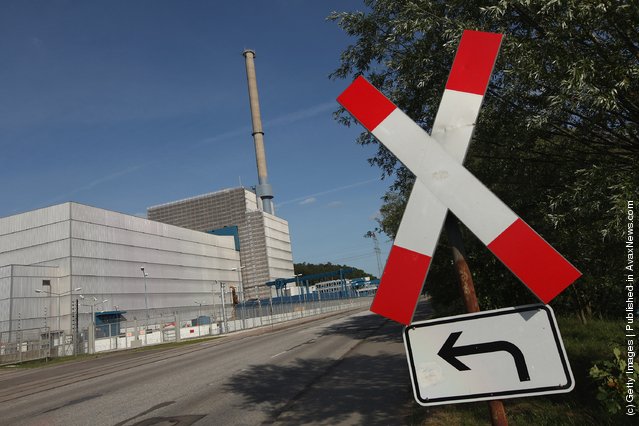
A sign marks a railway crossing next to the troubled Kruemmel nuclear power plant on June 2, 2011 in Geesthacht, Germany. The German government recently announced it will phase out the country's 17 remaining nuclear reactors by 2022 in a policy initiative that represents a radical reversal from its previous policy and was sparked by the disaster at Fukushima. Kruemmel went into operation in 1983 but was taken offline following a fire in 2007. (Photo by Sean Gallup/Getty Images)
Details
03 Jun 2011 09:12:00
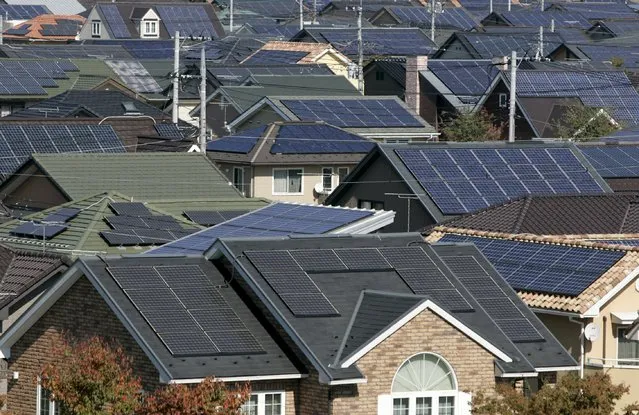
Rooftops of solar powered houses are pictured in Ota, 80 km northwest of Tokyo in this October 28, 2008 file photo. One by one, Japan is turning off the lights at the giant oil-fired power plants that propelled it to the ranks of the world's top industrialised nations. With nuclear power in the doldrums after the Fukushima disaster, it's solar energy that is becoming the alternative. (Photo by Yuriko Nakao/Reuters)

Rooftops of solar powered houses are pictured in Ota, 80 km northwest of Tokyo in this October 28, 2008 file photo. One by one, Japan is turning off the lights at the giant oil-fired power plants that propelled it to the ranks of the world's top industrialised nations. With nuclear power in the doldrums after the Fukushima disaster, it's solar energy that is becoming the alternative. Solar power is set to become profitable in Japan as early as this quarter, according to the Japan Renewable Energy Foundation (JREF), freeing it from the need for government subsidies and making it the last of the G7 economies where the technology has become economically viable. (Photo by Yuriko Nakao/Reuters)
Details
24 Nov 2015 08:04:00
People in Need

'The Dutch charity organization Mensen in Nood (people in need) hits the streets with a remarkable campaign. People in need are posing with the typical attributes of consumer culture. The price of a designer handbag (€32) is compared with the price of a whole week of food (€4), The price a pint of beer (€4.50) with the price of 50 liter clean water (€1.50). The pictures were taken by Swedish fashion photographer Carl Stolz.' - Occupy Design UK
Details
29 Jun 2013 11:21:00
A Cambodian girl goes through the garbage dump looking for things to recycle in order to survive

A Cambodian girl goes through the garbage dump looking for things to recycle in order to survive July 26, 2003 in Phnom Penh, Cambodia. Rampant corruption in this impoverished country has lead to extreme poverty with many Cambodians living below the poverty line. (Photo by Paula Bronstein/Getty Images)
Details
08 Aug 2011 11:50:00
Vietnam’s Son Doong cave, the largest in the world, could hold a 40-story skyscraper inside. The pristine ecosystem has its own river and jungle. Despite its size, Son Doong wasn’t discovered until 1991. It was lost again for nearly two decades and was fully explored for the first time in 2009. (Photo by Jason Speth/HuffPost)

Vietnam’s Son Doong cave, the largest in the world, could hold a 40-story skyscraper inside. The pristine ecosystem has its own river and jungle. Despite its size, Son Doong wasn’t discovered until 1991. It was lost again for nearly two decades and was fully explored for the first time in 2009. (Photo by Jason Speth/HuffPost)
Details
27 Mar 2017 08:37:00
A Guarani Indian woman jokes with her son in the village of Pyau at Jaragua district, in Sao Paulo April 27, 2015. The National Indian Foundation (FUNAI) has recognised 521 hectares of this area as indigenous territory, making it the smallest indigenous reserve in Brazil. Members of the Guarani community have now established a new village outside the demarcation and are being threatened with an eviction through a court order. (Photo by Nacho Doce/Reuters)

A Guarani Indian woman jokes with her son in the village of Pyau at Jaragua district, in Sao Paulo April 27, 2015. The National Indian Foundation (FUNAI) has recognised 521 hectares of this area as indigenous territory, making it the smallest indigenous reserve in Brazil. Members of the Guarani community have now established a new village outside the demarcation and are being threatened with an eviction through a court order. (Photo by Nacho Doce/Reuters)
Details
01 May 2015 12:42:00