Loading...
Done
An aerial view shows a sinkhole 3.5 km (2 miles) to the east of Solikamsk-2 mine in Perm region, November 20, 2014. Shares in Russia's Uralkali, the world's top potash producer, fell sharply for a second day on Wednesday after a mine accident that could reduce global supplies and push up prices of the crop nutrient worldwide. (Photo by Reuters/Press service of Uralkali company)

An aerial view shows a sinkhole 3.5 km (2 miles) to the east of Solikamsk-2 mine in Perm region, November 20, 2014. Shares in Russia's Uralkali, the world's top potash producer, fell sharply for a second day on Wednesday after a mine accident that could reduce global supplies and push up prices of the crop nutrient worldwide. Uralkali shares have fallen 28 percent since Tuesday when it suspended work at its Solikamsk-2 mine, which accounts for a fifth of the company's output and 3.5 percent of global capacity, following an inflow of water. A sinkhole, stretching 30 by 40 metres (yards), found at an abandoned mine 3.5 km (2 miles) to the east, increased concern about the future of the mine because an inflow of water and the resulting sinkhole in 2006 forced another Uralkali operation to shut permanently. (Photo by Reuters/Press service of Uralkali company)
Details
22 Nov 2014 13:51:00
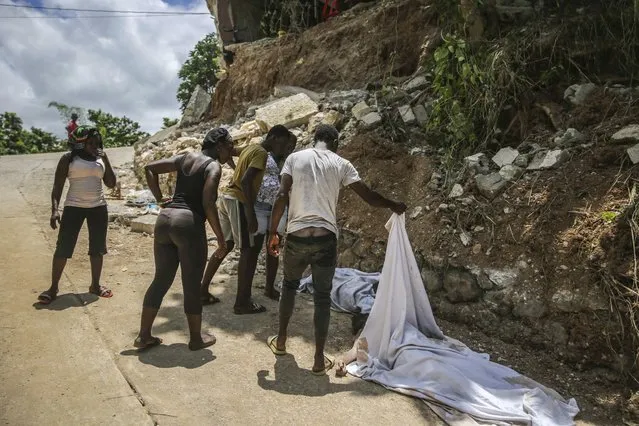
People look at the body of a person who died during the earthquake, on the road to Camp-Perrin, Les Cayes, Haiti, Sunday, August 15, 2021. A 7.2 magnitude earthquake struck Haiti on Saturday, with the epicenter about 125 kilometers (78 miles ) west of the capital of Port-au-Prince, the US Geological Survey said. (Photo by Joseph Odelyn/AP Photo)

People look at the body of a person who died during the earthquake, on the road to Camp-Perrin, Les Cayes, Haiti, Sunday, August 15, 2021. A 7.2 magnitude earthquake struck Haiti on Saturday, with the epicenter about 125 kilometers (78 miles ) west of the capital of Port-au-Prince, the US Geological Survey said. (Photo by Joseph Odelyn/AP Photo)
Details
16 Aug 2021 07:56:00
A person waves a drum while other people wearing traditional Russian village-style clothes celebrate the summer solstice near a bonfire in the village of Okunevo, about 200 kilometers (about 125 miles) northeast of the Siberian city of Omsk, Russia, on Wednesday, June 21, 2023. The festivities of Ivan Kupala, or John the Baptist, are similar to Mardi Gras and reflect pre-Christian Slavic traditions and practices. (Photo by Evgeniy Sofiychuk/AP Photo)

A person waves a drum while other people wearing traditional Russian village-style clothes celebrate the summer solstice near a bonfire in the village of Okunevo, about 200 kilometers (about 125 miles) northeast of the Siberian city of Omsk, Russia, on Wednesday, June 21, 2023. The festivities of Ivan Kupala, or John the Baptist, are similar to Mardi Gras and reflect pre-Christian Slavic traditions and practices. (Photo by Evgeniy Sofiychuk/AP Photo)
Details
26 Jun 2023 03:09:00
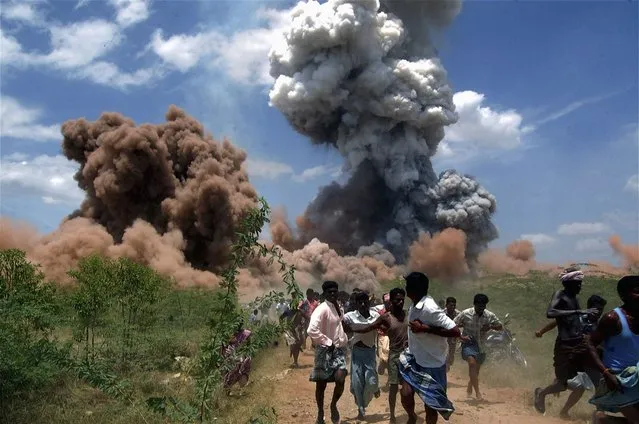
In this September 5, 2012 file photo, people run for cover as smoke rises from the site of a fire at a fireworks factory on the outskirts of Sivakasi, about 500 kilometers (310 miles) southwest of Chennai, India. Police in southern India arrested six employees of the fireworks factory for a massive blaze that killed 40 workers and injured 60 others. (Photo by AP Photo/File)

In this September 5, 2012 file photo, people run for cover as smoke rises from the site of a fire at a fireworks factory on the outskirts of Sivakasi, about 500 kilometers (310 miles) southwest of Chennai, India. Police in southern India arrested six employees of the fireworks factory for a massive blaze that killed 40 workers and injured 60 others. (Photo by AP Photo/File). P.S. I didn't publish the photos which you already saw here (Avax).
Details
04 Jan 2013 15:25:00
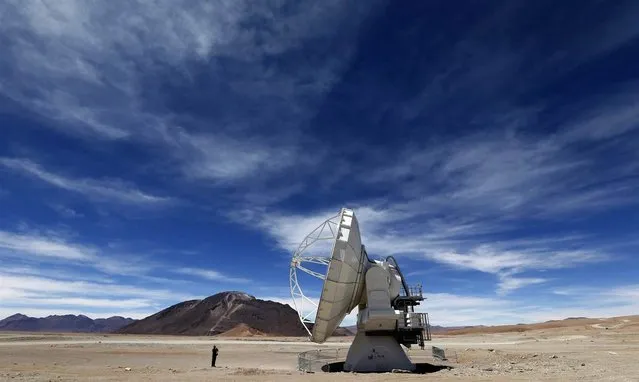
A man takes a photo of a radio antenna that's part of the Atacama Large Milimeter Array Observatory on March 12, 2013 at Llano de Chajnantor, about 43 miles (70 kilometers) from San Pedro de Atacama, Chile. The $1.5 billion ALMA facility, which had its official inauguration on March 13, is considered the world's most expensive ground-based observatory. (Photo by Felipe Trueba/EPA)

A man takes a photo of a radio antenna that's part of the Atacama Large Milimeter Array Observatory on March 12, 2013 at Llano de Chajnantor, about 43 miles (70 kilometers) from San Pedro de Atacama, Chile. The $1.5 billion ALMA facility, which had its official inauguration on March 13, is considered the world's most expensive ground-based observatory. (Photo by Felipe Trueba/EPA)
Details
03 Apr 2013 09:25:00
Tourists look at other festival-goers playing in the mud during the Boryeong Mud Festival at Daecheon beach in Boryeong, about 190 km (118 miles) southwest of Seoul, July 19, 2013. About 2 to 3 million domestic and international tourists visit the beach during the annual mud festival, according to the festival organisers. (Photo by Lee Jae-Won/Reuters)

Tourists look at other festival-goers playing in the mud during the Boryeong Mud Festival at Daecheon beach in Boryeong, about 190 km (118 miles) southwest of Seoul, July 19, 2013. About 2 to 3 million domestic and international tourists visit the beach during the annual mud festival, according to the festival organisers. (Photo by Lee Jae-Won/Reuters)
Details
21 Jul 2013 10:57:00
Matthias Broda, inventor and designer of the wooden e-bike, cycles a prototype along a street in Berlin, November 20, 2014. The wooden e-bike produced by German company Aceteam from ash wood, will be launched on the market by spring 2015 and will cost around 3,950 euro (4,950 dollars). The e-bike will be equipped with an 250W e-bike motor for a range of up to 100 kilometer  (62 miles) with a rechargeable battery. (Photo by Fabrizio Bensch/Reuters)

Matthias Broda, inventor and designer of the wooden e-bike, cycles a prototype along a street in Berlin, November 20, 2014. The wooden e-bike produced by German company Aceteam from ash wood, will be launched on the market by spring 2015 and will cost around 3,950 euro (4,950 dollars). The e-bike will be equipped with an 250W e-bike motor for a range of up to 100 kilometer (62 miles) with a rechargeable battery. (Photo by Fabrizio Bensch/Reuters)
Details
21 Nov 2014 13:02:00
On August 31, 2012, a long filament of solar material that had been hovering in the sun's atmosphere, the corona, erupted out into space at 4:36 p.m. EDT. The coronal mass ejection, or CME, traveled at over 900 miles per second. The CME did not travel directly toward Earth, but did connect with Earth's magnetic environment, or magnetosphere, causing aurora to appear on the night of Monday, September 3. (Photo by NASA/GSFC/SDO)

On August 31, 2012, a long filament of solar material that had been hovering in the sun's atmosphere, the corona, erupted out into space at 4:36 p.m. EDT. The coronal mass ejection, or CME, traveled at over 900 miles per second. The CME did not travel directly toward Earth, but did connect with Earth's magnetic environment, or magnetosphere, causing aurora to appear on the night of Monday, September 3. (Photo by NASA/GSFC/SDO via The Atlantic)
Details
14 Sep 2012 09:01:00