Loading...
Done
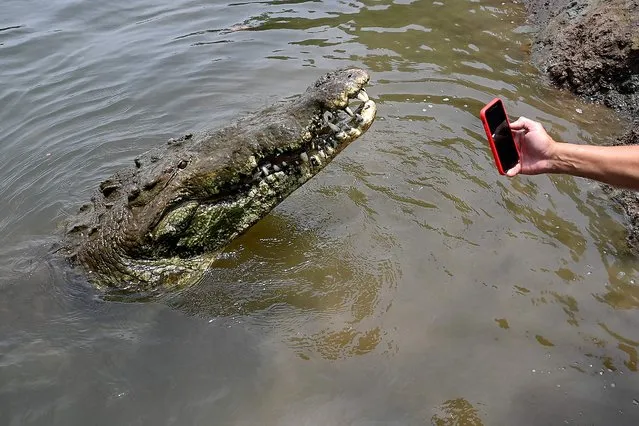
Jaison Vargas, crocodile tour guide, takes a picture of an American crocodile (Crocodylus acutus) during a tour at the Tarcoles river, in Tarcoles, Garabito municipality, Costa Rica, on March 31, 2022. Crocodile tours in the estuary of the Tarcoles River are a popular attraction for visitors to Costa Rica's Pacific coast, as the area gets back on its feet after being shaken by the pandemic. The river is home to nearly 500 species of birds and some 2,000 American crocodiles, many of which have been named after famous people. (Photo by Luis Acosta/AFP Photo)

Jaison Vargas, crocodile tour guide, takes a picture of an American crocodile (Crocodylus acutus) during a tour at the Tarcoles river, in Tarcoles, Garabito municipality, Costa Rica, on March 31, 2022. Crocodile tours in the estuary of the Tarcoles River are a popular attraction for visitors to Costa Rica's Pacific coast, as the area gets back on its feet after being shaken by the pandemic. The river is home to nearly 500 species of birds and some 2,000 American crocodiles, many of which have been named after famous people. (Photo by Luis Acosta/AFP Photo)
Details
10 Apr 2022 04:56:00
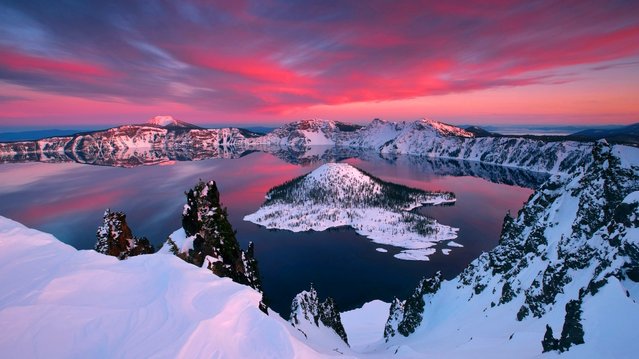
Crater Lake In Oregon

As you look at the majestic Crater Lake, located in south-central Oregon, United States, it is hard to imagine that thousands of years ago this place was one giant crater with scorching hot lava spilling over the sides. Those were the times of turmoil. Now, however, this place is the essence of tranquility. The lake that was formed, after the volcano died down, is amazingly clear due to the fact that the water isn’t moving at all. No rivers go in or out of the Crater Lake, and the water lost through evaporation is compensated by the rain and snowfall. This lake is also frighteningly deep – 1,943 feet (592 m) at its deepest point – making it the deepest lake in the United States. If you love nature and if you ever come to Oregon, this is truly a sight to behold.
Details
19 Nov 2014 14:14:00
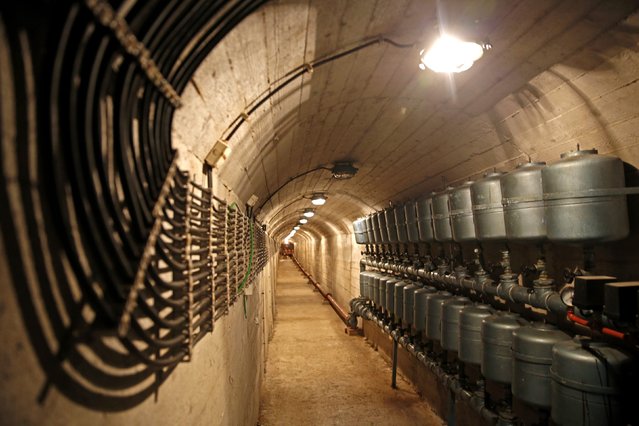
A tunnel with electric switches are seen in Josip Broz Tito's underground secret bunker (ARK) in Konjic, October 16, 2014. (Photo by Dado Ruvic/Reuters)

A tunnel with electric switches are seen in Josip Broz Tito's underground secret bunker (ARK) in Konjic, October 16, 2014. In the early 1950s, Josip Broz Tito, the late leader of the former Yugoslavia, ordered the building of the secret bunker, located 900 feet (270 m) underground and near the Bosnian town of Konjic, to safeguard the country's ruling class in case of a nuclear attack. Construction at the complex, which had a cost equivalent price tag of $4.6 billion, continued until 1979, the year before Tito died. (Photo by Dado Ruvic/Reuters)
Details
28 Nov 2014 12:14:00
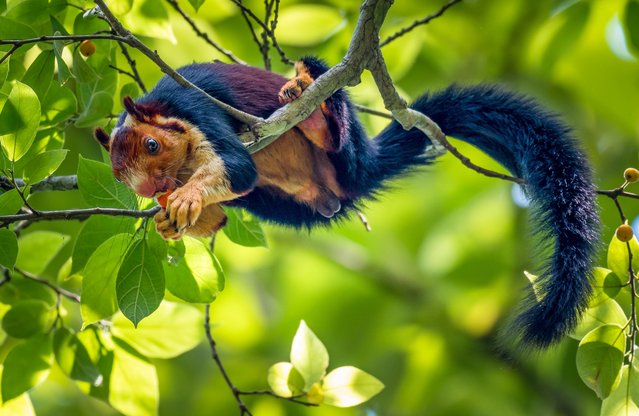
Its main predators are the birds of prey and the leopard. The Giant Squirrel is mostly active in the early hours of the morning and in the evening, resting in the midday. They are typically solitary animals that only come together for breeding. (Photo by Kaushik Vijayan/South West News Service)

The Malabar Giant squirrel – double the size of their grey relatives and measuring up to 36 inches (91.5 cm) from head to tail – lives deep in the forests of India. The athletic animals can leap an incredible 20 feet (6 m) between trees. Photographer Kaushik Vijayan, 39, snapped the animals in their native habit to produce these stunning images. Kaushik, from Kerala State, India, said: “Up until that point I had never heard about a squirrel like that or seen one. The sight was an absolute feast for my eyes. The squirrels fascinated me and I got excited to capture this beauty on my camera”. (Photo by Kaushik Vijayan/South West News Service)
Details
04 Apr 2019 00:03:00
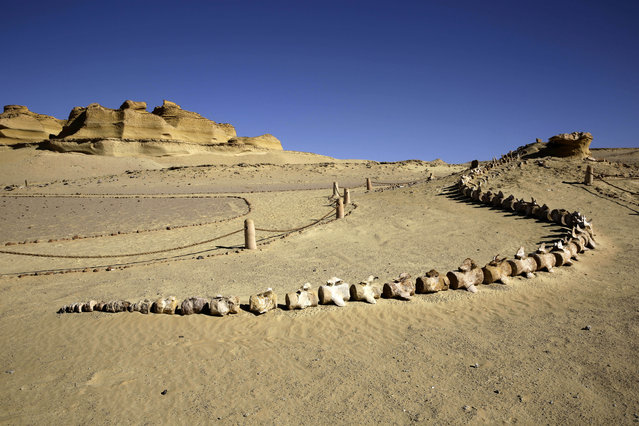
Fossilized whale bones are on display  outside the Wati El Hitan Fossils and Climate Change Museum, a UNESCO natural World Heritage site, on the opening day, in the Fayoum oasis, Egypt, Thursday, January 14, 2016. Egypt has cut the ribbon on the Middle East's first fossil museum housing the world's largest intact skeleton of a "walking whale" in an attempt to attract much-needed tourists driven off by recent militant attacks. The construction of the much-hyped Fossils and Climate Change Museum was covered a 2 billion euros (2. 17 billion dollars) grant from Italy, according to Italian Ambassador Maurizio Massari. (Photo by Thomas Hartwell/AP Photo)

Fossilized whale bones are on display outside the Wati El Hitan Fossils and Climate Change Museum, a UNESCO natural World Heritage site, on the opening day, in the Fayoum oasis, Egypt, Thursday, January 14, 2016. Egypt has cut the ribbon on the Middle East's first fossil museum housing the world's largest intact skeleton of a "walking whale" in an attempt to attract much-needed tourists driven off by recent militant attacks. The construction of the much-hyped Fossils and Climate Change Museum was covered a 2 billion euros (2. 17 billion dollars) grant from Italy, according to Italian Ambassador Maurizio Massari. Its centerpiece is an intact, 37-million-year-old and 20-meter-long skeleton of a legged form of whale that testifies to how modern-day whales evolved from land mammals. The sand-colored, dome-shaped museum is barely discernible in the breathtaking desert landscape that stretches all around. (Photo by Thomas Hartwell/AP Photo)
Details
16 Jan 2016 08:06:00
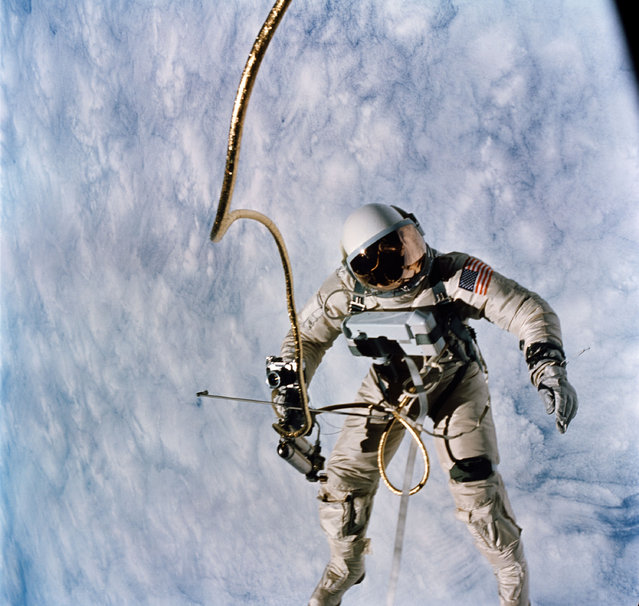
Astronaut Edward H. White II, pilot for the Gemini-Titan 4 (GT-4) spaceflight, floats in the zero-gravity of space during the third revolution of the GT-4 spacecraft on June 3, 1965. White wears a specially designed spacesuit. His face is shaded by a gold-plated visor to protect him from unfiltered rays of the sun. (Photo by NASA)

Astronaut Edward H. White II, pilot for the Gemini-Titan 4 (GT-4) spaceflight, floats in the zero-gravity of space during the third revolution of the GT-4 spacecraft on June 3, 1965. White wears a specially designed spacesuit. His face is shaded by a gold-plated visor to protect him from unfiltered rays of the sun. In his right hand he carries a Hand-Held Self-Maneuvering Unit (HHSMU) that gives him control over his movements in space. White also wears an emergency oxygen chest pack; and he carries a camera mounted on the HHSMU for taking pictures of the sky, Earth and the GT-4 spacecraft. He is secured to the spacecraft by a 25-feet umbilical line and a 23-feet tether line. Both lines are wrapped together in gold tape to form one cord. Astronaut James A. McDivitt, command pilot, remained inside the spacecraft during the extravehicular activity (EVA). Astronaut White died in the Apollo/Saturn 204 fire at Cape Kennedy on January 27, 1967. (Photo by NASA)
Details
22 Jul 2014 12:05:00


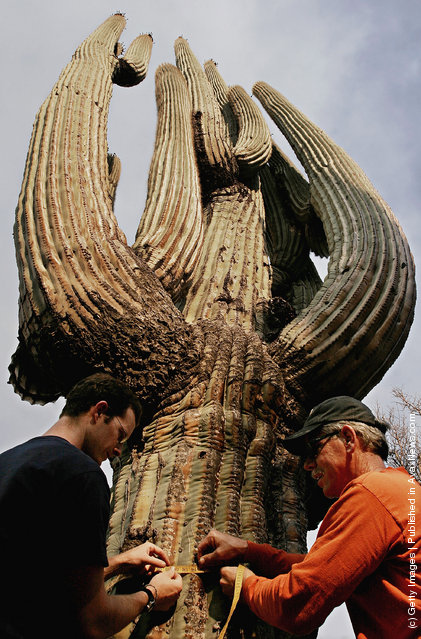
“The saguaro (scientific name Carnegiea gigantea) is a large, tree-sized cactus species in the monotypic genus Carnegiea. It is native to the Sonoran Desert in the U.S. state of Arizona, the Mexican state of Sonora, a small part of Baja California in the San Felipe Desert and an extremely small area of California, U.S. The saguaro blossom is the State Wildflower of Arizona”. – Wikipedia

Photo: Daniel Appel (L), a firefighter with Engine 84 from the Lassen National Forest in California and Mike Hallen, (R), Arizona representative of the National Register of Big Trees, measure the circumference of this Saguaro cactus called the "Grand One," in the Tonto National Forest on July 1, 2005 35 miles north of Phoenix, near Carefree, Arizona. The cactus, estimated to be more than 200 years old, measures a circumference of 7 feet, 10 inches (2.4 meters) and stands 46 feet high (14 meters). The cactus was burned in the Cave Creek Complex fire and may not survive. It was once the largest Saguaro in the world, two others have been found recently that have tied it's measurements. The fire has burned more than 214,000 acres of the Sonoran desert. (Photo by Jeff Topping/Getty Images)
Details
26 Jul 2011 12:27:00
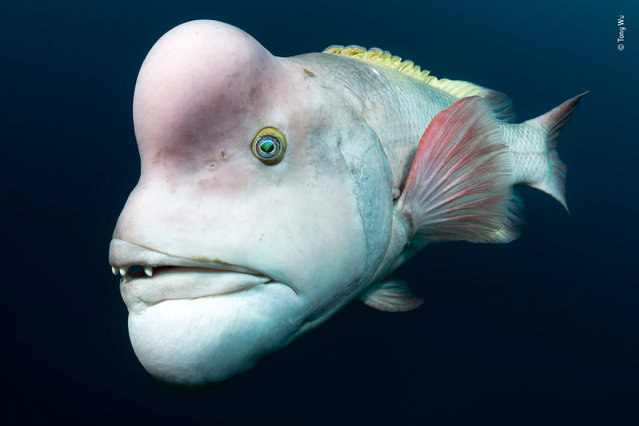
Looking for love by Tony Wu, USA. Highly commended, Animal Portraits. “Accentuating his mature appearance with pastel colours, protruding lips and an outstanding pink forehead, this Asian sheepshead wrasse sets out to impress females and see off rivals, which he will head-butt and bite, near Japan’s remote Sado Island. Individuals start out as females, and when they reach a certain age and size – up to a metre (more than 3 feet) long – can transform into males. Long-lived and slow-growing, the species is intrinsically vulnerable to overfishing”. (Photo by Tony Wu/2018 Wildlife Photographer of the Year)

Looking for love by Tony Wu, USA. Highly commended, Animal Portraits. “Accentuating his mature appearance with pastel colours, protruding lips and an outstanding pink forehead, this Asian sheepshead wrasse sets out to impress females and see off rivals, which he will head-butt and bite, near Japan’s remote Sado Island. Individuals start out as females, and when they reach a certain age and size – up to a metre (more than 3 feet) long – can transform into males. Long-lived and slow-growing, the species is intrinsically vulnerable to overfishing”. (Photo by Tony Wu/2018 Wildlife Photographer of the Year)
Details
03 Sep 2018 08:17:00