Loading...
Done
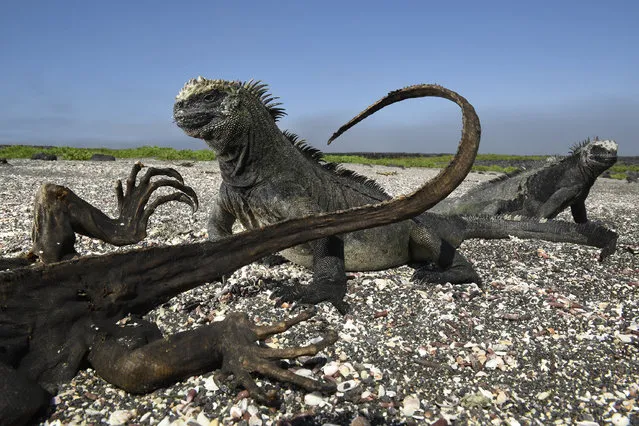
Galapagos – Rocking the Cradle: Four major ocean currents converge along the Galapagos archipelago, creating the conditions for an extraordinary diversity of animal life, April 25, 2016. The islands are home to at least 7,000 flora and fauna species, of which 97 percent of the reptiles, 80 percent of the land birds, 50 percent of the insects and 30 percent of the plants are endemic. The local ecosystem is highly sensitive to the changes in temperature, rainfall and ocean currents that characterize the climatic events known as El Niño and La Niña. These changes cause marked fluctuations in weather and food availability. Many scientists expect the frequency of El Niño and La Niña to increase as a result of climate change, making the Galapagos a possible early-warning location for its effects. (Photo by Thomas P. Peschak for National Geographic/World Press Photo)

Galapagos – Rocking the Cradle: Four major ocean currents converge along the Galapagos archipelago, creating the conditions for an extraordinary diversity of animal life, April 25, 2016. The islands are home to at least 7,000 flora and fauna species, of which 97 percent of the reptiles, 80 percent of the land birds, 50 percent of the insects and 30 percent of the plants are endemic. (Photo by Thomas P. Peschak for National Geographic/World Press Photo)
Details
16 Apr 2018 00:01:00
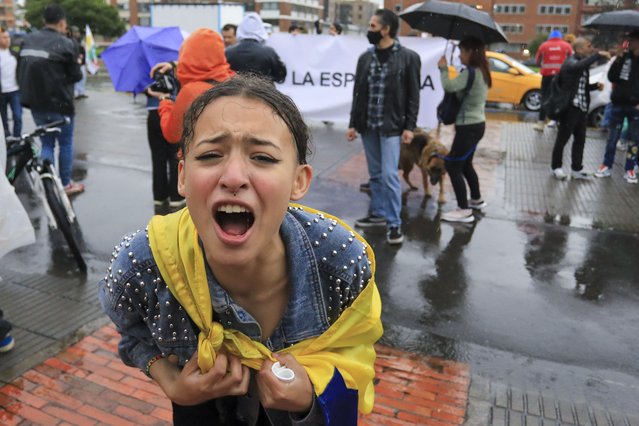
Supporters of presidential candidate Gustavo Petro, with the Historical Pact coalition, celebrate after his candidate won a presidential runoff in Bogota, Colombia, Sunday, June 19, 2022. (Photo by Fernando Vergara/AP Photo)

Supporters of presidential candidate Gustavo Petro, with the Historical Pact coalition, celebrate after his candidate won a presidential runoff in Bogota, Colombia, Sunday, June 19, 2022. (Photo by Fernando Vergara/AP Photo)
Details
05 Sep 2023 03:52:00
The National Geographic Photo Ark is a travelling exhibition of photographer Joel Sartore’s quest to create a photo archive of biodiversity around the world. So far, Sartore has captured studio portraits of more than 6,000 species – a number that he hopes to double. On 1 July, the ark will open at Melbourne zoo – the first time it has been exhibited in the southern hemisphere. More than 50 portraits will be on display, including many of Australian endangered animals being protected by programs at the zoo itself. These captions have been edited from text supplied by Melbourne zoo. Here: Barking owl. So-named because its call sounds like a barking dog, these birds are native to Australia, Indonesia and Papua New Guinea. In Victoria they are listed as an endangered species, and in 2003 there were estimated to be fewer than 50 breeding pairs. The main threat to the species in Victoria is loss of habitat, especially large trees with hollows in which they can nest and on which many of their prey depend. Apart from a bark, they may utter a chilling scream when they feel threatened. (Photo by Joel Sartore/National Geographic Photo Ark/The Guardian)

The National Geographic Photo Ark is a travelling exhibition of photographer Joel Sartore’s quest to create a photo archive of biodiversity around the world. So far, Sartore has captured studio portraits of more than 6,000 species – a number that he hopes to double. On 1 July, the ark will open at Melbourne zoo – the first time it has been exhibited in the southern hemisphere. More than 50 portraits will be on display, including many of Australian endangered animals being protected by programs at the zoo itself. These captions have been edited from text supplied by Melbourne zoo. Here: Barking owl. (Photo by Joel Sartore/National Geographic Photo Ark/The Guardian)
Details
01 Jul 2017 07:45:00
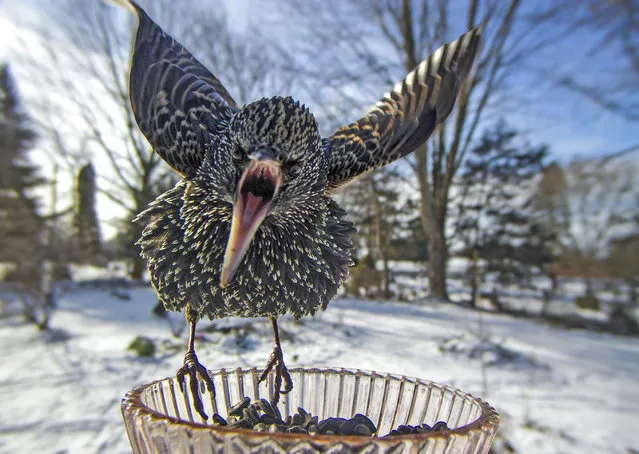
A starling jealously guards a seed station in the back garden of the photographer’s Michigan home in January 2024. (Photo by Lisa Cavanary/Solent News)

A starling jealously guards a seed station in the back garden of the photographer’s Michigan home in January 2024. (Photo by Lisa Cavanary/Solent News)
Details
04 Feb 2024 09:40:00
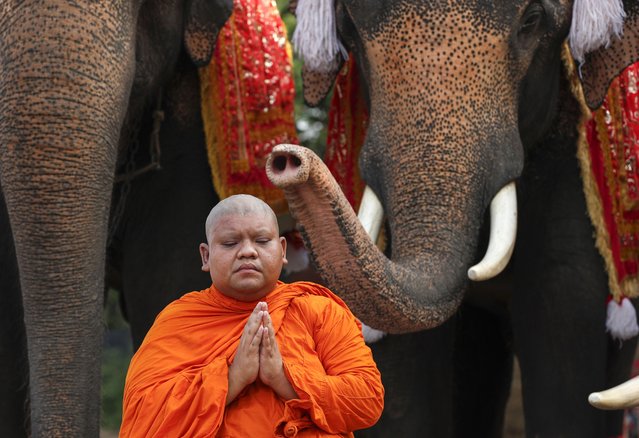
A Thai Buddhist monk performs a religious rite blessing elephants and mahouts to mark the National Elephant Day at the Ayutthaya Elephant Palace and Royal Kraal in the world heritage city of Ayutthaya, Thailand, 13 March 2025. The National Elephant Day has been observed annually on 13 March since 1998 when it was established by the Thai government, in an effort to protect and conserve Thai elephants, who are part of the Asian elephant family classified as an endangered species. (Photo by Rungroj Yongrit/EPA)

A Thai Buddhist monk performs a religious rite blessing elephants and mahouts to mark the National Elephant Day at the Ayutthaya Elephant Palace and Royal Kraal in the world heritage city of Ayutthaya, Thailand, 13 March 2025. The National Elephant Day has been observed annually on 13 March since 1998 when it was established by the Thai government, in an effort to protect and conserve Thai elephants, who are part of the Asian elephant family classified as an endangered species. (Photo by Rungroj Yongrit/EPA)
Details
03 Apr 2025 04:25:00
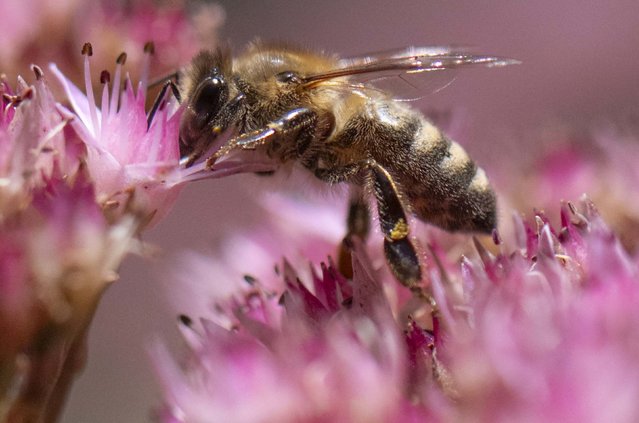
A bee searches for nectar on a flower in Frankfurt am Main, Germany, on Friday, September 19, 2025. (Photo by Boris Roessler/dpa/picture alliance/Getty Images)

A bee searches for nectar on a flower in Frankfurt am Main, Germany, on Friday, September 19, 2025. (Photo by Boris Roessler/dpa/picture alliance/Getty Images)
Details
19 Oct 2025 03:44:00
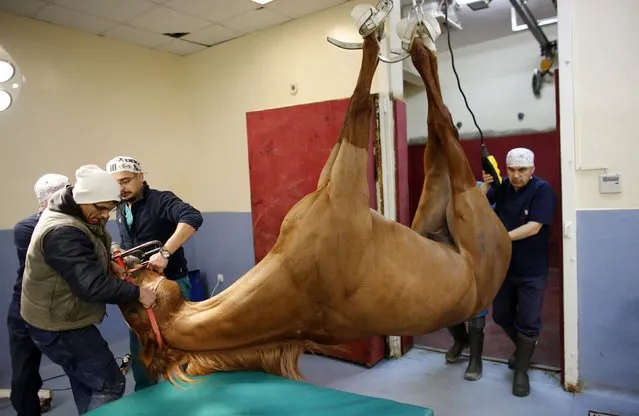
A racehorse is hoisted up before its operation at Veliefendi equine hospital in Istanbul March 3, 2015. (Photo by Murad Sezer/Reuters)

A racehorse is hoisted up before its operation at Veliefendi equine hospital in Istanbul March 3, 2015. A state-of-the-art hospital for hundreds of horses run by the Jockey Club of Turkey at Istanbul's Veliefendi racecourse is the country's oldest and biggest. Grooms and trainers at the equine clinic work with vets and nurses while owners hope their prize runners, often worth hundreds of thousands of dollars, will recover quickly and then run faster still. (Photo by Murad Sezer/Reuters)
Details
10 Apr 2015 07:12:00
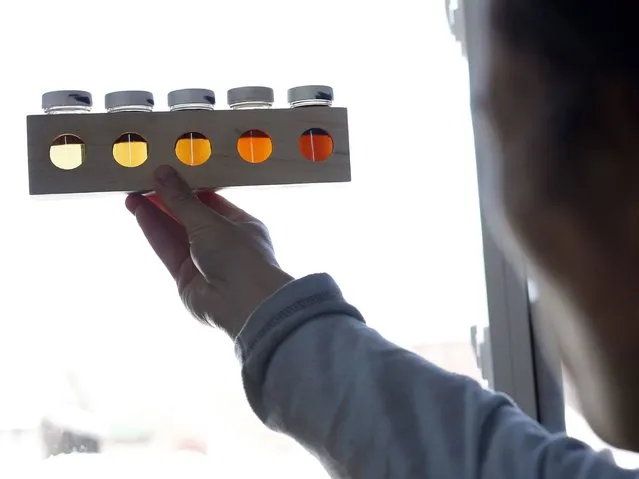
Sarah Gibbons grades a new batch of Maple Syrup at Gibbons Family Farm in Frankville, Ontario, Canada, 31 March 2014. The annual maple syrup season marks the end of the often brutal central Canadian winters and heralds the beginning of spring. The maple tree, whose leaf dominates the Canada's flag, plays both a symbolic and practical role in the identity of Canadians who produce around 95 percent of the world's supply of maple syrup. (Photo by Stephen Morrison/EPA)

Sarah Gibbons grades a new batch of Maple Syrup at Gibbons Family Farm in Frankville, Ontario, Canada, 31 March 2014. The annual maple syrup season marks the end of the often brutal central Canadian winters and heralds the beginning of spring. The maple tree, whose leaf dominates the Canada's flag, plays both a symbolic and practical role in the identity of Canadians who produce around 95 percent of the world's supply of maple syrup. (Photo by Stephen Morrison/EPA)
Details
08 May 2014 07:24:00