Loading...
Done
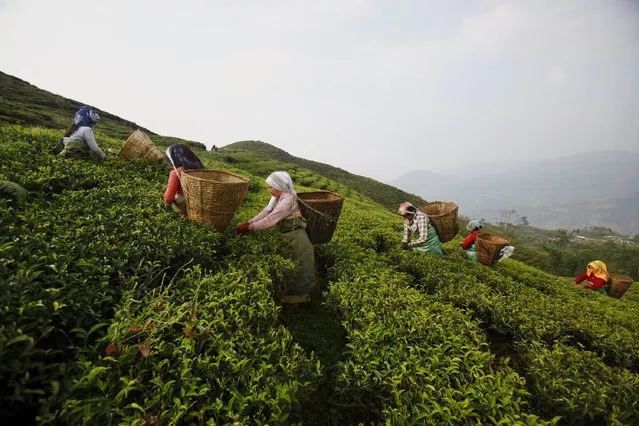
In this Sunday, November 16, 2014 photo, Nepalese women pick tea at a tea garden of Kanyam in Illam district, around 500 kilometers (310 miles) from Katmandu, Nepal. Illam is a hilly district of tea gardens and estates in eastern Nepal's Himalayan region with one of its largest and most productive tea estate being Kanyam estates. (Photo by Niranjan Shrestha/AP Photo)

In this Sunday, November 16, 2014 photo, Nepalese women pick tea at a tea garden of Kanyam in Illam district, around 500 kilometers (310 miles) from Katmandu, Nepal. Illam is a hilly district of tea gardens and estates in eastern Nepal's Himalayan region with one of its largest and most productive tea estate being Kanyam estates. The district produces orthodox tea, hand-processed or machine rolled, which is generally exported to international markets, specially Europe and the United States. Most of the tea pickers here are paid 186 Nepalese Rupees (US $ 2) for 8 hours of work everyday. (Photo by Niranjan Shrestha/AP Photo)
Details
19 Nov 2014 14:28:00
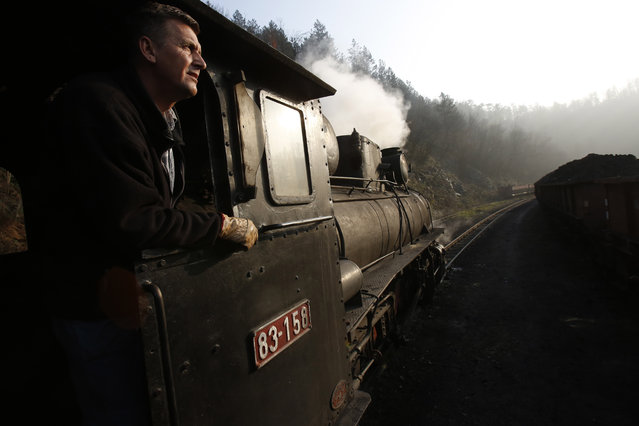
Bosnian worker Sefik Salihovic drives a steam engine in the Bosnian town of Banovici, 140 kms (86.9 miles) north of Sarajevo, on Monday, November 24, 2014. Every day, steam engines over 60 years old, defy their age and still pull wagons of coal from Banovici's coal mine to clients in nearby towns. But in the summer some of them turn into the only tourist attraction this impoverished north Bosnian town has to offer. (Photo by Amel Emric/AP Photo)

Bosnian worker Sefik Salihovic drives a steam engine in the Bosnian town of Banovici, 140 kms (86.9 miles) north of Sarajevo, on Monday, November 24, 2014. Every day, steam engines over 60 years old, defy their age and still pull wagons of coal from Banovici's coal mine to clients in nearby towns. But in the summer some of them turn into the only tourist attraction this impoverished north Bosnian town has to offer. (Photo by Amel Emric/AP Photo)
Details
05 Dec 2014 13:07:00
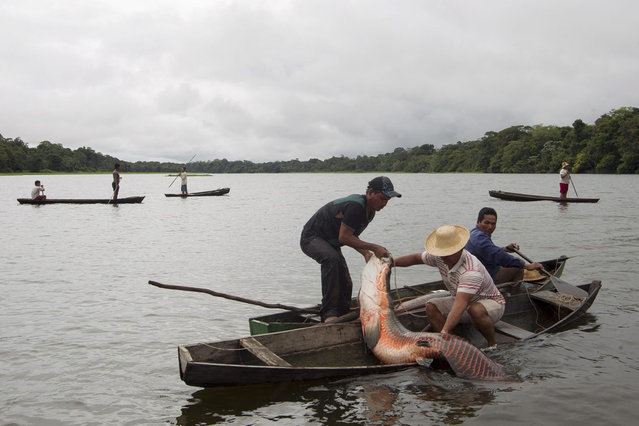
Villagers from the Porto Novo community load into their canoes arapaima or pirarucu, the largest freshwater fish species in South America and one of the largest in the world, while fishing in Poco Fundo lake along a branch of the Solimoes river, one of the main tributaries of the Amazon, in the Mamiraua nature reserve near Fonte Boa about 600 km (373 miles) west of Manaus, November 26, 2013. (Photo by Bruno Kelly/Reuters)

Villagers from the Porto Novo community load into their canoes arapaima or pirarucu, the largest freshwater fish species in South America and one of the largest in the world, while fishing in Poco Fundo lake along a branch of the Solimoes river, one of the main tributaries of the Amazon, in the Mamiraua nature reserve near Fonte Boa about 600 km (373 miles) west of Manaus, November 26, 2013. Catching the arapaima, a fish that is sought after for its meat and is considered by biologists to be a living fossil, is only allowed once a year by Brazil's environmental protection agency. The minimum size allowed for a fisherman to keep an arapaima is 1.5 meters (4.9 feet). (Photo by Bruno Kelly/Reuters)
Details
17 Dec 2013 08:03:00
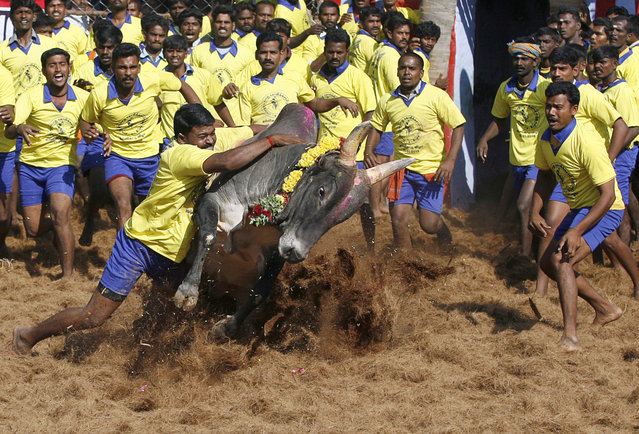
Bull tamers try to control a bull during the bull-taming sport called Jallikattu, in Palamedu, about 575 kilometers (359 miles) south of Chennai, India, Tuesday, Jan. 15, 2013. (Photo by Arun Sankar K./AP Photo)

“Jallikattu is a bull taming sport played in Tamil Nadu as a part of Pongal celebrations on Mattu Pongal day. Annually, jallikattu is held from January to July, played first in world-famous Palamedu, near Madurai on January 15 followed by “Alanganallur-jallikattu” in Alanganallur, near Madurai on 16 January. There is a specific breed of cattle bred for this purpose known as Jellicut and from the place of a big breeder Pulikulam”. – Wikipedia. Photo: Bull tamers try to control a bull during the bull-taming sport called Jallikattu, in Palamedu, about 575 kilometers (359 miles) south of Chennai, India, Tuesday, January 15, 2013. (Photo by Arun Sankar K./AP Photo)
Details
17 Jan 2014 10:06:00
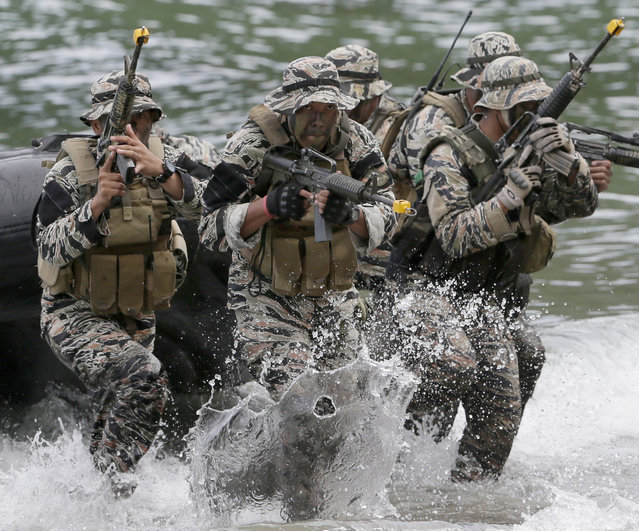
Philippine Marines from the Naval Special Operations Group (NAVSOG) storm the beach to simulate an “extraction” of a kidnapped victim as they kick off a five-day amphibious military exercise at the Philippine Marines training center in Ternate, Cavite province, about 50 miles (80kms) south of Manila, Philippines Thursday, September 24, 2015. (Photo by Bullit Marquez/AP Photo)

Philippine Marines from the Naval Special Operations Group (NAVSOG) storm the beach to simulate an “extraction” of a kidnapped victim as they kick off a five-day amphibious military exercise at the Philippine Marines training center in Ternate, Cavite province, about 50 miles (80kms) south of Manila, Philippines Thursday, September 24, 2015. The naval exercise dubbed PAGSISIKAP 2015 is aimed at enhancing capability of their fleet and forces as well as to strengthen interoperability of the Marines. (Photo by Bullit Marquez/AP Photo)
Details
26 Sep 2015 08:01:00
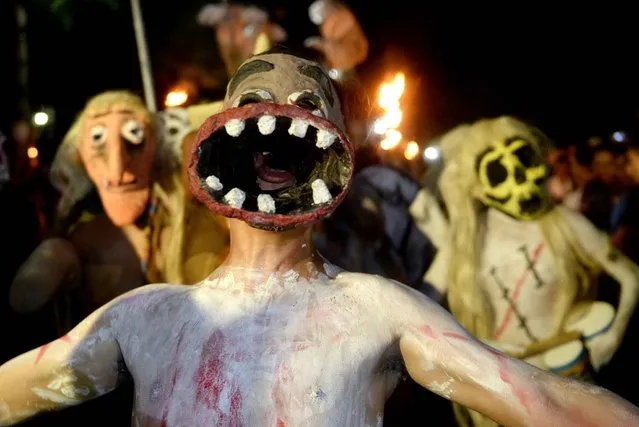
Young revelers take part in a parade called "La Calabiuza" on November 1, 2015, on the eve of the Day of the Dead in Tonacatepeque, 20 kms (13 miles) north of San Salvador. During the celebration, the residents of Tonacatepeque, originally an indigenous community, recall the characters from the mythology of Cuscatlan – pre-Columbian west and central regions of El Salvador – and their dead relatives. (Photo by Marvin Recinos/AFP Photo)

Young revelers take part in a parade called "La Calabiuza" on November 1, 2015, on the eve of the Day of the Dead in Tonacatepeque, 20 kms (13 miles) north of San Salvador. During the celebration, the residents of Tonacatepeque, originally an indigenous community, recall the characters from the mythology of Cuscatlan – pre-Columbian west and central regions of El Salvador – and their dead relatives. (Photo by Marvin Recinos/AFP Photo)
Details
04 Nov 2015 11:50:00
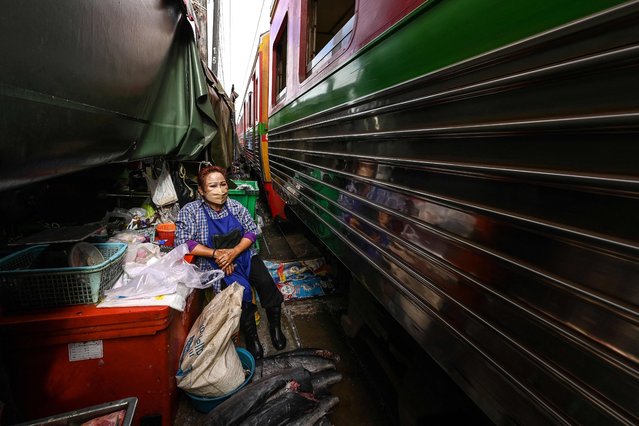
This photograph taken on June 4, 2022 shows fish vendor Somporn Thathom sitting at her stall as a passenger train passes through the Mae Klong railway market in Samut Songkhram province, around 80 kms (50 miles) southwest of Bangkok. Six times a day at the market, local customers and foreign tourists scramble into nooks and crannies while vendors calmly move their woven baskets of goods away from the tracks and close their umbrellas. (Photo by Manan Vatsyayana/AFP Photo)

This photograph taken on June 4, 2022 shows fish vendor Somporn Thathom sitting at her stall as a passenger train passes through the Mae Klong railway market in Samut Songkhram province, around 80 kms (50 miles) southwest of Bangkok. Six times a day at the market, local customers and foreign tourists scramble into nooks and crannies while vendors calmly move their woven baskets of goods away from the tracks and close their umbrellas. (Photo by Manan Vatsyayana/AFP Photo)
Details
29 Jun 2022 04:38:00
Rickshaw puller Shiori Yoshida, 28, attracts tourists to the guided tour at the Asakusa district in Tokyo, Japan on August 22, 2023. Pullers walk or run an average of 20 km (12 miles) a day and, in addition to being physically strong, they must have extensive knowledge of Tokyo and know how to engage with the tourists who mostly hire them for sightseeing. “I have fun and enjoy myself”, Yoshida said. “In order for the customers to enjoy themselves, I also enjoy myself”. (Photo by Issei Kato/Reuters)

Rickshaw puller Shiori Yoshida, 28, attracts tourists to the guided tour at the Asakusa district in Tokyo, Japan on August 22, 2023. Pullers walk or run an average of 20 km (12 miles) a day and, in addition to being physically strong, they must have extensive knowledge of Tokyo and know how to engage with the tourists who mostly hire them for sightseeing. “I have fun and enjoy myself”, Yoshida said. “In order for the customers to enjoy themselves, I also enjoy myself”. (Photo by Issei Kato/Reuters)
Details
16 Oct 2023 04:43:00