Loading...
Done
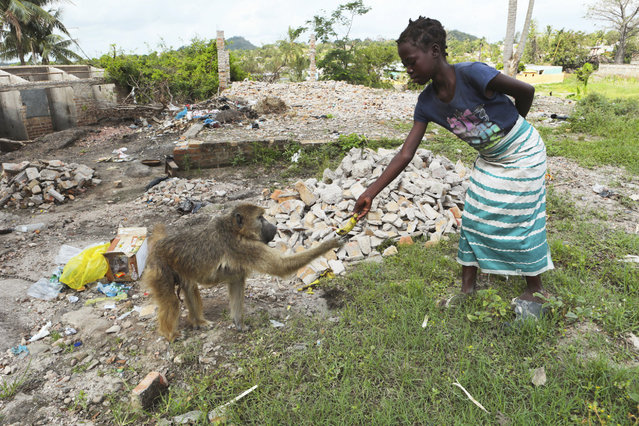
A young girl gives a banana to a tamed baboon on the outskirts of Beira, Mozambique, Sunday, March, 31, 2019. Cholera cases among cyclone survivors in Mozambique have jumped to 271, authorities said. So far no cholera deaths have been confirmed. (Photo by Tsvangirayi Mukwazhi/AP Photo)

A young girl gives a banana to a tamed baboon on the outskirts of Beira, Mozambique, Sunday, March, 31, 2019. Cholera cases among cyclone survivors in Mozambique have jumped to 271, authorities said. So far no cholera deaths have been confirmed. (Photo by Tsvangirayi Mukwazhi/AP Photo)
Details
07 Apr 2019 00:03:00
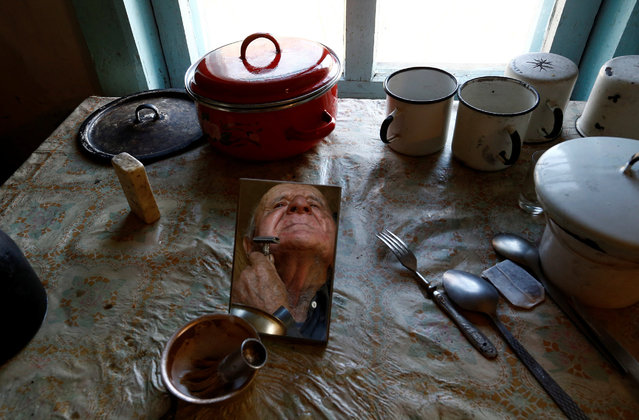
Ivan Shamyanok, 90, shaves in his house in the village of Tulgovichi, near the exclusion zone around the Chernobyl nuclear reactor, Belarus March 15, 2016. “My sister lived here with her husband. They decided to leave and soon enough they were in the ground ... They died from anxiety. I'm not anxious. I sing a little, take a turn in the yard, take things slowly like this and I live”, he said. (Photo by Vasily Fedosenko/Reuters)

Ivan Shamyanok, 90, shaves in his house in the village of Tulgovichi, near the exclusion zone around the Chernobyl nuclear reactor, Belarus March 15, 2016. “My sister lived here with her husband. They decided to leave and soon enough they were in the ground ... They died from anxiety. I'm not anxious. I sing a little, take a turn in the yard, take things slowly like this and I live”, he said. (Photo by Vasily Fedosenko/Reuters)
Details
27 Apr 2016 09:50:00
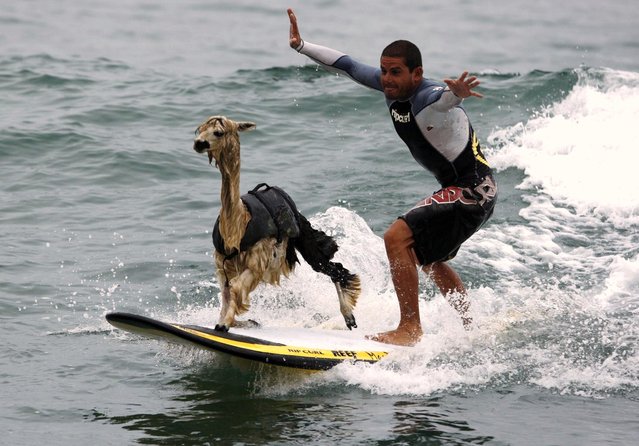
Peruvian surfer Domingo Pianezzi rides a wave with his alpaca Pisco at San Bartolo beach in Lima March 16, 2010. Pianezzi has spent a decade training dogs to ride the nose of his board when he catches waves, and now he is the first to do so with an alpaca. (Photo by Pilar Olivares/Reuters)

Peruvian surfer Domingo Pianezzi rides a wave with his alpaca Pisco at San Bartolo beach in Lima March 16, 2010. Pianezzi has spent a decade training dogs to ride the nose of his board when he catches waves, and now he is the first to do so with an alpaca. (Photo by Pilar Olivares/Reuters)
Details
02 Sep 2013 12:49:00
Fans react as Danish singer Thomas Helmig performs during a concert at the Northside Festival in Aarhus, Denmark on June 3, 2022. (Photo by Helle Arensbak/Ritzau Scanpix via Reuters)

Fans react as Danish singer Thomas Helmig performs during a concert at the Northside Festival in Aarhus, Denmark on June 3, 2022. (Photo by Helle Arensbak/Ritzau Scanpix via Reuters)
Details
31 Aug 2023 02:38:00
Artists from the Beijing Dance Academy perform to celebrate the Chinese Lunar New Year in Budapest, capital of Hungary, February 6, 2019. (Photo by Attila Volgyi/Xinhua News Agency/Barcroft Media)

Artists from the Beijing Dance Academy perform to celebrate the Chinese Lunar New Year in Budapest, capital of Hungary, February 6, 2019. (Photo by Attila Volgyi/Xinhua News Agency/Barcroft Media)
Details
08 Feb 2019 06:23:00
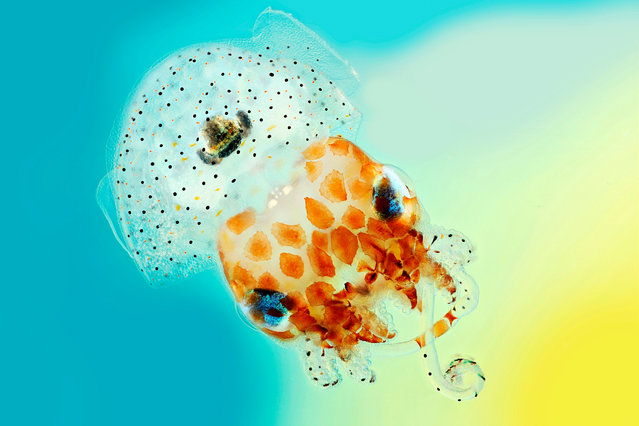
With its huge eyes, comical name and diminutive size, Mark R. Smith’s image of a baby Hawaiian bobtail squid can’t help but raise a smile. A curiously endearing creature, the cephalopod is just 1.5cm across, its mantle cavity bearing more than a passing resemblance to a rather natty shower cap. But it is also a beautiful example of symbiosis – nature’s version of “I’ll scratch your back if you scratch mine” – for on the underside of the squid is a light organ which houses bioluminescent bacteria. The squid offers the bacteria protection and food, while the bacteria emit a glow – a handy trait that the squid uses to offset its silhouette, helping it to evade predators in the depths below. Mark R. Smith’s entry combines several images of a Hawaiian bobtail squid with different focus lengths to create a final picture with greater depth of field than normal. (Photo by Mark R. Smith/Wellcome Images/Macroscopic Solutions)

With its huge eyes, comical name and diminutive size, Mark R. Smith’s image of a baby Hawaiian bobtail squid can’t help but raise a smile. A curiously endearing creature, the cephalopod is just 1.5cm across, its mantle cavity bearing more than a passing resemblance to a rather natty shower cap. But it is also a beautiful example of symbiosis – nature’s version of “I’ll scratch your back if you scratch mine” – for on the underside of the squid is a light organ which houses bioluminescent bacteria. The squid offers the bacteria protection and food, while the bacteria emit a glow – a handy trait that the squid uses to offset its silhouette, helping it to evade predators in the depths below. Mark R. Smith’s entry combines several images of a Hawaiian bobtail squid with different focus lengths to create a final picture with greater depth of field than normal. (Photo by Mark R. Smith/Wellcome Images/Macroscopic Solutions)
Details
08 Mar 2017 00:05:00
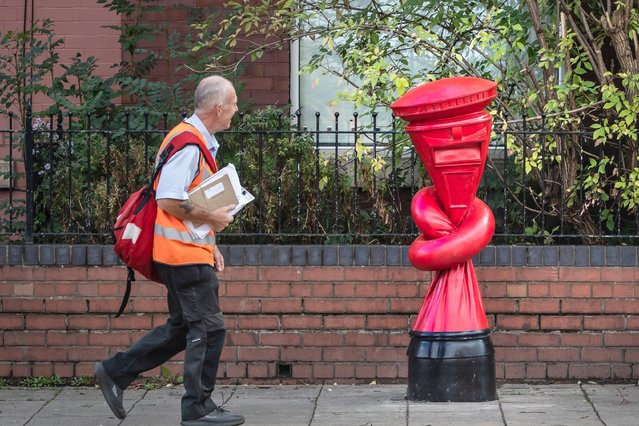
A postman walks past an art work titled “Alphabetti Spaghett” by artist Alex Chinneck on Norborough Road in Sheffield, Yorkshire, England on September 26, 2019. (Photo by Danny Lawson/PA Images via Getty Images)

A postman walks past an art work titled “Alphabetti Spaghett” by artist Alex Chinneck on Norborough Road in Sheffield, Yorkshire, England on September 26, 2019. (Photo by Danny Lawson/PA Images via Getty Images)
Details
28 Sep 2019 00:07:00
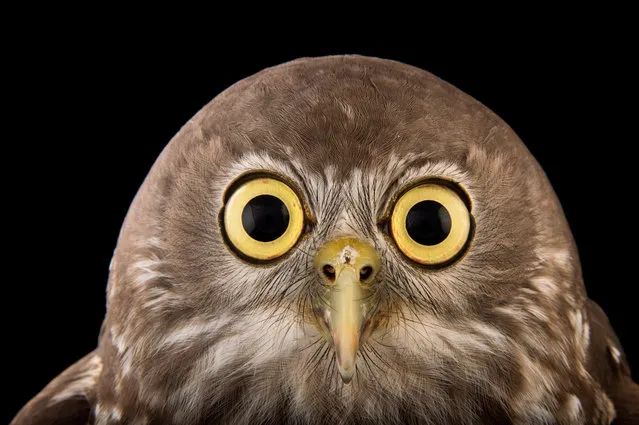
The National Geographic Photo Ark is a travelling exhibition of photographer Joel Sartore’s quest to create a photo archive of biodiversity around the world. So far, Sartore has captured studio portraits of more than 6,000 species – a number that he hopes to double. On 1 July, the ark will open at Melbourne zoo – the first time it has been exhibited in the southern hemisphere. More than 50 portraits will be on display, including many of Australian endangered animals being protected by programs at the zoo itself. These captions have been edited from text supplied by Melbourne zoo. Here: Barking owl. So-named because its call sounds like a barking dog, these birds are native to Australia, Indonesia and Papua New Guinea. In Victoria they are listed as an endangered species, and in 2003 there were estimated to be fewer than 50 breeding pairs. The main threat to the species in Victoria is loss of habitat, especially large trees with hollows in which they can nest and on which many of their prey depend. Apart from a bark, they may utter a chilling scream when they feel threatened. (Photo by Joel Sartore/National Geographic Photo Ark/The Guardian)

The National Geographic Photo Ark is a travelling exhibition of photographer Joel Sartore’s quest to create a photo archive of biodiversity around the world. So far, Sartore has captured studio portraits of more than 6,000 species – a number that he hopes to double. On 1 July, the ark will open at Melbourne zoo – the first time it has been exhibited in the southern hemisphere. More than 50 portraits will be on display, including many of Australian endangered animals being protected by programs at the zoo itself. These captions have been edited from text supplied by Melbourne zoo. Here: Barking owl. (Photo by Joel Sartore/National Geographic Photo Ark/The Guardian)
Details
01 Jul 2017 07:45:00