A Belarussian border guard checks a passenger's passport in a train after it arrived from Lithuania, at the railway station Gudogai, Belarus, November 22, 2016. (Photo by Vasily Fedosenko/Reuters)
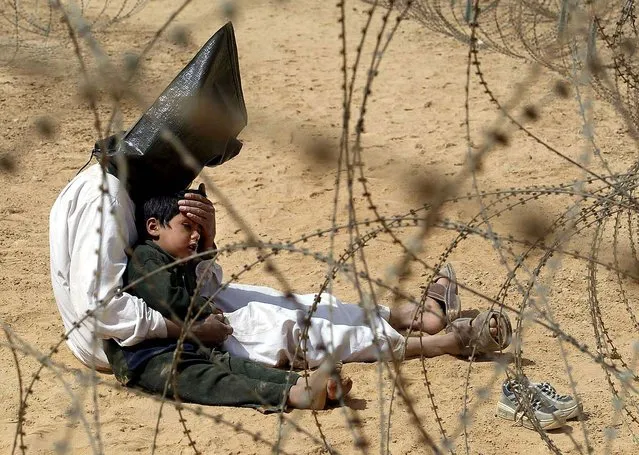
An Iraqi man comforts his 4-year-old son at a regroupment center for POWs of the 101st Airborne Division near An Najaf, Iraq, March 31, 2003. The man was seized in An Najaf with his son and the U.S. military did not want to separate them. (Photo by Jean-Marc Bouju/Associated Press)
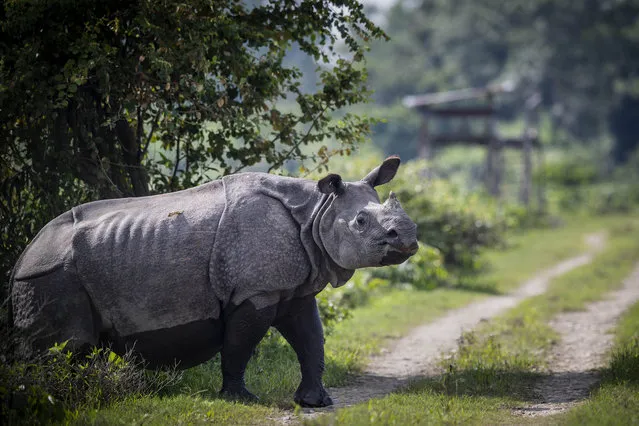
A one-horned rhinoceros crosses a road inside Kaziranga national park on the eve of the World Rhino Day in Gauhati, India, Tuesday, September 21, 2021. Kaziranga is home to nearly 2,500 one-horned rhinos and is the world’s largest habitat for the rare animal. (Photo by Anupam Nath/AP Photo)
Jaime “Ka Diego” Padilla (R), spokesperson of the Melito Glor Command of the New People's Army (NPA), and Ka Kathryn (Comrade Kathryn) (L) react during their 50th founding anniversary celebration at an undisclosed location in the mountains of Sierra Madre, Philippines, 31 March 2019. (Photo by Alecs Ongcal/EPA/EFE)
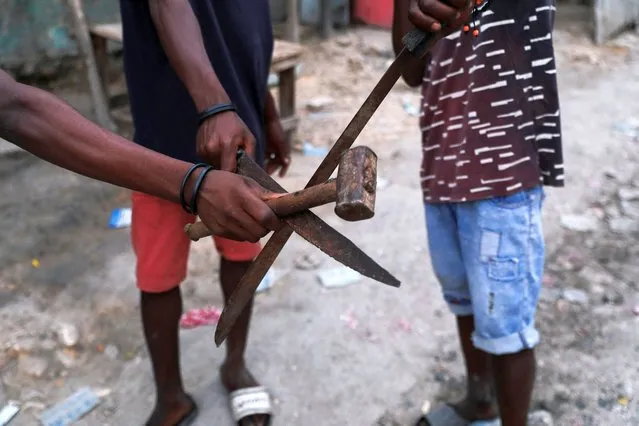
Men who are part of a neighbourhood vigilante group hold a hammer and machetes while posing for a photograph after suspected gang leader Makandal was killed and set on fire, amid an escalation in gang violence, in Port-au-Prince, Haiti on March 20, 2024. (Photo by Ralph Tedy Erol/Reuters)
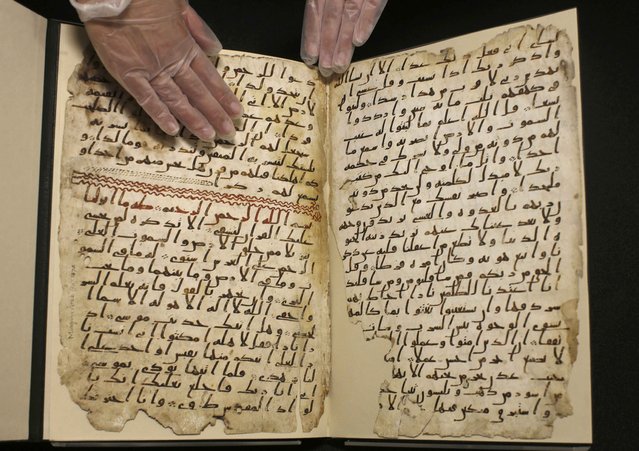
A fragment of a Koran manuscript is seen in the library at the University of Birmingham in Britain July 22, 2015. A British university said on Wednesday that fragments of a Koran manuscript found in its library were from one of the oldest surviving copies of the Islamic text in the world, possibly written by someone who might have known Prophet Mohammad. Radiocarbon dating indicated that the parchment folios held by the University of Birmingham in central England were at least 1,370 years old, which would make them one of the earliest written forms of the Islamic holy book in existence. (Photo by Peter Nicholls/Reuters)
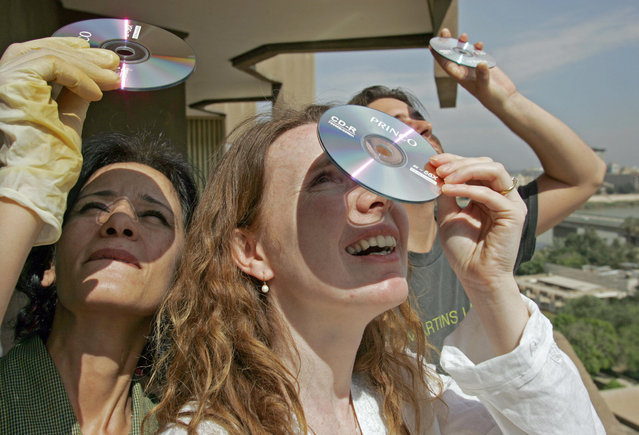
An Iraqi woman and foreigners use pair of compact discs as a filter to watch the partial solar eclipse in war-torn Baghdad, 29 March 2006. Without access to proper equipment to protect their eyes from the sun's rays, eclipse watchers in Iraq used makeshift filters. The moon blotted out the sun over northwest Africa early Wednesday, turning day into night in a total solar eclipse as it swept a shadowy path from the outer tip of Brazil to the steppes of Mongolia. (Photo by Hassan Ammar/AFP Photo)