Loading...
Done
In this photo taken on Monday, October 27, 2014, a cactus stands at a broken window in a damaged house after shelling not far from Donetsk airport in the town of Donetsk, eastern Ukraine. (Photo by Dmitry Lovetsky/AP Photo)

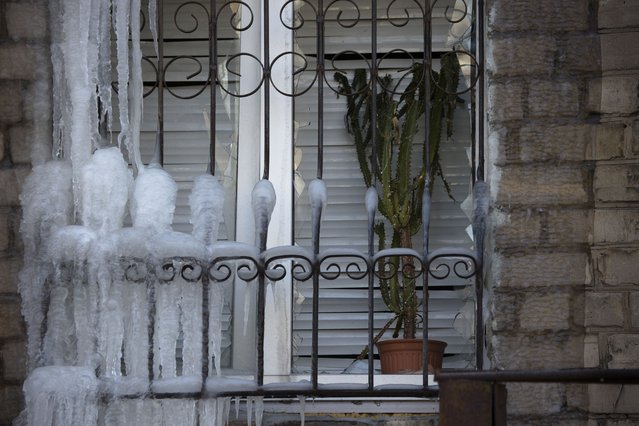
In this photo taken on Monday, October 27, 2014, a cactus stands at a broken window in a damaged house after shelling not far from Donetsk airport in the town of Donetsk, eastern Ukraine. Donetsk, which has lost about 400,000 of its 1 million pre-war population, is bracing to a winter ahead. In a climate like eastern Ukraine's, where temperatures typically stay below zero all winter, the damage to the critical infrastructure and lack of effort to provide adequate shelter to people whose homes were destroyed could literally mean a death from the cold. (Photo by Dmitry Lovetsky/AP Photo)
Details
06 Nov 2014 09:06:00
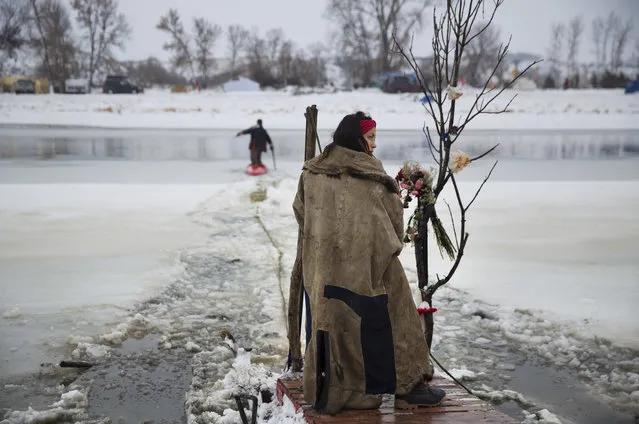
In this Thursday, December 1, 2016 photo, Cat Bigney, part of the Oglala Native American tribe, waits on the shore of the Cannonball river for travelers to arrive by canoe at the Oceti Sakowin camp where people have gathered to protest the Dakota Access oil pipeline in Cannon Ball, N.D. So far, those at the camp have shrugged off the heavy snow, icy winds and frigid temperatures. But if they defy next week's government deadline to abandon the camp, demonstrators know the real deep freeze lies ahead. Life-threatening wind chills and towering snow drifts could mean the greatest challenge is simple survival. (Photo by David Goldman/AP Photo)

In this Thursday, December 1, 2016 photo, Cat Bigney, part of the Oglala Native American tribe, waits on the shore of the Cannonball river for travelers to arrive by canoe at the Oceti Sakowin camp where people have gathered to protest the Dakota Access oil pipeline in Cannon Ball, N.D. So far, those at the camp have shrugged off the heavy snow, icy winds and frigid temperatures. But if they defy next week's government deadline to abandon the camp, demonstrators know the real deep freeze lies ahead. Life-threatening wind chills and towering snow drifts could mean the greatest challenge is simple survival. (Photo by David Goldman/AP Photo)
Details
06 Dec 2016 10:22:00
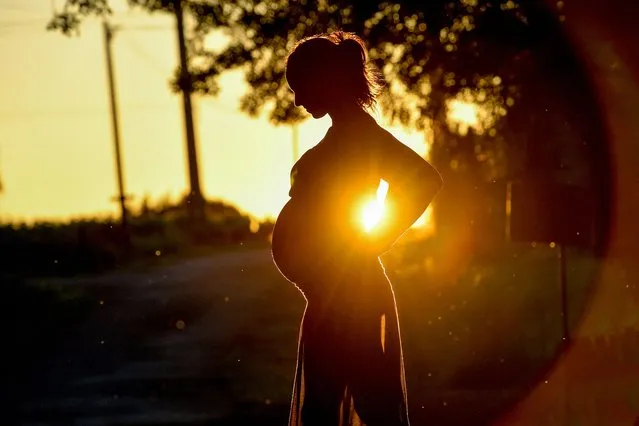
A pregnant woman poses on June 19, 2018 in Vertou, western France. France had an estimated population of 68.4 million by January 1, 2024, representing a further year-on-year increase of 0.3 percent, limited by a marked drop in the birth rate, the INSEE national statistics bureau of France reported on January 16, 2024. In 2023, 678,000 babies were born in France, 6.6 percent fewer than the previous year, the lowest number of births in any year since 1946. Over the same period, there were 631,000 deaths, down 6.5 percent on 2022, a year marked by the consequences of the Covid-19 pandemic and episodes of extreme heat. (Photo by Loic Venance/AFP Photo)

A pregnant woman poses on June 19, 2018 in Vertou, western France. France had an estimated population of 68.4 million by January 1, 2024, representing a further year-on-year increase of 0.3 percent, limited by a marked drop in the birth rate, the INSEE national statistics bureau of France reported on January 16, 2024. In 2023, 678,000 babies were born in France, 6.6 percent fewer than the previous year, the lowest number of births in any year since 1946. Over the same period, there were 631,000 deaths, down 6.5 percent on 2022, a year marked by the consequences of the Covid-19 pandemic and episodes of extreme heat. (Photo by Loic Venance/AFP Photo)
Details
27 Feb 2024 07:29:00
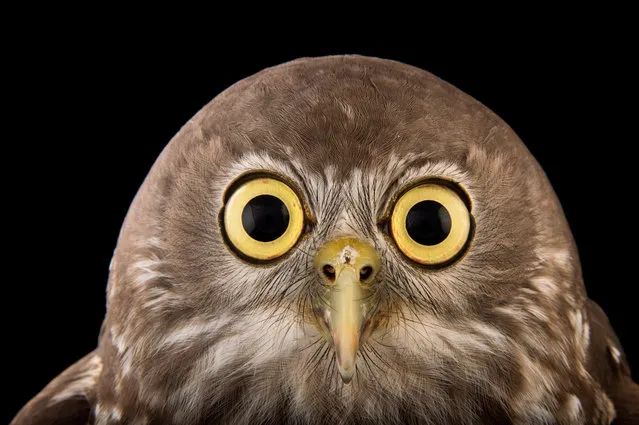
The National Geographic Photo Ark is a travelling exhibition of photographer Joel Sartore’s quest to create a photo archive of biodiversity around the world. So far, Sartore has captured studio portraits of more than 6,000 species – a number that he hopes to double. On 1 July, the ark will open at Melbourne zoo – the first time it has been exhibited in the southern hemisphere. More than 50 portraits will be on display, including many of Australian endangered animals being protected by programs at the zoo itself. These captions have been edited from text supplied by Melbourne zoo. Here: Barking owl. So-named because its call sounds like a barking dog, these birds are native to Australia, Indonesia and Papua New Guinea. In Victoria they are listed as an endangered species, and in 2003 there were estimated to be fewer than 50 breeding pairs. The main threat to the species in Victoria is loss of habitat, especially large trees with hollows in which they can nest and on which many of their prey depend. Apart from a bark, they may utter a chilling scream when they feel threatened. (Photo by Joel Sartore/National Geographic Photo Ark/The Guardian)

The National Geographic Photo Ark is a travelling exhibition of photographer Joel Sartore’s quest to create a photo archive of biodiversity around the world. So far, Sartore has captured studio portraits of more than 6,000 species – a number that he hopes to double. On 1 July, the ark will open at Melbourne zoo – the first time it has been exhibited in the southern hemisphere. More than 50 portraits will be on display, including many of Australian endangered animals being protected by programs at the zoo itself. These captions have been edited from text supplied by Melbourne zoo. Here: Barking owl. (Photo by Joel Sartore/National Geographic Photo Ark/The Guardian)
Details
01 Jul 2017 07:45:00
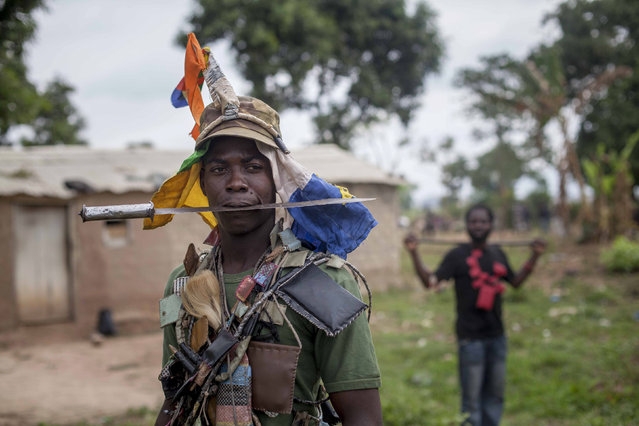
Anti-balaka fighters from the town of Bossembele patrol in the Boeing district of Bangui, Central African Republic, February 24, 2014. (Photo by Camille Lepage/Reuters)

“Camille Lepage, a 26-year-old French photojournalist who had spent months documenting deadly conflict in Central African Republic has been killed, the French presidency said Tuesday, May 13. Lepage, a freelance photographer whose work was published in major French and American newspapers, died in western Central African Republic not far from the border with Cameroon, authorities said”. – Associated Press. Photo: Anti-balaka fighters from the town of Bossembele patrol in the Boeing district of Bangui, Central African Republic, February 24, 2014. (Photo by Camille Lepage/Reuters)
Details
18 May 2014 08:54:00
A women sell food under the wing of a plane wreckage being used as housing in M'Poko Internally Displaced Persons camp in Bangui, Central African Republic on Saturday, February 13, 2016. The M'Poko IDP camp, just outside the capitol's airport, currently houses close to 20,000 people displaced due to the ongoing conflict in Central African Republic. The camp was established in late 2013 and contained upto 70,000 people at the height of the crisis in 2014. (Photo by Jane Hahn/The Washington Post)

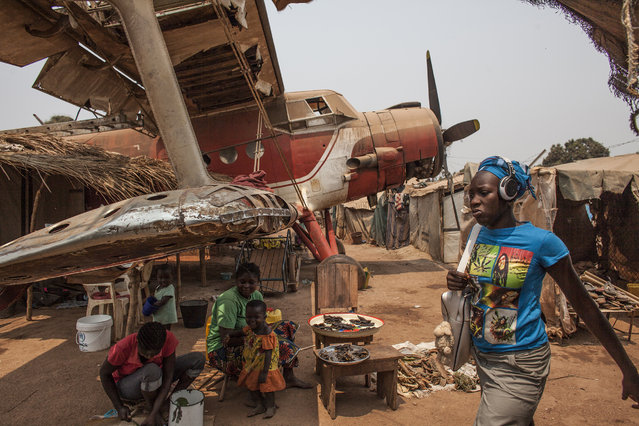
A women sell food under the wing of a plane wreckage being used as housing in M'Poko Internally Displaced Persons camp in Bangui, Central African Republic on Saturday, February 13, 2016. The M'Poko IDP camp, just outside the capitol's airport, currently houses close to 20,000 people displaced due to the ongoing conflict in Central African Republic. (Photo by Jane Hahn/The Washington Post)
Details
28 Feb 2016 11:09:00
In this September 4, 1963, file photo, a police officer carries off a demonstrator holding a Confederate flag after a group of demonstrators protested enrollment of two African-Americans at Ramsay High School in Birmingham, Ala. The Confederate battle flag has been removed from South Carolina's Statehouse grounds, in the wake of the massacre of nine African-Americans, including a state senator, at an historic black church in Charleston in June 2015. (Photo by AP Photo)

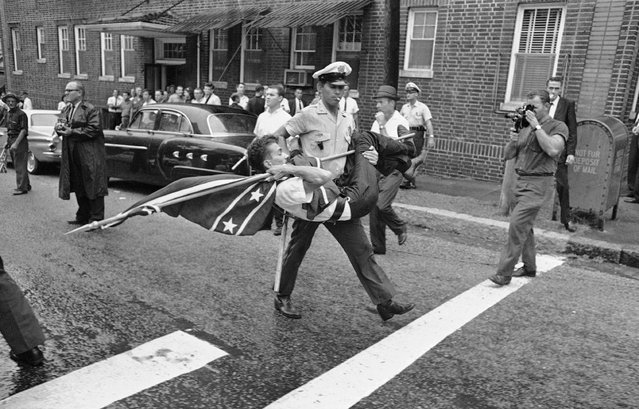
In this September 4, 1963, file photo, a police officer carries off a demonstrator holding a Confederate flag after a group of demonstrators protested enrollment of two African-Americans at Ramsay High School in Birmingham, Ala. The Confederate battle flag has been removed from South Carolina's Statehouse grounds, in the wake of the massacre of nine African-Americans, including a state senator, at an historic black church in Charleston in June 2015. (Photo by AP Photo)
Details
15 Jul 2016 12:53:00
A parishioner of the St. Joseph the Worker Parish in Nairobi's Kangemi slum carries the vestments to be worn by Pope Francis during his visit to Kenya on November 24, 2015 in Kenya. Pope Francis makes his first visit to Kenya on a five day African tour that is scheduled to include Uganda and the Central African Republic. Africa is recognised as being crucial to the future of the Catholic Church with the continent's Catholic numbers growing faster than anywhere else in the world. (Photo by Nichole Sobecki/Getty Images)

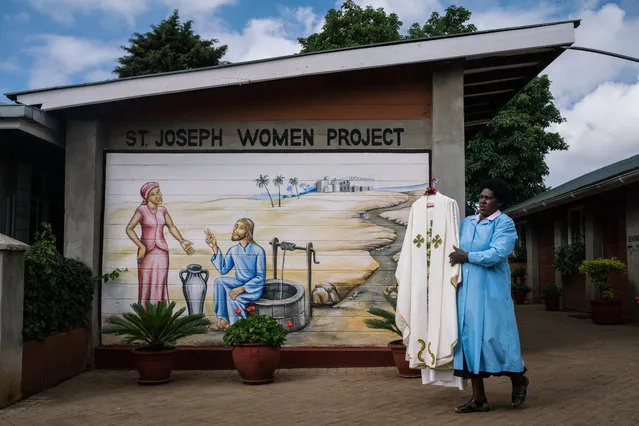
A parishioner of the St. Joseph the Worker Parish in Nairobi's Kangemi slum carries the vestments to be worn by Pope Francis during his visit to Kenya on November 24, 2015 in Kenya. Pope Francis makes his first visit to Kenya on a five day African tour that is scheduled to include Uganda and the Central African Republic. Africa is recognised as being crucial to the future of the Catholic Church with the continent's Catholic numbers growing faster than anywhere else in the world. (Photo by Nichole Sobecki/Getty Images)
Details
26 Nov 2015 08:05:00