Loading...
Done
Winner, Wildflower Landscapes category. Alto Paraíso de Goiás, Goiás, Brazil. (Photo by Marcio Cabral/The Guardian)

The International Garden Photographer of the Year is one of the world’s premier competitions specialising in botanical photography. There are 11 main categories and numerous special awards including Young Garden Photographer of the Year, and the mobile-only category Gardens on the Go. Here: Winner, Wildflower Landscapes category. Alto Paraíso de Goiás, Goiás, Brazil. (Photo by Marcio Cabral/The Guardian)
Details
17 Feb 2018 00:02:00
Komodo Judo by Andrey Gudkov. Finalist, Amphibians & Reptiles. Two large male Komodo dragons hissing angrily at each other in Indonesia’s Komodo national park. Komodo dragons can grow up to 8ft. (Photo by Andrey Gudkov/Wildlife Photographer of the Year 2015)

Komodo Judo by Andrey Gudkov. Finalist, Amphibians & Reptiles. Two large male Komodo dragons hissing angrily at each other in Indonesia’s Komodo national park. Komodo dragons can grow up to 8ft. (Photo by Andrey Gudkov/Wildlife Photographer of the Year 2015)
Details
16 Nov 2015 08:15:00
First place, The Beauty of Plants. “There are many stages of lotus growth on display at the Aquatic Gardens, but to come across twotwisted dancing stems of nelumbo nucifera was unexpected and quite magical”. (Photo by Kathleen Furey/The Guardian)

First place, The Beauty of Plants. “There are many stages of lotus growth on display at the Aquatic Gardens, but to come across twotwisted dancing stems of nelumbo nucifera was unexpected and quite magical”. (Photo by Kathleen Furey/The Guardian)
Details
13 Mar 2019 00:03:00
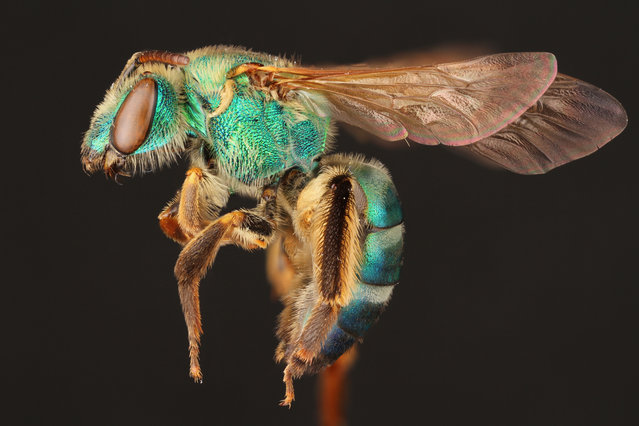
These macro images by Alejandro Santillana are being showcased in the Insects Unlocked project at the University of Texas at Austin. Here: A female sweat bee. (Photo by Alejandro Santillana/Insects Unlocked/Cover Images)

These macro images by Alejandro Santillana are being showcased in the Insects Unlocked project at the University of Texas at Austin. Here: A female sweat bee. (Photo by Alejandro Santillana/Insects Unlocked/Cover Images)
Details
21 Jul 2017 07:55:00
Scared of Heights. “Taken from the highest residential building in Asia: the Zenith in Busan. This was taken with official permission (which took me months to get) and safety measures were taken. I had to hang myself over the edge to get this shot. Not for the faint of heart! But when you’re at a height like this, the world below you just seems different. It takes away the fear one would normally have, and gives a sense of peace instead”. (Photo by Albert Dros/NatGeo Cities Travel Photographer of the Year 2017)

Scared of Heights. “Taken from the highest residential building in Asia: the Zenith in Busan. This was taken with official permission (which took me months to get) and safety measures were taken. I had to hang myself over the edge to get this shot. Not for the faint of heart! But when you’re at a height like this, the world below you just seems different. It takes away the fear one would normally have, and gives a sense of peace instead”. (Photo by Albert Dros/NatGeo Cities Travel Photographer of the Year 2017)
Details
03 Jul 2017 08:55:00
“Mr Big Dipper”, Nicholas Roemmelt (Denmark). A stargazer observes the constellation of the Big Dipper perfectly aligned with the window of the entrance to a large glacier cave in Engadin, Switzerland. This is a panorama of two pictures, and each is a stack of another two pictures: one for the stars and another one for the foreground, but with no composing or time blending. (Photo by Nicholas Roemmelt/National Maritime Museum/The Guardian)

“Mr Big Dipper”, Nicholas Roemmelt (Denmark). A stargazer observes the constellation of the Big Dipper perfectly aligned with the window of the entrance to a large glacier cave in Engadin, Switzerland. This is a panorama of two pictures, and each is a stack of another two pictures: one for the stars and another one for the foreground, but with no composing or time blending. (Photo by Nicholas Roemmelt/National Maritime Museum/The Guardian)
Details
27 Jul 2017 06:50:00
Sharafkhaneh port and lake Urmia. Masoud Ghadiri (Iran). The summer Milky Way is very prominent in this photo. On the galaxy zone, Saturn is located besides the Lagoon nebula. On the right of the horizon, you can see the extreme light pollution of Urmia, which is caused by ever-increasing city development. (Photo by Masoud Ghadiri/National Maritime Museum)

Sharafkhaneh port and lake Urmia. Masoud Ghadiri (Iran). The summer Milky Way is very prominent in this photo. On the galaxy zone, Saturn is located besides the Lagoon nebula. On the right of the horizon, you can see the extreme light pollution of Urmia, which is caused by ever-increasing city development. (Photo by Masoud Ghadiri/National Maritime Museum)
Details
20 Jun 2019 00:01:00
Soap Bubble Structures by Kym Cox. Bubbles optimise space and minimise their surface area for a given volume of air. This phenomenon makes them a useful tool in many areas of research, in particular, materials science and ‘packing’ – how things fit together. Bubble walls drain under gravity, thin at the top, thick at the bottom, which interferes with travelling lightwaves to create bands of colour. Black spots show the wall is too thin for interference colours, indicating the bubble is about to burst. (Photo by Kym Cox/2019 Science Photographer of the Year/RPS)

Soap Bubble Structures by Kym Cox. Bubbles optimise space and minimise their surface area for a given volume of air. This phenomenon makes them a useful tool in many areas of research, in particular, materials science and “packing” – how things fit together. Bubble walls drain under gravity, thin at the top, thick at the bottom, which interferes with travelling lightwaves to create bands of colour. Black spots show the wall is too thin for interference colours, indicating the bubble is about to burst. (Photo by Kym Cox/2019 Science Photographer of the Year/RPS)
Details
15 Aug 2019 00:03:00