Loading...
Done
Afghanistan: Dogs of War Part 1

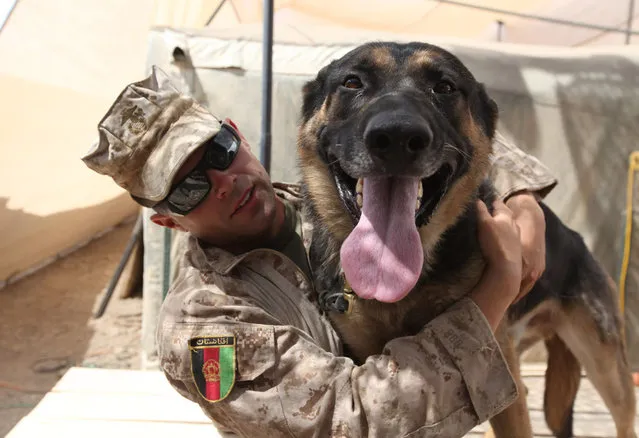
Throughout the course of the long war in Afghanistan, Coalition troops have relied on thousands of military working dogs to help keep them safe, and make their jobs easier. The dogs are trained to detect explosives, to find illegal drugs, to search for missing comrades, or target enemy combatants. Not only are they active on the front lines, but behind the lines they serve as therapy dogs, service dogs, and loyal companions. They also share the same risks as the ground troops, suffering injuries and sometimes death on the battlefields. Gathered here are images of these dogs and their handlers in Afghanistan and back home, from over the past several years, part of the ongoing series here on Afghanistan.
Details
03 Jun 2014 21:02:00
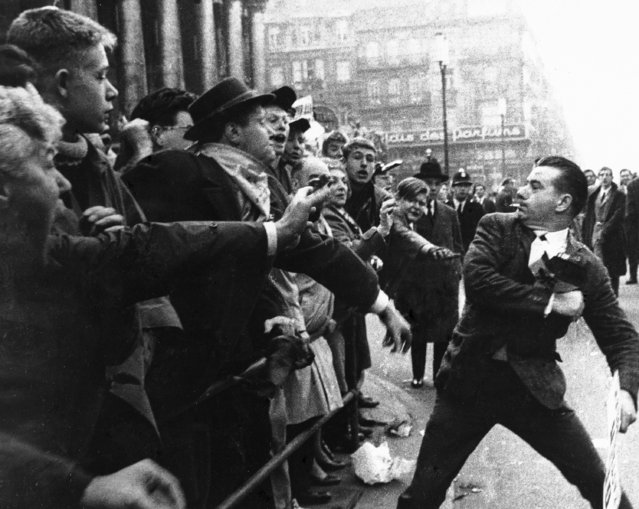
A Flemish demonstrator, one of thousands who gathered for a march through Brussels to protest against what the Flemings call their subjucation by the French-speaking Walloons, draws back as he is jeered by a crowd of Walloons on the pavement in a Brussels Street, on October 14, 1962. The Flemish demonstrators clashed with Walloon counter demonstrators as riot police sought to maintain order. (Photo by AP Photo)

A Flemish demonstrator, one of thousands who gathered for a march through Brussels to protest against what the Flemings call their subjucation by the French-speaking Walloons, draws back as he is jeered by a crowd of Walloons on the pavement in a Brussels Street, on October 14, 1962. The Flemish demonstrators clashed with Walloon counter demonstrators as riot police sought to maintain order. The Flemings claim that although they form 60% of the population in Belgium, they are inadequately represented in the government, and they say, the Walloons get most of the top jobs in the armed forces and the diplomatic service. (Photo by AP Photo)
Details
16 Oct 2015 08:05:00
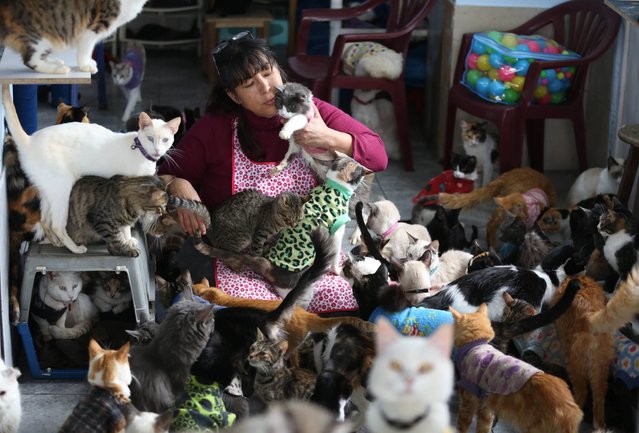
In this August 2, 2014 photo, Maria Torero, plays with a group of 175 cats with leukemia in her home in Lima, Peru. Torero says caring for cats with feline leukemia is her responsibility. Anybody else can care for healthy animals. (Photo by Martin Mejia/AP Photo)

“At her job, Maria Torero cares for sick human beings. At home, she lavishes love on slowly dying cats – 175 of them at last count. The 45-year-old nurse has turned her two-story, eight-room apartment into a hospice for cats with feline leukemia, scattering it with scores of feeding dishes and at least two dozen boxes litter boxes. Some have suggested she shelter healthy cats instead. “That's not my role”, she told The Associated Press. “I'm a nurse. My duty is to the cats that nobody cares about”. She said that “people don't adopt adult cats, especially if they are terminally ill”. – Franklin Briceno via Associated Press. (Photo by Martin Mejia/AP Photo)
Details
24 Aug 2014 09:28:00
State Plates Project By Jonathan Lawrence

You have to agree, that most of the designs of the license plates in the United States are pretty boring and bland. In most cases, a three-year-old could have done a better job. This is the reason why Jonathan Lawrence has decided to create a project of redesigning the license plates of all 50 states. His designs feature fresh vibrant colors, as well as clean and readable design. These are the license plates you’d want to use if you have anything that is better than a rundown, old pickup truck (no offence to owners of rundown, old pickup trucks). Some of his designs are humorous, some are strict and official; however, all of them look better than the license plates that are in circulation today. (Photo by Jonathan Lawrence)
Details
24 Nov 2014 13:45:00
Yang Juan, an employee at Goopal Group, takes a nap in her seat after lunch, in Beijing, China, April 21, 2016. (Photo by Jason Lee/Reuters)

Yang Juan, an employee at Goopal Group, takes a nap in her seat after lunch, in Beijing, China, April 21, 2016. Office workers sleeping on the job is a common sight in China, where a surplus of cheap labour can lead to downtime at work. But in China's technology sector, where business is growing faster than many start-up firms can hire new staff, workers burn the midnight oil to meet deadlines and compete with their rivals. Some companies provide sleeping areas and beds for workers to rest during late nights. (Photo by Jason Lee/Reuters)
Details
12 May 2016 14:53:00
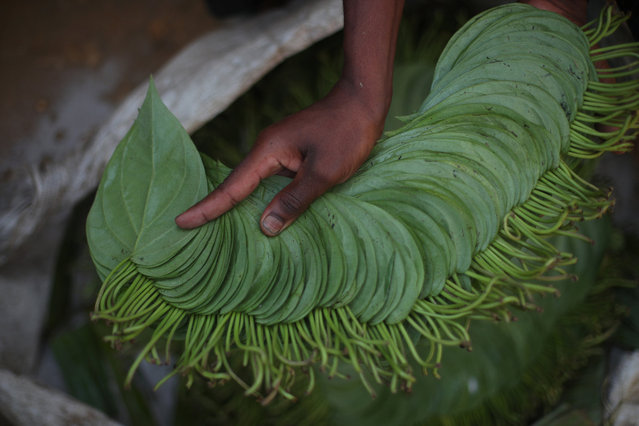
Faruk, 17, a Rohingya refugee trader holds betel leaves which are on sale at a stall in Palong Khali refugee camp near Cox's Bazar, Bangladesh, November 3, 2017. He left his village in Myanmar when the military opened fire towards the Rohingya. “I buy this betel leaf from Palong Khali market, in one bundle there are 160 pieces, I buy it for 80 taka and I sell it for 100 taka. Bangladeshi's and I sell for the same rate in the camp. Outside in the local market it is 80 taka per bundle. My problem is that I don't have money so I can't buy anything to eat, I can't buy fish to eat”, he said. (Photo by Hannah McKay/Reuters)

Faruk, 17, a Rohingya refugee trader holds betel leaves which are on sale at a stall in Palong Khali refugee camp near Cox's Bazar, Bangladesh, November 3, 2017. He left his village in Myanmar when the military opened fire towards the Rohingya. “I buy this betel leaf from Palong Khali market, in one bundle there are 160 pieces, I buy it for 80 taka and I sell it for 100 taka (1 Bangladeshi Taka = 0.012 US Dollar). Bangladeshi's and I sell for the same rate in the camp. Outside in the local market it is 80 taka per bundle. My problem is that I don't have money so I can't buy anything to eat, I can't buy fish to eat”, he said. (Photo by Hannah McKay/Reuters)
Details
27 Nov 2017 08:54:00
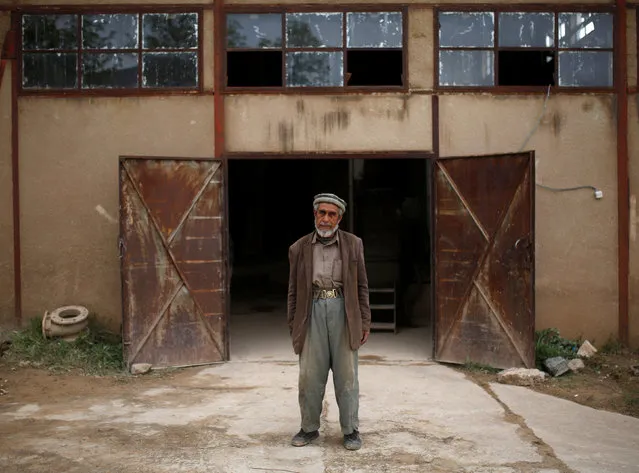
A worker at the Jabal Saraj cement factory poses for a photograph in Jabal Saraj, north of Kabul, Afghanistan April 19, 2016. (Photo by Ahmad Masood/Reuters)

A worker at the Jabal Saraj cement factory poses for a photograph in Jabal Saraj, north of Kabul, Afghanistan April 19, 2016. In an area desperately short of industry and jobs, local workers hope that the relaunch of the plant in Jabal Saraj, built by Czech engineers in 1957 and closed down by the Taliban in 1995, can show that Afghanistan's shattered industry can climb back to its feet after decades of war and destruction. But the outdated state-owned plant some 75 kilometres outside Kabul also shows how far it has to go before that promise can be achieved and there are serious questions over whether it has a viable future unless a new, modern facility is built to replace it. (Photo by Ahmad Masood/Reuters)
Details
31 May 2016 11:29:00
Apple Unveils Updated iPad 3 (iPad HD) In San Francisco

Apple Senior VP of Worldwide Marketing Phil Schiller talks about the display on the new iPad during an Apple product launch event at Yerba Buena Center for the Arts on March 7, 2012 in San Francisco, California. In the first product release following the death of Steve Jobs, Apple Inc. introduced the third version of the iPad (iOS 5.1; Processor is an Apple A5X ARM-based unit; Display 2048 x 1536 pixels; Camera is set at 5 megapixels and has a 5-element lens plus auto face-detection, auto focus lock and image stabilisation for video; Wi-Fi + 4G) and an updated Apple TV. (Photo by Kevork Djansezian/Getty Images)
Details
08 Mar 2012 11:53:00