Loading...
Done
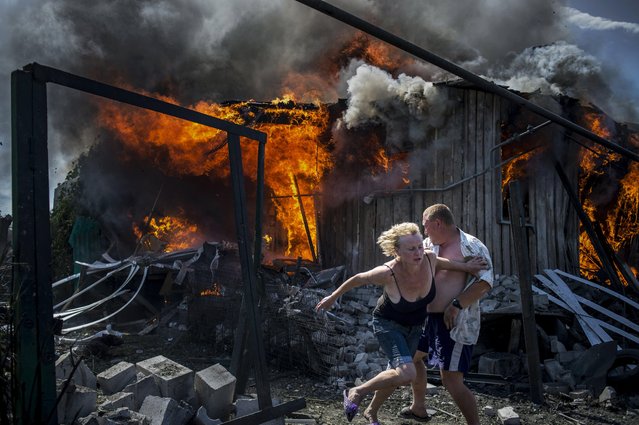
A handout photo made available by the World Press Photo (WPP) organization on 13 February 2017 shows a picture by Rossiya Segodnya photographer Valery Melnikov that won the Long-Term Projects – First Prize award of the 60th annual World Press Photo Contest, it was announced by the WPP Foundation in Amsterdam, The Netherlands on 13 February 2017. Caption: Civilians escape from a fire at a house destroyed by an air attack in the Luhanskaya village. Story: Ordinary people became victims of the conflict between self-proclaimed republics and the official Ukrainian authorities from 2014 onwards in the region of Donbass. Disaster came into their lives unexpectedly. These people were involved in the military confrontation against their will. They experienced the most terrible things: the death of their friends and relatives, destroyed homes and the ruined lives of thousands of people. (Photo by Valery Melnikov/EPA/Rossiya Segodnya/World Press Photo)

A handout photo made available by the World Press Photo (WPP) organization on 13 February 2017 shows a picture by Rossiya Segodnya photographer Valery Melnikov that won the Long-Term Projects – First Prize award of the 60th annual World Press Photo Contest, it was announced by the WPP Foundation in Amsterdam, The Netherlands on 13 February 2017. Caption: Civilians escape from a fire at a house destroyed by an air attack in the Luhanskaya village. (Photo by Valery Melnikov/EPA/Rossiya Segodnya/World Press Photo)
Details
15 Feb 2017 00:06:00
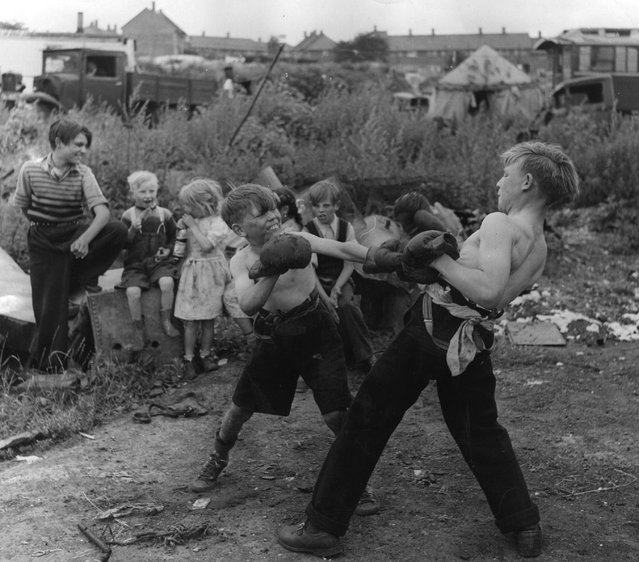
The unromantic gypsies. Children boxing in a gypsy camp in Kent, England on July 1, 1951. Like all boys these gypsy lads like to try their hand at boxing. Encouraged by their friends they fight it out on Corke's Meadow. Few Romanies now live a life of wandering romance. Most are like the three hundred squatters of Corke's Meadow, Kent, which is part of a “gypsy problem” that involves about 100,000 today. Of those about 25,000 can be rightly called gypsies, the rest are Mumpers and Posh-rats and Hobos. Corke's Meadow has both kinds. “Picture Post” cameraman Bert Hardy photographs the Corke's Meadow gypsies in their encampment. (Photo by Hulton-Deutsch Collection/Corbis via Getty Images)

The unromantic gypsies. Children boxing in a gypsy camp in Kent, England on July 1, 1951. Like all boys these gypsy lads like to try their hand at boxing. Encouraged by their friends they fight it out on Corke's Meadow. Few Romanies now live a life of wandering romance. Most are like the three hundred squatters of Corke's Meadow, Kent, which is part of a “gypsy problem” that involves about 100,000 today. Of those about 25,000 can be rightly called gypsies, the rest are Mumpers and Posh-rats and Hobos. Corke's Meadow has both kinds. “Picture Post” cameraman Bert Hardy photographs the Corke's Meadow gypsies in their encampment. (Photo by Hulton-Deutsch Collection/Corbis via Getty Images)
Details
12 Mar 2017 00:01:00
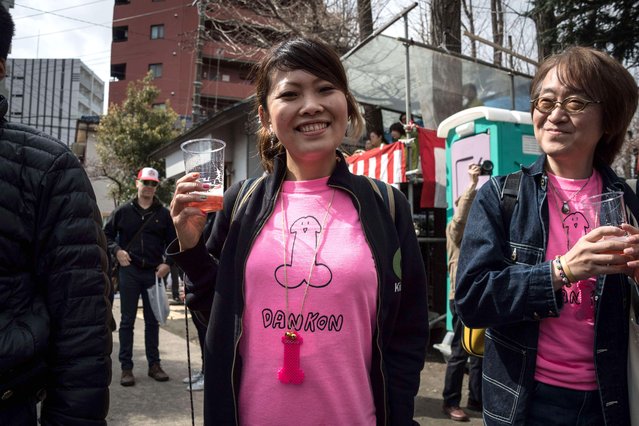
Festival goer with phallus logo t-shirt during the Kanamara Matsuri Steel Phallus Festival at Kawasaki, Japan on April 2, 2017. The Kanamara Matsuri or Festival of the Steel Phallus is held on the first Sunday of April at the Kanayama shrine. The shrine celebrates a legend of a steel pen*s and was frequented by prostitutes who wished to pray for protection from sexually transmitted diseases. Visitors now wish for easy delivery, marriage and matrimonial harmony. Because of the large steel phallus the unusual festival has become a tourist attraction attracting many overseas visitors and is used to raise money for HIV charities. Phallus shaped candy, carved vegetables, decorations, and a big parade are all part of the festival. (Photo by DELETREE/SIPA Press/Rex Features/Shutterstock)

Festival goer with phallus logo t-shirt during the Kanamara Matsuri Steel Phallus Festival at Kawasaki, Japan on April 2, 2017. The Kanamara Matsuri or Festival of the Steel Phallus is held on the first Sunday of April at the Kanayama shrine. The shrine celebrates a legend of a steel pen*s and was frequented by prostitutes who wished to pray for protection from sexually transmitted diseases. Visitors now wish for easy delivery, marriage and matrimonial harmony. Because of the large steel phallus the unusual festival has become a tourist attraction attracting many overseas visitors and is used to raise money for HIV charities. Phallus shaped candy, carved vegetables, decorations, and a big parade are all part of the festival. (Photo by DELETREE/SIPA Press/Rex Features/Shutterstock)
Details
04 Apr 2017 09:48:00
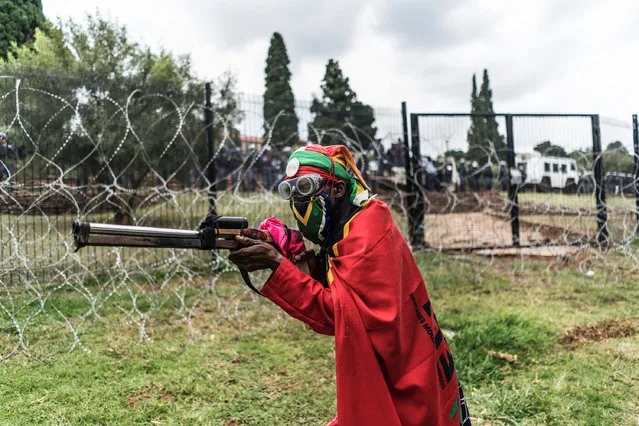
An Economic Freedom Fighters supporter shows a mock weapons during a demonstration in Pretoria on April 12, 2017 calling for South African President Jacob Zuma to resign. Tens of thousand demonstrators took part in the march to Union Buildings, the official seat of government, which was organised on Zuma's 75th birthday and came after nationwide rallies against the president last week. Zuma's recent sacking of respected finance minister Pravin Gordhan has fanned years of public anger over government corruption scandals, record unemployment and slowing economic growth. (Photo by Marco Longari/AFP Photo)

An Economic Freedom Fighters supporter shows a mock weapons during a demonstration in Pretoria on April 12, 2017 calling for South African President Jacob Zuma to resign. Tens of thousand demonstrators took part in the march to Union Buildings, the official seat of government, which was organised on Zuma's 75th birthday and came after nationwide rallies against the president last week. Zuma's recent sacking of respected finance minister Pravin Gordhan has fanned years of public anger over government corruption scandals, record unemployment and slowing economic growth. (Photo by Marco Longari/AFP Photo)
Details
13 Apr 2017 09:53:00
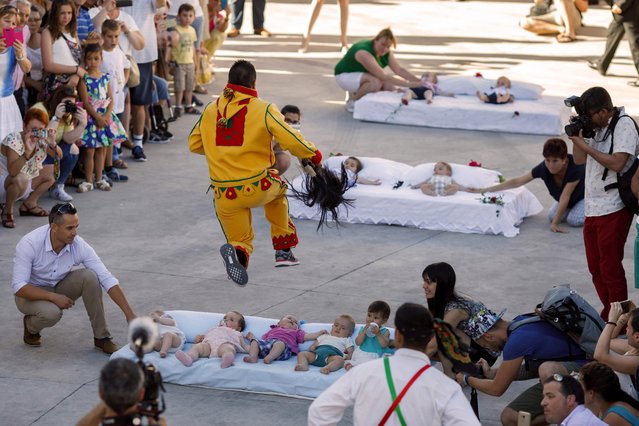
A man dressed up as the devil jumps over babies lying on a mattress in the street during “El Colacho”, the “baby jumping festival” in the village of Castrillo de Murcia, near Burgos on June 18, 2017. Baby jumping (El Colacho) is a traditional Spanish practice dating back to 1620 that takes place annually to celebrate the Catholic feast of Corpus Christi. During the act – known as El Salto del Colacho (the devil's jump) or simply El Colacho – men dressed as the Devil jump over babies born in the last twelve months of the year who lie on mattresses in the street. (Photo by Cesar Manso/AFP Photo)

A man dressed up as the devil jumps over babies lying on a mattress in the street during “El Colacho”, the “baby jumping festival” in the village of Castrillo de Murcia, near Burgos on June 18, 2017. Baby jumping (El Colacho) is a traditional Spanish practice dating back to 1620 that takes place annually to celebrate the Catholic feast of Corpus Christi. During the act – known as El Salto del Colacho (the devil's jump) or simply El Colacho – men dressed as the Devil jump over babies born in the last twelve months of the year who lie on mattresses in the street. (Photo by Cesar Manso/AFP Photo)
Details
20 Jun 2017 07:29:00
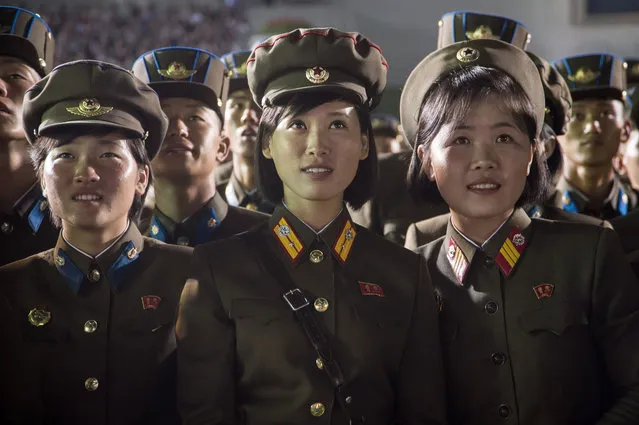
In a photo taken on July 6, 2017 soldiers of the Korean People' s Army (KPA) watch a fireworks display as part of celebrations marking the July 4 launch of the Hwasong-14 intercontinental ballistic missile, in Pyongyang Fireworks lit up the sky over Pyongyang' s Juche Tower as North Korea celebrated its launch of intercontinental ballistic missile, a milestone in its decades- long weapons drive. On July 4 – the United States' Independence Day – it launched a Hwasong-14 rocket that analysts and overseas officials said had a range of up to 8,000 kilometres, which would put Alaska and Hawaii within reach. (Photo by Kim Won-Jin/AFP Photo)

In a photo taken on July 6, 2017 soldiers of the Korean People' s Army (KPA) watch a fireworks display as part of celebrations marking the July 4 launch of the Hwasong-14 intercontinental ballistic missile, in Pyongyang Fireworks lit up the sky over Pyongyang' s Juche Tower as North Korea celebrated its launch of intercontinental ballistic missile, a milestone in its decades- long weapons drive. On July 4 – the United States' Independence Day – it launched a Hwasong-14 rocket that analysts and overseas officials said had a range of up to 8,000 kilometres, which would put Alaska and Hawaii within reach. (Photo by Kim Won-Jin/AFP Photo)
Details
14 Jul 2017 07:17:00
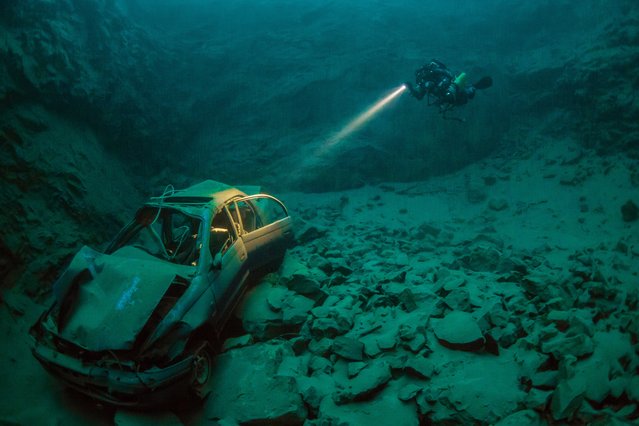
Wide-angle category winner. Part of the Illusion by Marcus Blatchford (UK). Location: National Dive & Activity Centre, Chepstow, Wales. “This is the deepest inland dive centre in the UK. The dive plan was to explore the deep end, but this time I dived ‘unplugged’ (without my strobes). With the exception of this change to my camera technique, there were no planned shots I wanted to achieve – just a fun dive with ad-hoc photos along the way. Shortly after this photo was captured, in 6C water and two hours of decompression ahead of us, we turned and started the long ascent back to the surface”. (Photo by Marcus Blatchford/Underwater Photographer of the Year 2016)

Wide-angle category winner. Part of the Illusion by Marcus Blatchford (UK). Location: National Dive & Activity Centre, Chepstow, Wales. “This is the deepest inland dive centre in the UK. The dive plan was to explore the deep end, but this time I dived ‘unplugged’ (without my strobes). With the exception of this change to my camera technique, there were no planned shots I wanted to achieve – just a fun dive with ad-hoc photos along the way. Shortly after this photo was captured, in 6C water and two hours of decompression ahead of us, we turned and started the long ascent back to the surface”. (Photo by Marcus Blatchford/Underwater Photographer of the Year 2016)
Details
18 Feb 2016 13:44:00
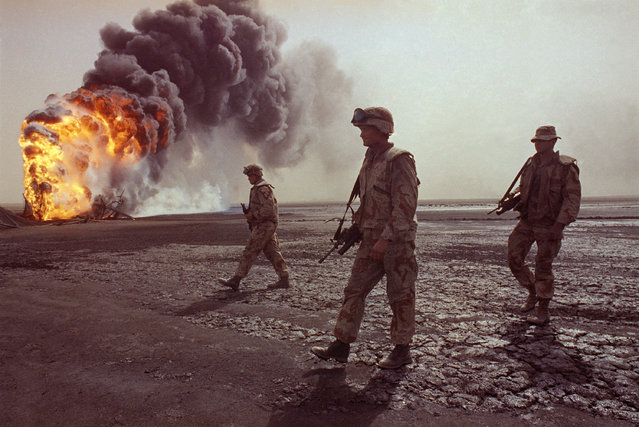
In this March 7, 1991 file photo, a U.S. Marine patrol walks across the charred oil landscape near a burning well during perimeter security patrol near Kuwait City. Twenty five years after the first U.S. Marines swept across the border into Kuwait in the 1991 Gulf War, American forces find themselves battling the extremist Islamic State group, born out of al-Qaida, in the splintered territories of Iraq and Syria. The Arab allies that joined the 1991 coalition are fighting their own conflicts both at home and abroad, as Iran vies for greater regional power following a nuclear deal with world powers. (Photo by John Gaps III/AP Photo)

In this March 7, 1991 file photo, a U.S. Marine patrol walks across the charred oil landscape near a burning well during perimeter security patrol near Kuwait City. Twenty five years after the first U.S. Marines swept across the border into Kuwait in the 1991 Gulf War, American forces find themselves battling the extremist Islamic State group, born out of al-Qaida, in the splintered territories of Iraq and Syria. The Arab allies that joined the 1991 coalition are fighting their own conflicts both at home and abroad, as Iran vies for greater regional power following a nuclear deal with world powers. (Photo by John Gaps III/AP Photo)
Details
23 Feb 2016 11:43:00