Loading...
Done
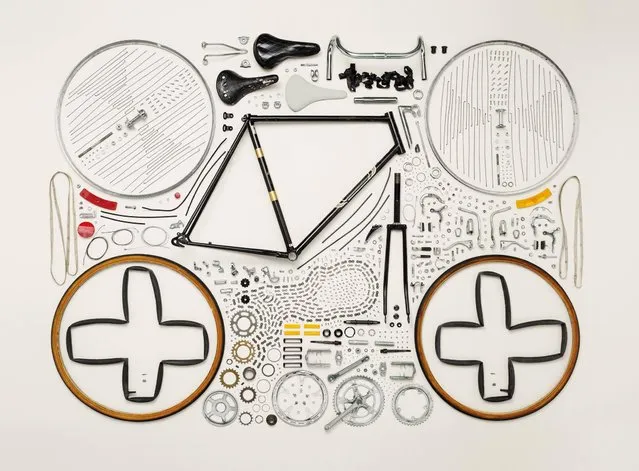
Deconstructed Objects By Todd McLellan

It is simply staggering how complicated some items really are. We never think about it, but some items that we use every day consist of hundreds of parts meticulously put together and working perfectly. Todd McLellan is a photographer who based his newest book “Things Come Apart” on the complexity of various old and new tech. By carefully taking apart various items and arranging all of the parts in perfect order, Todd has allowed us not only to look inside various appliances, but also to appreciate the astounding complexity of these items. Just like the human mind, we are so used to seeing and talking with people that we forget just how complicated their minds really are. It would be great if we could “take apart” the human mind in order to gain some insight into the person’s thoughts and desires. However, very few people are capable of doing it, while the rest will remain blind to the obvious. (Photo by Todd McLellan)
Details
15 Nov 2014 12:30:00
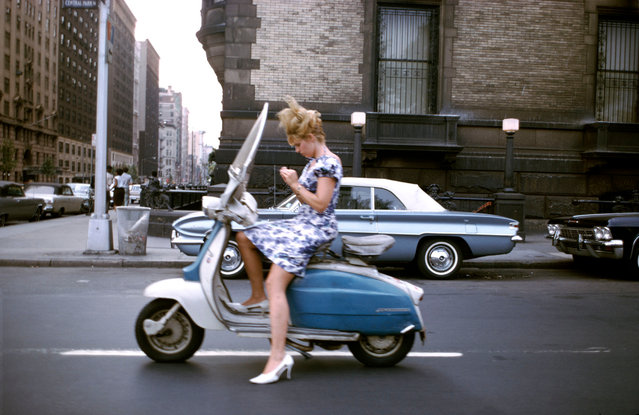
New York City, 1965, by Joel Meyerowitz. “A girl on a Vespa on her way to who knows where, when the light stopped her at the 72nd street crossing near the Dakota, where John Lennon would one day cross paths with his fate. She takes this moment to finesse a fingernail before she resumes her downtown journey, while I, stopping at the same crossing, but on foot, leap into the street to capture this vision of a dream girl before time takes her on her way”. (Photo by Joel Meyerowitz/Courtesy Aperture)

The November 2018 Square Print Sale, presented by Magnum Photos and Aperture, brings together over 100 images to explore perspectives on transition and transformation in photography. Here: New York City, 1965, by Joel Meyerowitz. “A girl on a Vespa on her way to who knows where, when the light stopped her at the 72nd street crossing near the Dakota, where John Lennon would one day cross paths with his fate. She takes this moment to finesse a fingernail before she resumes her downtown journey, while I, stopping at the same crossing, but on foot, leap into the street to capture this vision of a dream girl before time takes her on her way”. (Photo by Joel Meyerowitz/Courtesy Aperture)
Details
31 Oct 2018 00:05:00
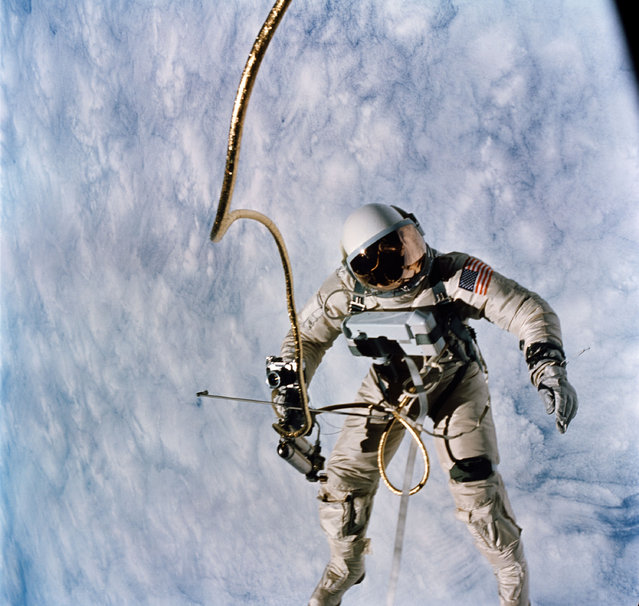
Astronaut Edward H. White II, pilot for the Gemini-Titan 4 (GT-4) spaceflight, floats in the zero-gravity of space during the third revolution of the GT-4 spacecraft on June 3, 1965. White wears a specially designed spacesuit. His face is shaded by a gold-plated visor to protect him from unfiltered rays of the sun. (Photo by NASA)

Astronaut Edward H. White II, pilot for the Gemini-Titan 4 (GT-4) spaceflight, floats in the zero-gravity of space during the third revolution of the GT-4 spacecraft on June 3, 1965. White wears a specially designed spacesuit. His face is shaded by a gold-plated visor to protect him from unfiltered rays of the sun. In his right hand he carries a Hand-Held Self-Maneuvering Unit (HHSMU) that gives him control over his movements in space. White also wears an emergency oxygen chest pack; and he carries a camera mounted on the HHSMU for taking pictures of the sky, Earth and the GT-4 spacecraft. He is secured to the spacecraft by a 25-feet umbilical line and a 23-feet tether line. Both lines are wrapped together in gold tape to form one cord. Astronaut James A. McDivitt, command pilot, remained inside the spacecraft during the extravehicular activity (EVA). Astronaut White died in the Apollo/Saturn 204 fire at Cape Kennedy on January 27, 1967. (Photo by NASA)
Details
22 Jul 2014 12:05:00
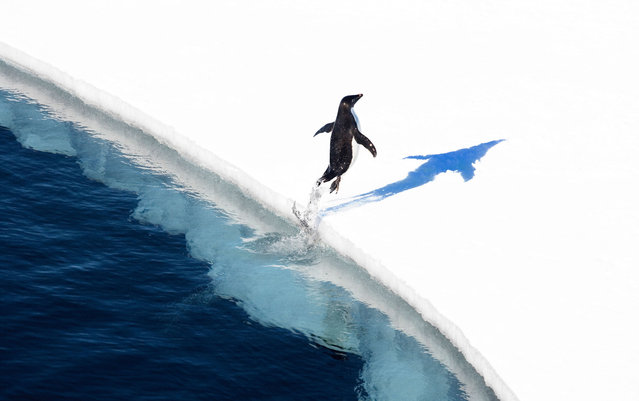
This undated handout photo received from the Antarctic Ocean Alliance on October 28, 2016 shows a adelie penguin jumping onto the ice in the Ross Sea in Antarctica. The world's largest marine reserve aimed at protecting the pristine wilderness of Antarctica will be created after a “momentous” agreement was finally reached on October 28, 2016 with Russia dropping its long-held opposition. A remote and largely pristine stretch of ocean off Antarctica received international protection on Friday, becoming the world's largest marine reserve as a broad coalition of countries came together to protect 598,000 square miles of water. The new marine protected area in the Ross Sea was created by a unanimous decision of the international body that oversees the waters around Antarctica – the Commission for the Conservation of Antarctic Marine Living Resources – and was announced at the commission's annual meeting in Tasmania. The commission comprises 24 countries, including the United States, and the European Union. (Photo by John Weller/AFP Photo/Antarctic Ocean Alliance)

This undated handout photo received from the Antarctic Ocean Alliance on October 28, 2016 shows a adelie penguin jumping onto the ice in the Ross Sea in Antarctica. The world's largest marine reserve aimed at protecting the pristine wilderness of Antarctica will be created after a “momentous” agreement was finally reached on October 28, 2016 with Russia dropping its long-held opposition. (Photo by John Weller/AFP Photo/Antarctic Ocean Alliance)
Details
29 Oct 2016 11:43:00
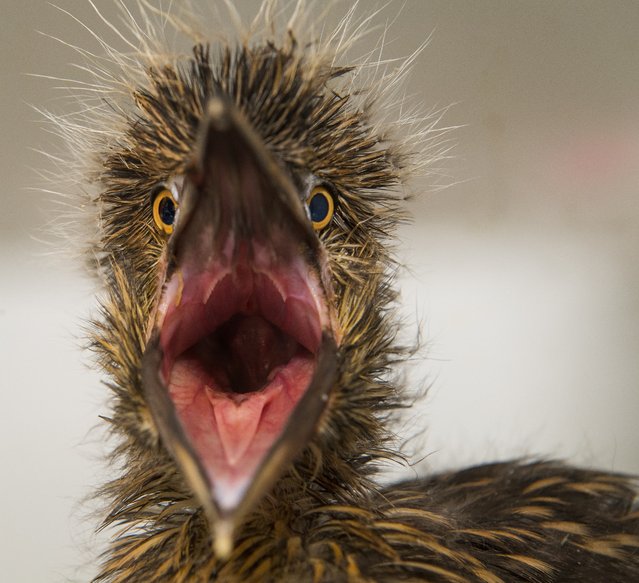
A baby Black-crowned Night Heron squawks in its incubator while being cared for at City Wildlife rescue and rehabilitation center in Washington, DC on May 31, 2017. The heron is one of several that have been brought to CW by the staff at The National Zoo over the past few years. The heron is a native bird and has made an established rookery inside the zoo grounds over a hundred years ago.  Every year at this time, some of the chicks get pushed or fall out of the nest and require human care.  Because the birds are native and not part of the Smithsonian collection, they partnered with CW to rehabilitate the herons for re-release back to the flock inside Zoo. They're reintroduced back to their flock so that they can migrate together in the Fall. The Black-crowned heron usually migrates from the DC area down to southeast North Carolina, some going as far as Jacksonville, FL in winter. The Black-crowned heron is the species of greatest conservation need in the District of Columbia because their numbers are in such rapid decline due to habitat loss. (Photo Linda Davidson/The Washington Post)

A baby Black-crowned Night Heron squawks in its incubator while being cared for at City Wildlife rescue and rehabilitation center in Washington, DC on May 31, 2017. The heron is one of several that have been brought to CW by the staff at The National Zoo over the past few years. (Photo Linda Davidson/The Washington Post)
Details
04 Jun 2017 08:04:00
Two women wearing nun outfits drink beer while watching the 2014 Tim Hortons Brier curling championships in Kamloops, British Columbia in this March 8, 2014 file photo. (Photo and caption by Ben Nelms/Reuters)

Two women wearing nun outfits drink beer while watching the 2014 Tim Hortons Brier curling championships in Kamloops, British Columbia in this March 8, 2014 file photo. Although some people might conclude that a curling event could produce a dull atmosphere, it is actually far from it. Some of the most energetic and loyal fans are committed to showing their colours at tournaments around the world. There was a lull in the games that were being held on this day and I remember spotting these nuns sitting in their seats earlier. Although them just sitting there didn't produce a picture, I kept my eye on them for the entire match. As soon as I spotted them with beer in their hands, I slowly turned my camera towards them and waited for them to take a drink. One of the challenges of shooting this image was to not have everyone notice me taking the photo. I had a longer lens on and was right in the middle of the rink. I slowly turned my lens, not to make my intentions too obvious, and waited until they drank from their beers together. (Photo and caption by Ben Nelms/Reuters)
Details
27 Nov 2014 14:39:00
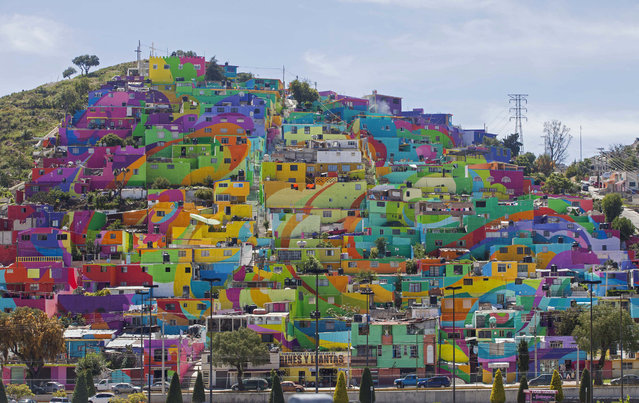
Hundreds of houses painted in bright colors in what organizers claim is Mexico's largest mural, is part of a government-sponsored project is called Pachuca Paints Itself, in the Palmitas neighborhood, in Pachuca, Mexico, Thursday, July 30, 2015. German Crew is the artist collective responsible for painting the mural project. Director Enrique Gomez, who goes by MYBE, said the crew has painted 1,500 square meters with 20,000 liters of paint. (Photo by Sofia Jaramillo/AP Photo)

Hundreds of houses painted in bright colors in what organizers claim is Mexico's largest mural, is part of a government-sponsored project is called Pachuca Paints Itself, in the Palmitas neighborhood, in Pachuca, Mexico, Thursday, July 30, 2015. German Crew is the artist collective responsible for painting the mural project. Director Enrique Gomez, who goes by MYBE, said the crew has painted 1,500 square meters with 20,000 liters of paint. Working hand-in-hand with residents, muralists have painted the facades of 200 homes bright lavender, lime green, incandescent orange – hues more commonly found in a bag of Skittles than in the drab, cement-and-cinderblock neighborhoods where many of Mexico's poor live. The project aims to bring the community together and rehabilitate the area. (Photo by Sofia Jaramillo/AP Photo)
Details
03 Aug 2015 12:02:00
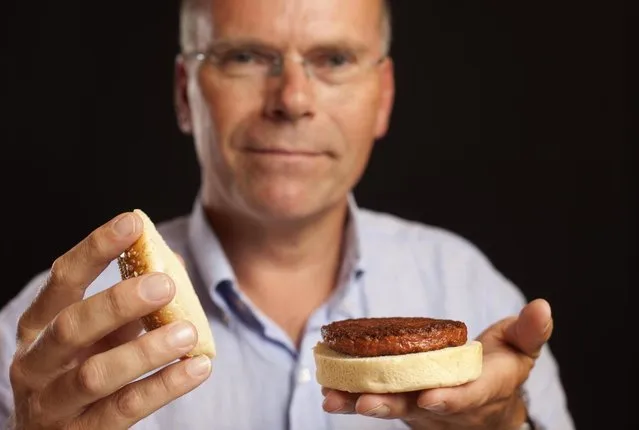
In this handout image provided by Ogilvy, a burger made from cultured beef, which has been developed by Professor Mark Post of Maastricht University in the Netherlands (pictured) is shown to the media during a press conference on August 5, 2013 in London, England. Cultured Beef could help solve the coming food crisis and combat climate change with commercial production of Cultured Beef beginning within ten to twenty years. (Photo by David Parry via Getty Images)

In this handout image provided by Ogilvy, a burger made from cultured beef, which has been developed by Professor Mark Post of Maastricht University in the Netherlands (pictured) is shown to the media during a press conference on August 5, 2013 in London, England. The in-vitro burger, cultured from cattle stem cells, the first example of what its creator says could provide an answer to global food shortages and help combat climate change, was fried in a pan and tasted by two volunteers. The burger is the result of years of research by Dutch scientist Mark Post, a vascular biologist at the University of Maastricht, who is working to show how meat grown in petri dishes might one day be a true alternative to meat from livestock.The meat in the burger has been made by knitting together around 20,000 strands of protein that has been cultured from cattle stem cells in Post's lab. (Photo by David Parry)
Details
06 Aug 2013 08:48:00