Loading...
Done
A policewoman uses her mobile phone as navy honor guards stand near of a World War Two memorial during celebrations to mark Victory Day in the Black Sea port of Odessa May 9, 2014. Ukraine celebrates the 1945 victory over Nazi Germany during World War Two on May 9. (Photo by Gleb Garanich/Reuters)

A policewoman uses her mobile phone as navy honor guards stand near of a World War Two memorial during celebrations to mark Victory Day in the Black Sea port of Odessa May 9, 2014. Ukraine celebrates the 1945 victory over Nazi Germany during World War Two on May 9. (Photo by Gleb Garanich/Reuters)
Details
11 May 2014 12:00:00
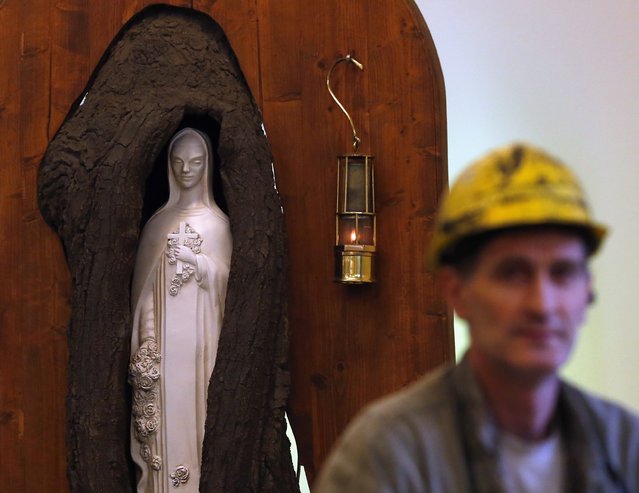
A miner sits front of the statue of St. Barbara, saint of the miners, during last working day at Hungary's last hard coal deep-cast mine at Markushegy December 23, 2014.The underground mine, west of the capital city Budapest, has to stop producing coal at the end of this year in line with a European Union effort to shut down uncompetitive hard coal mines. (Photo by Laszlo Balogh/Reuters)

A miner sits front of the statue of St. Barbara, saint of the miners, during last working day at Hungary's last hard coal deep-cast mine at Markushegy December 23, 2014.The underground mine, west of the capital city Budapest, has to stop producing coal at the end of this year in line with a European Union effort to shut down uncompetitive hard coal mines. (Photo by Laszlo Balogh/Reuters)
Details
24 Dec 2014 13:36:00
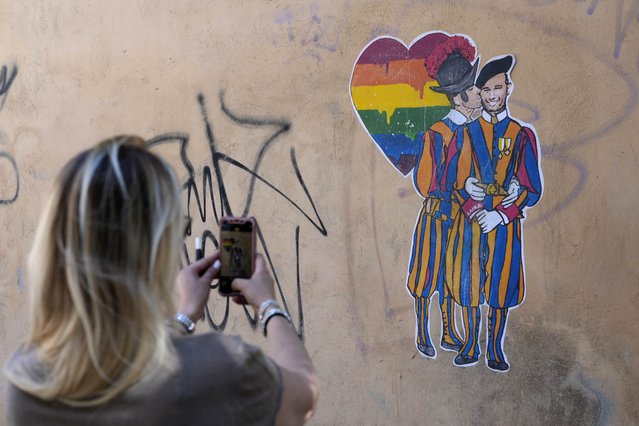
A murales showing a Swiss guard kissing a colleague, by street artist Laika, is seen on the day of the annual Pride march, in Rome, Saturday, June 26, 2021. This year's march comes amid widespread concern in Europe about legislation in Hungary that will ban showing content about LGBT issues to children and a controversial Vatican communication to Italy, criticizing a law that would extend additional protections from discrimination to the LGBT community. (Photo by Gregorio Borgia/AP Photo)

A murales showing a Swiss guard kissing a colleague, by street artist Laika, is seen on the day of the annual Pride march, in Rome, Saturday, June 26, 2021. This year's march comes amid widespread concern in Europe about legislation in Hungary that will ban showing content about LGBT issues to children and a controversial Vatican communication to Italy, criticizing a law that would extend additional protections from discrimination to the LGBT community. (Photo by Gregorio Borgia/AP Photo)
Details
13 Aug 2021 09:40:00
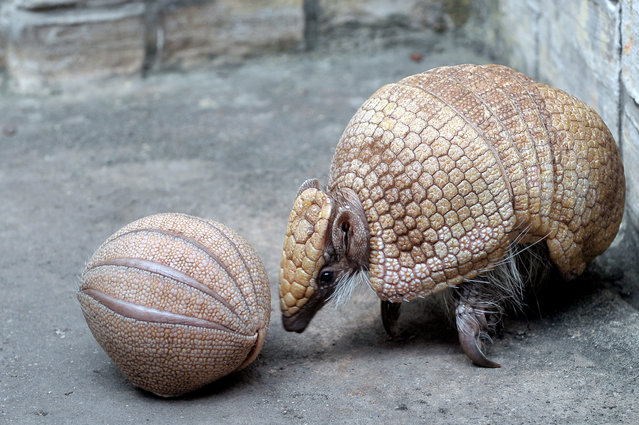
A four-week old southern three-banded armadillo (Tolypeutes matacus) is rolled up into a ball next to its mother in the tropical house of Budapest Zoo in Budapest, Hungary on May 3, 2019. The South American insect-eating mammal and its close relative, the Brasilian three-banded armadillo (Tolypeutes tricinctus) are the only two species of armadillos capable of rolling into a complete ball to defend themselves when feeling threatened. (Photo by Attila Kovács/EPA/EFE)

A four-week old southern three-banded armadillo (Tolypeutes matacus) is rolled up into a ball next to its mother in the tropical house of Budapest Zoo in Budapest, Hungary on May 3, 2019. The South American insect-eating mammal and its close relative, the Brasilian three-banded armadillo (Tolypeutes tricinctus) are the only two species of armadillos capable of rolling into a complete ball to defend themselves when feeling threatened. (Photo by Attila Kovács/EPA/EFE)
Details
05 May 2019 00:03:00


A Chinese girl touches the gun of a relievo featuring Chinese soldiers fighting with Japanese troops during World War II at an exhibition at the Anti-Japan War Museum to mark the 60th Anniversary of the Victory of the Chinese People's War of Resistance Against Japan on August 18, 2005 in Beijing, China. (Photo by Cancan Chu/Getty Images)
Details
30 Jul 2011 13:51:00
Members of the Mayossa folk dance group pour water on a young woman in Kiskunmajsa, Hungary on April 2, 2018. According to an old Hungarian tradition, celebrated for several hundred years, young men pour water on young women, who in exchange present their sprinklers with beautifully colored eggs on Easter Monday. (Photo by Sandor Ujvari/EPA/EFE/Rex Features/Shutterstock)

Members of the Mayossa folk dance group pour water on a young woman in Kiskunmajsa, Hungary on April 2, 2018. According to an old Hungarian tradition, celebrated for several hundred years, young men pour water on young women, who in exchange present their sprinklers with beautifully colored eggs on Easter Monday. (Photo by Sandor Ujvari/EPA/EFE/Rex Features/Shutterstock)
Details
08 Apr 2018 07:48:00
A meteorite of the swarm of meteorites Perseida flies above the Ujudvar TV Tower as seen from Ujudvar, Hungary, late Friday, August 13, 2021. Perseidas, one of the brightest meteorite swarms, consist of a multitude of stellar particles which due to their high speed glow up and burn by entering Earth's atmosphere. (Photo by Gyorgy Varga/MTI via AP Photo)

A meteorite of the swarm of meteorites Perseida flies above the Ujudvar TV Tower as seen from Ujudvar, Hungary, late Friday, August 13, 2021. Perseidas, one of the brightest meteorite swarms, consist of a multitude of stellar particles which due to their high speed glow up and burn by entering Earth's atmosphere. (Photo by Gyorgy Varga/MTI via AP Photo)
Details
21 Oct 2021 08:48:00
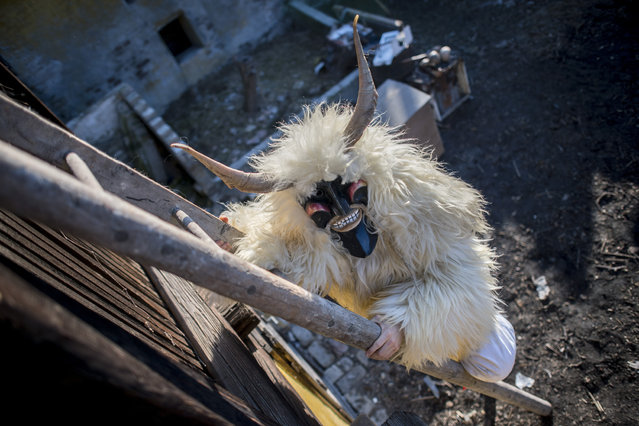
A man wears a busho mask and a costume made of sheep pelt while climbing up a ladder outside a barn in Mohacs, Hungary, 20 February 2020, on the first day of carnival. The traditional Busho carnival, which marks the end of winter, dates back to the 16th century. According to local legend, members of an ethnic South Slavic group living in Mohacs at the time dressed up in similar costumes and wore wooden masks to scare away Ottoman invaders, who mistook them for demons. (Photo by Tamas Soki/EPA/EFE)

A man wears a busho mask and a costume made of sheep pelt while climbing up a ladder outside a barn in Mohacs, Hungary, 20 February 2020, on the first day of carnival. The traditional Busho carnival, which marks the end of winter, dates back to the 16th century. According to local legend, members of an ethnic South Slavic group living in Mohacs at the time dressed up in similar costumes and wore wooden masks to scare away Ottoman invaders, who mistook them for demons. (Photo by Tamas Soki/EPA/EFE)
Details
23 Feb 2020 00:07:00