Loading...
Done
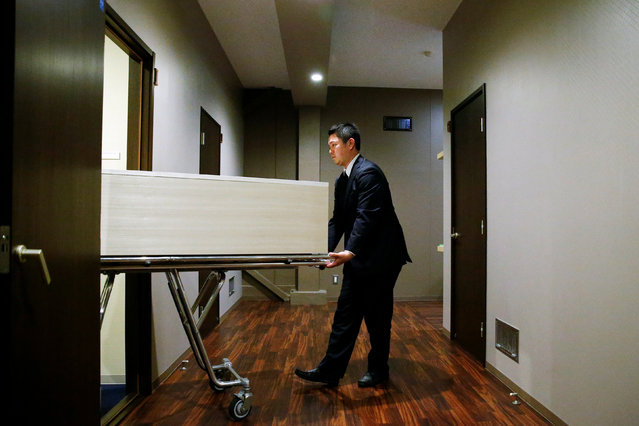
A staff member removes a coffin from a room of the “Corpse Hotel” in Kawasaki, Japan, April 20, 2016. (Photo by Thomas Peter/Reuters)

A staff member removes a coffin from a room of the “Corpse Hotel” in Kawasaki, Japan, April 20, 2016. Many so-called corpse hotels have emerged as a flourishing business in the city following a crunch in crematoriums. Families can rent a room in Sousou on a daily charge of 9,000 Japanese yen (£58, €74, $84) to keep the body of the deceased relative for up to four days until they find a crematorium. (Photo by Thomas Peter/Reuters)
Details
30 Apr 2016 09:46:00
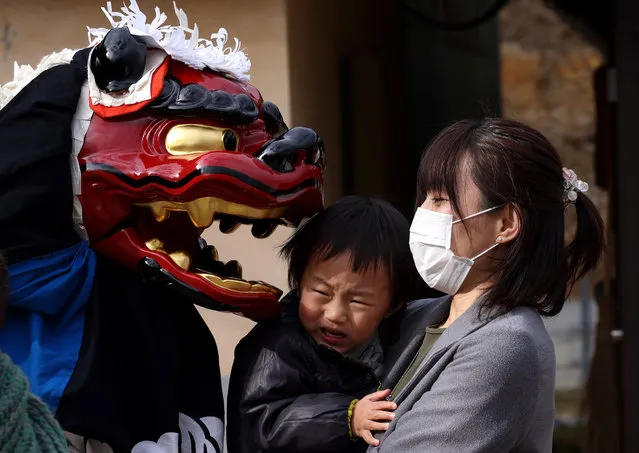
A performer wearing a lion mask performs the Ise Daikagura lion dance at the remote village of Yamanawa on February 08, 2021 in Ryuo, Japan. Ise Daikagura is a group of traditional Lion Dance performers who pray in front of farmers houses and businesses for good grain harvests and disease-free lives. Performers play sacred music using drums and flutes with two lion mask dancers. A lion mask is considered a symbol of God, who enters the house and performs in front of the Shinto God, a statue placed inside the house, mostly in the kitchen. These prayers are called “Kamodo Barai”. After the prayers, they are gifted with money, rice, sake and Japanese sweets from the householders. A group can travel for more than one hundred days to thousands of households and businesses throughout rural-villages in western Japan, and pray to those who are unable to visit the country’s most sacred shrine, the Grand Ise Shrine in Mie Prefecture. The group started its performance in the Edo era between 1603 to 1868 according to Japanese history. The Japanese government designated it as an important folk cultural national property in 1981. (Photo by Buddhika Weerasinghe/Getty Images)

A performer wearing a lion mask performs the Ise Daikagura lion dance at the remote village of Yamanawa on February 08, 2021 in Ryuo, Japan. Ise Daikagura is a group of traditional Lion Dance performers who pray in front of farmers houses and businesses for good grain harvests and disease-free lives. (Photo by Buddhika Weerasinghe/Getty Images)
Details
18 Feb 2021 09:27:00
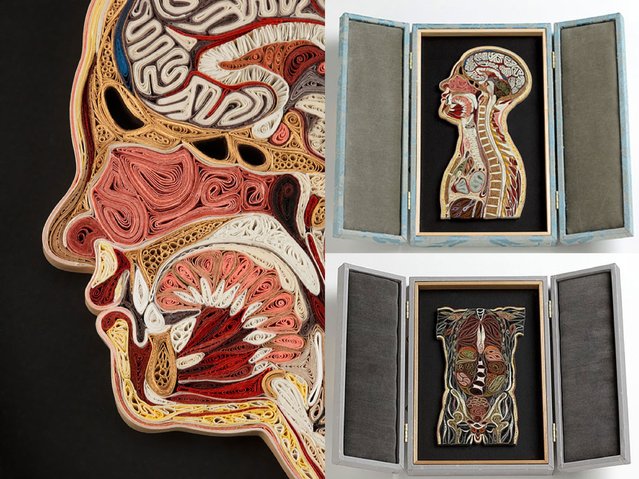
 Paper Anatomy By Lisa Nilsson

These pieces are made of Japanese mulberry paper and the gilded edges of old books. They are constructed by a technique of rolling and shaping narrow strips of paper called quilling or paper filigree. Quilling was first practiced by Renaissance nuns and monks who are said to have made artistic use of the gilded edges of worn out bibles, and later by 18th century ladies who made artistic use of lots of free time. I find quilling exquisitely satisfying for rendering the densely squished and lovely internal landscape of the human body in cross section.
Details
14 Apr 2013 11:07:00
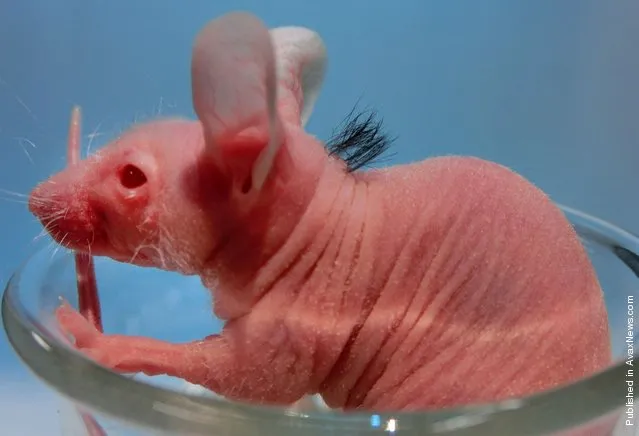
A hairless mouse with black hair on its back at the laboratory in Noda, Chiba Prefecture

Japanese researchers have sparked hopes of finding a cure for human baldness after successfully growing hair on hairless mice by implanting follicles created from stem cells, Agence France Presse reports. A picture taken on April 13, 2012 and released by the Tsuji Lab Research Institute for Science and Technology of the Tokyo University of Science shows a hairless mouse with black hair on its back at the laboratory in Noda, Chiba Prefecture. (Photo by Tokyo University of Science via AFP)
Details
22 Apr 2012 11:53:00


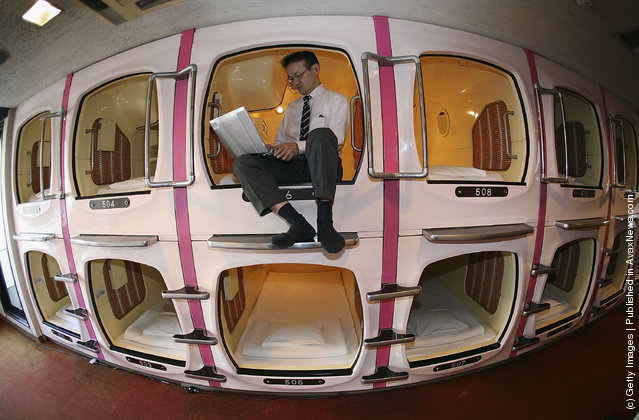
A visitor relaxes in a sleeping module at Tokyo's tube Hotel “Capsule Inn Akihabara” on February 6, 2007 in Tokyo, Japan. The two-square-meter sleep modules are equipped with a TV, Radio and Wireless LAN and are priced at 3500 yen per night. Uptil recently it has mainly been the office workers who stay at such tube hotels when they cannot go home, but recently they are attracting many foreign travellers due to their Japanese style. (Photo by Koichi Kamoshida/Getty Images)
Details
20 May 2011 08:50:00
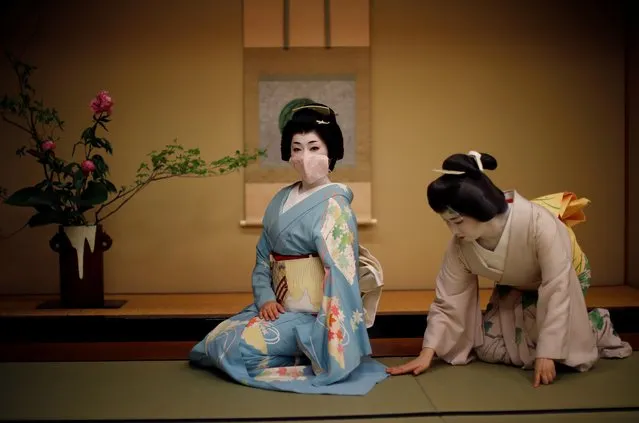
Mayu adjusts Koiku’s kimono, as Koiku wears a protective face mask while posing for a photograph, before they work at a party where they will entertain with other geisha at Japanese luxury restaurant Asada in Tokyo, Japan, June 23, 2020. The coronavirus pandemic has made Tokyo's geisha fear for their centuries-old profession as never before. Though the number of geisha - famed for their witty conversation, beauty and skill at traditional arts - has been falling for years, they were without work for months due to Japan's state of emergency and now operate under awkward social distancing rules. Engagements are down 95 percent, and come with new rules: no pouring drinks for customers or touching them even to shake hands, and sitting 2 meters apart. Masks are hard to wear with their elaborate wigs, so they mostly don't. “I was just full of anxiety”, said Mayu, 47. “I went through my photos, sorted my kimonos ... The thought of a second wave is terrifying”. (Photo by Kim Kyung-Hoon/Reuters)

Mayu adjusts Koiku’s kimono, as Koiku wears a protective face mask while posing for a photograph, before they work at a party where they will entertain with other geisha at Japanese luxury restaurant Asada in Tokyo, Japan, June 23, 2020. (Photo by Kim Kyung-Hoon/Reuters)
Details
23 Jul 2020 00:03:00
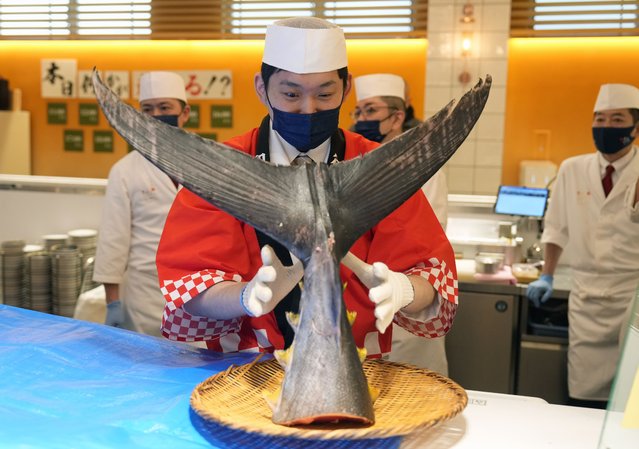
A sushi restaurant staff member holds the cut tail of the auctioned 212-kilogram Bluefin tuna after the New Year's first auction of the Toyosu Market, at the Kaiten Sushi Ginza Onodera in Tokyo, Japan, 05 January 2023. Yukitaka Yamaguchi, president of wholesaler Yamayuki, and the company operating the Sushi Ginza Onodera restaurants, secured the first tuna auction of the New Year with a bid of almost 257,000 euros (36.04 million Japanese Yen). (Photo by Franck Robichon/EPA/EFE)

A sushi restaurant staff member holds the cut tail of the auctioned 212-kilogram Bluefin tuna after the New Year's first auction of the Toyosu Market, at the Kaiten Sushi Ginza Onodera in Tokyo, Japan, 05 January 2023. Yukitaka Yamaguchi, president of wholesaler Yamayuki, and the company operating the Sushi Ginza Onodera restaurants, secured the first tuna auction of the New Year with a bid of almost 257,000 euros (36.04 million Japanese Yen). (Photo by Franck Robichon/EPA/EFE)
Details
13 Jan 2023 02:02:00
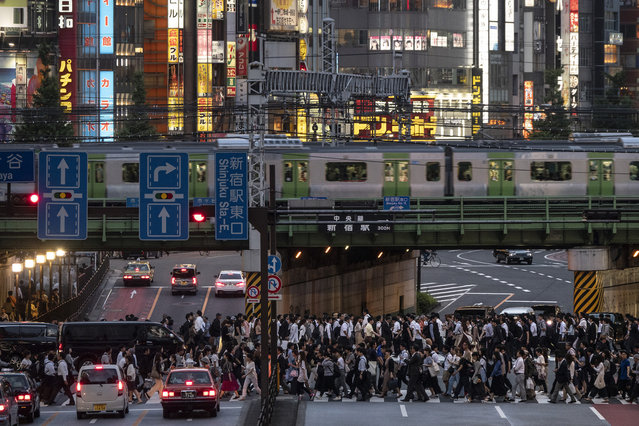
In this Tuesday, June 4, 2019, photo, a Yamanote Line train travels above commuters walking across the crossing during evening rush hours in the Shinjuku district of Tokyo. Operated by the East Japan Railway Co., the Yamanote Line in Tokyo makes a loop around the center of the city, connecting 29 stations that include key stops such as Shinjuku, Shibuya and Ikebukuro. A complete loop of about an hour offers scenes of Japanese daily lives. (Photo by Jae C. Hong/AP Photo)

In this Tuesday, June 4, 2019, photo, a Yamanote Line train travels above commuters walking across the crossing during evening rush hours in the Shinjuku district of Tokyo. Operated by the East Japan Railway Co., the Yamanote Line in Tokyo makes a loop around the center of the city, connecting 29 stations that include key stops such as Shinjuku, Shibuya and Ikebukuro. A complete loop of about an hour offers scenes of Japanese daily lives. (Photo by Jae C. Hong/AP Photo)
Details
27 Jun 2019 00:03:00