Loading...
Done
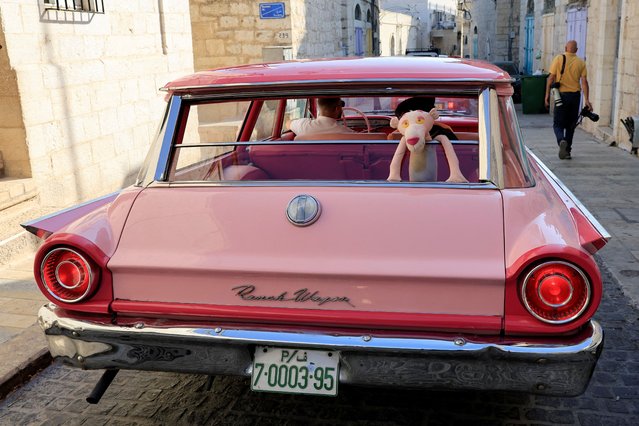
Palestinians drive classic cars during a gathering organized by the Bethlehem municipality near the Church of the Nativity in Manger Square in Bethlehem in the Israeli-occupied West Bank, on October 17, 2025. (Photo by Mussa Qawasma/Reuters)

Palestinians drive classic cars during a gathering organized by the Bethlehem municipality near the Church of the Nativity in Manger Square in Bethlehem in the Israeli-occupied West Bank, on October 17, 2025. (Photo by Mussa Qawasma/Reuters)
Details
17 Nov 2025 02:18:00


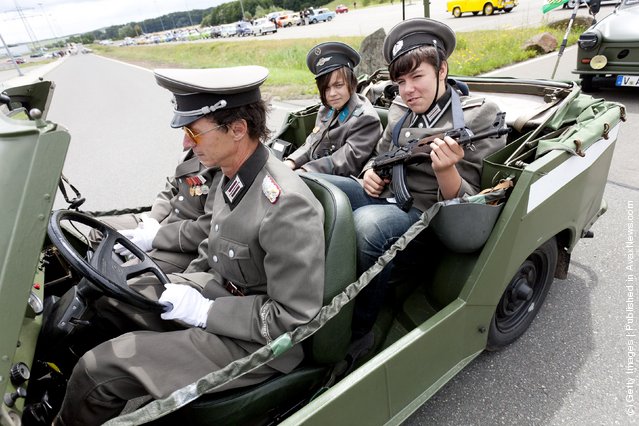
“The Trabant is a car that was produced by former East German auto maker VEB Sachsenring Automobilwerke Zwickau in Zwickau, Sachsen. It was the most common vehicle in East Germany, and was also exported to countries both inside and outside the communist bloc. The main selling points was that it had room for four adults and luggage in a compact, light and durable shell and that it was fast (when introduced) and durable. With its mediocre performance, smoky two-stroke engine, and production shortages, the Trabant is often cited as an example of the disadvantages of centralized planning; on the other hand, it is regarded with derisive affection as a symbol of the failed former East Germany and of the fall of communism (in former West Germany, as many East Germans streamed into West Berlin and West Germany in their Trabants after the opening of the Berlin Wall in 1989). It was in production without any significant changes for nearly 30 years with 3,096,099 Trabants produced in total”. – Wikipedia

Photo: Enthusiasts weared in uniforms of the former eastern german army trive in a military Trabant car as fans and owners of East German-era Trabant cars gather at the 2011 International Trabantfahrer Treffen (International Trabant Drivers Meeting) on June 26, 2011 in Zwickau, Germany. The Trabant, also known as the Trabi, was among the main cars produced in communist East Germany and built by VEB Sachsenring Automobilwerke in Zwickau for 30 years until 1989. Today the car has cult status for many followers and one company, IndiKar, is even seeking to revive the brand in a modern, electric version. (Photo by Carsten Koall/Getty Images)

Details
27 Jun 2011 12:21:00


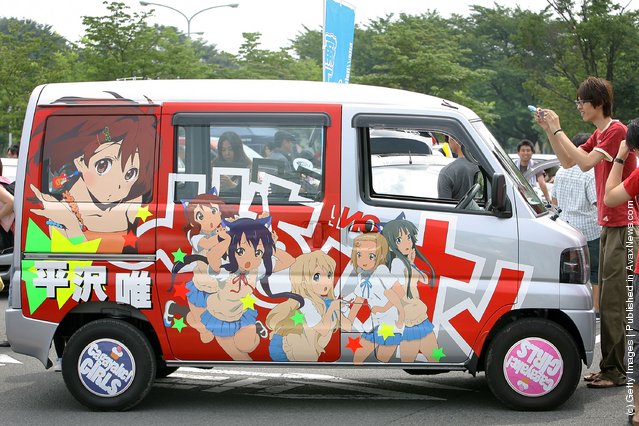
“Itasha (痛車), literally “painmobile”, is a Japanese term for an otaku fad of individuals decorating the bodies of their cars with fictional characters of anime, manga, or video games (especially bishōjo game or eroge). These characters are predominately “cute” female. The decorations usually involve paint schemes and stickers. Automobiles are called Itasha, while similar motorcycles and bicycles are called itansha (痛単車) and itachari (痛チャリ), respectively”. – Wikipedia


Photo: A visitor takes pictures of an anime-decorated «Itasha» car displayed during the “Moe Fes in Washimiya” at Washimiya Town Hall on July 18, 2009 in Washimiya, Saitama, Japan. Itasha, a word derived from “itai” (painful) and “sha” (car), are vehicles decorated with mostly female characters from Japanese manga, anime and video games. (Photo by Kiyoshi Ota/Getty Images)
Details
02 May 2011 08:38:00
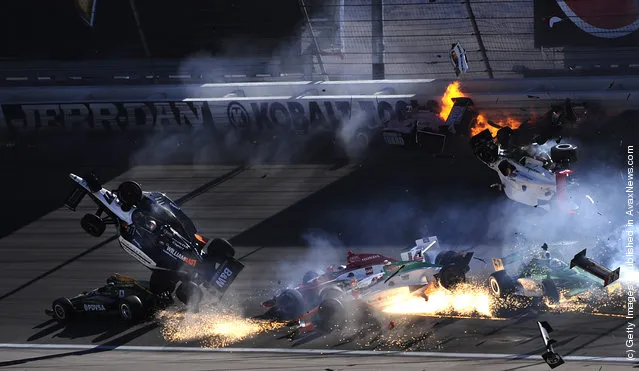
Car of Dan Wheldon of England driver of the #77 Bowers & Wilkins Sam Schmidt Motorsports Dallara Honda (left) flies in the air during the Las Vegas Indy 300 part

The car of Dan Wheldon of England driver of the #77 Bowers & Wilkins Sam Schmidt Motorsports Dallara Honda (left) flies in the air during the Las Vegas Indy 300 part of the IZOD IndyCar World Championships presented by Honda on October 16, 2011 at the Las Vegas Motor Speedway in Las Vegas, Nevada. (Photo by Robert Laberge/Getty Images)
Details
17 Oct 2011 09:25:00
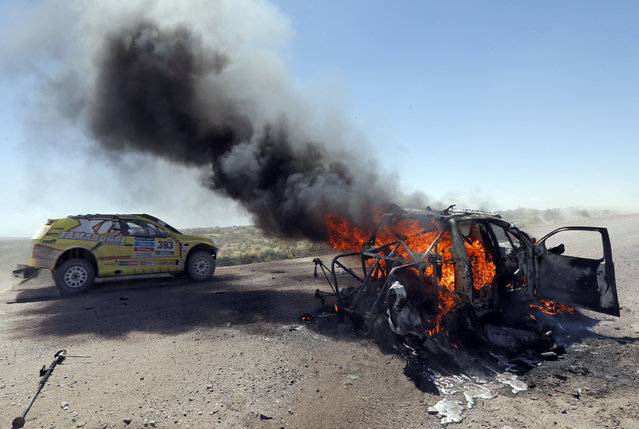
Chile's Javier Campillay drives past the burning car of Kazakhstan's Bauyrzhan Issabayev and Gabdulla Ashimov during the Dakar Rally 2014 Stage 2 from San Luis to San Rafael, on January 6, 2014. (Photo by Jean-Paul Pelissier/AFP Photo)

Chile's Javier Campillay drives past the burning car of Kazakhstan's Bauyrzhan Issabayev and Gabdulla Ashimov during the Dakar Rally 2014 Stage 2 from San Luis to San Rafael, on January 6, 2014. (Photo by Jean-Paul Pelissier/AFP Photo)
Details
14 Jan 2014 11:18:00
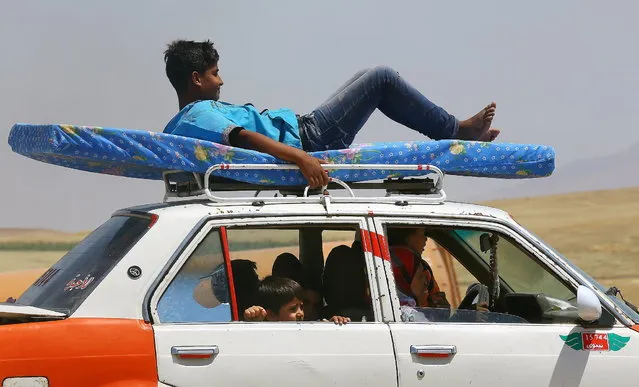
Iraqis who have fled fighting between security forces and al-Qaida inspired militants in their hometown of Tal Afar arrive in a car at Germawa camp for displaced Iraqis, in a hot dusty plain in the largely-autonomous Kurdish area of Dahuk, 260 miles (430 kilometers) northwest of Baghdad Tuesday, June 17, 2014. (Photo by AP Photo)

Iraqis who have fled fighting between security forces and al-Qaida inspired militants in their hometown of Tal Afar arrive in a car at Germawa camp for displaced Iraqis, in a hot dusty plain in the largely-autonomous Kurdish area of Dahuk, 260 miles (430 kilometers) northwest of Baghdad Tuesday, June 17, 2014. (Photo by AP Photo)
Details
21 Jun 2014 12:44:00
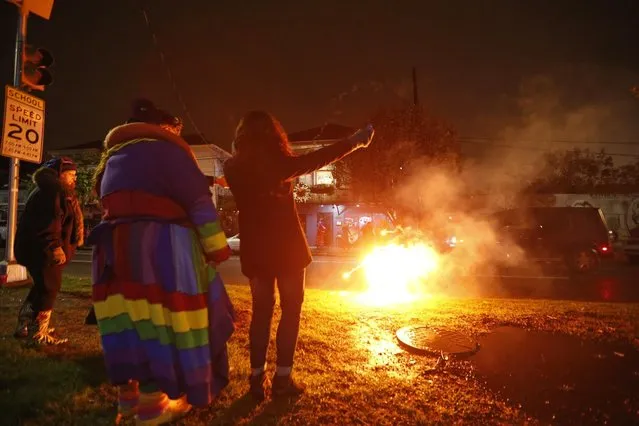
Revelers of the “Societe des Champs Elysee” launch fireworks before boarding the Rampart-St. Claude street car line, which just opened last fall, to commemorate the official start of Mardi Gras season, in New Orleans, Friday, January 6, 2017. (Photo by Gerald Herbert/AP Photo)

Revelers of the “Societe des Champs Elysee” launch fireworks before boarding the Rampart-St. Claude street car line, which just opened last fall, to commemorate the official start of Mardi Gras season, in New Orleans, Friday, January 6, 2017. (Photo by Gerald Herbert/AP Photo)
Details
08 Jan 2017 14:00:00
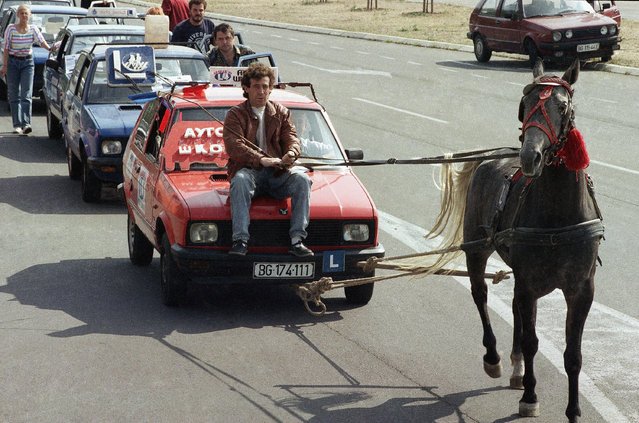
A horse pulls a driving school car as other drivers push their vehicles behind during a demonstration by driving instructors in Belgrade, September 25, 1992. Due to gasoline shortage in the Yugoslav capital, driving instructors are staying away from work. (Photo by AP Photo)

A horse pulls a driving school car as other drivers push their vehicles behind during a demonstration by driving instructors in Belgrade, September 25, 1992. Due to gasoline shortage in the Yugoslav capital, driving instructors are staying away from work. (Photo by AP Photo)
Details
26 Sep 2015 08:04:00