Loading...
Done
Anissa Barbato from New York looks out over the city as she takes pictures from the Edge, the highest outdoor sky deck in the Western Hemisphere on September 2, 2020 as it reopened to the public in New York. Rising 1,131 feet in the air from the heart of Hudson Yards it offers  360-degree views of New York Citys iconic skyline from the 100th floor outdoor viewing. (Photo by Timothy A. Clary/AFP Photo)

Anissa Barbato from New York looks out over the city as she takes pictures from the Edge, the highest outdoor sky deck in the Western Hemisphere on September 2, 2020 as it reopened to the public in New York. Rising 1,131 feet in the air from the heart of Hudson Yards it offers 360-degree views of New York Citys iconic skyline from the 100th floor outdoor viewing. (Photo by Timothy A. Clary/AFP Photo)
Details
24 Jan 2021 09:56:00
A mesmerising waterfall in the Icelandic country-side. (Photo by Arnar Kristjansson/Caters News)

These stunning pictures of beautiful Icelandic waterfalls will take your breath away. The mesmerizing shots show the striking waterfalls set against the night sky and the hypnotic green glow of the northern lights, as well as the picturesque Icelandic scenery and stunning sunrises. Here: A mesmerising waterfall in the Icelandic country-side. (Photo by Arnar Kristjansson/Caters News)
Details
01 Dec 2015 08:05:00
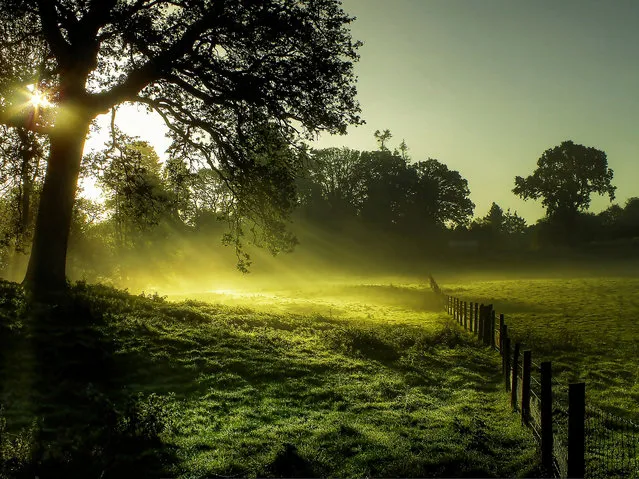
Let the light enter. (Eric Goncalves)

“I'm very lucky to be in a wonderful part of England , where the ever changing sky's are always a new opportunity for a good shot. To me photography is the art of using light to one's advantage”. – Eric Goncalves. Photo: “Let the light enter”. (Photo by Eric Goncalves)
Details
20 May 2013 11:09:00
The Luminous Lantern Parade on June 10, 2016 in Brisbane, Australia. (Photo by Glenn Hunt/Getty Images)

The Luminous Lantern Parade on June 10, 2016 in Brisbane, Australia. The Luminous Lantern Parade was held at Brisbane’s South Bank on Friday, featuring a parade of glowing animals and characters of all shapes and sizes lighting up the night sky. (Photo by Glenn Hunt/Getty Images)
Details
11 Jun 2016 12:26:00
A herd of wildebeest cross the skyline against the fading light in Masai Mara, Kenya, 25 August 2017. Stunning sunset photos silhouette Africa’s wildlife against streaks of orange and red sky. In August, German photographer Ingo Gerlach was on safari in the Masai Mara when he convinced his safari guide to stop and take in the sunset. The wildlife photographer was rewarded with his patience by an eye-catching sunset, which cast Africa’s wildlife into dark shadows against the vibrant skies. (Photo by Ingo Gerlach/Barcroft Images)

A herd of wildebeest cross the skyline against the fading light in Masai Mara, Kenya, 25 August 2017. Stunning sunset photos silhouette Africa’s wildlife against streaks of orange and red sky. In August, German photographer Ingo Gerlach was on safari in the Masai Mara when he convinced his safari guide to stop and take in the sunset. The wildlife photographer was rewarded with his patience by an eye-catching sunset, which cast Africa’s wildlife into dark shadows against the vibrant skies. (Photo by Ingo Gerlach/Barcroft Images)
Details
14 Sep 2017 08:17:00
A member of the wingsuit flyers duo, known as the Soul Flyers, is seen in mid-air as he catches up and flies into the open door of Pilatus Porter plane, piloted by Philippe Bouvier, after B.A.S.E. jumping off the Jungfrau mountain, 4158 meters, in Lauterbrunnen, Switzerland, October 13, 2017. French athletes Fred Fugen and Vince Reffet had 2.45 minutes and a free fall distance of 3200 meters to complete their project “Door In The Sky”, coordinated by Yves Rossy know as the “Jetman”. (Photo by Thibault Gachet/Reuters)

A member of the wingsuit flyers duo, known as the Soul Flyers, is seen in mid-air as he catches up and flies into the open door of Pilatus Porter plane, piloted by Philippe Bouvier, after B.A.S.E. jumping off the Jungfrau mountain, 4158 meters, in Lauterbrunnen, Switzerland, October 13, 2017. French athletes Fred Fugen and Vince Reffet had 2.45 minutes and a free fall distance of 3200 meters to complete their project “Door In The Sky”, coordinated by Yves Rossy know as the “Jetman”. (Photo by Thibault Gachet/Reuters)
Details
30 Nov 2017 08:39:00
Four pillars of light from the 4 Laser Guide Star Facility on ESO's Very Large Telescope (VLT) are shown reaching into the Chilean night sky in this image from ESO Photo Ambassador Fred Kamphues, on September 2, 2016. The lasers are a key part of the adaptive optics system on the VLT. Adaptive optics allows astronomers to drastically reduce the atmospheric distortion present at even the best sites in the world for astronomy, including Paranal in Chile, the home of the VLT. (Photo by F. Kamphues/ESO)

Four pillars of light from the 4 Laser Guide Star Facility on ESO's Very Large Telescope (VLT) are shown reaching into the Chilean night sky in this image from ESO Photo Ambassador Fred Kamphues, on September 2, 2016. The lasers are a key part of the adaptive optics system on the VLT. Adaptive optics allows astronomers to drastically reduce the atmospheric distortion present at even the best sites in the world for astronomy, including Paranal in Chile, the home of the VLT. (Photo by F. Kamphues/ESO)
Details
23 Feb 2017 00:06:00
Chileans watch the sky with special suits prior to a total solar eclipse on July 2, 2019 in Paiguano, Chile. Around 25,0000 tourists arrived to Paiguano, a small town of around 1,000 inhabitants in the Elqui Valley, 650 km away Santiago. This is the only Earth's total solar eclipse of 2019 and the first one since 2017. From this point, the sun will fully disappear for around two minutes. It is best visible from a stripe in the South Pacific, Chile and Argentina. (Photo by Marcelo Hernandez/Getty Images)

Chileans watch the sky with special suits prior to a total solar eclipse on July 2, 2019 in Paiguano, Chile. Around 25,0000 tourists arrived to Paiguano, a small town of around 1,000 inhabitants in the Elqui Valley, 650 km away Santiago. This is the only Earth's total solar eclipse of 2019 and the first one since 2017. From this point, the sun will fully disappear for around two minutes. It is best visible from a stripe in the South Pacific, Chile and Argentina. (Photo by Marcelo Hernandez/Getty Images)
Details
04 Jul 2019 00:05:00