A woman waits outside a shop wearing protective gear due to the COVID-19 pandemic in downtown Lima, Peru, Monday, July 6, 2020. (Photo by Rodrigo Abd/AP Photo)
Youths cover their faces with plastic bags while pushing a handcart during rainfall in Peshawar, Pakistan, Sunday, July 12, 2020. (Photo by Muhammad Sajjad/AP Photo)
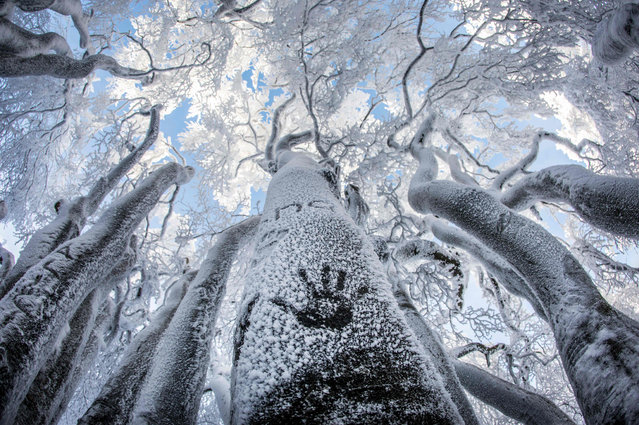
A walker has left a handprint on a snow- covered tree trunk on Grosser Feldberg mountain in the Taunus mountain range, Germany, 16 January 2017. (Photo by Frank Rumpenhorst/DPA)
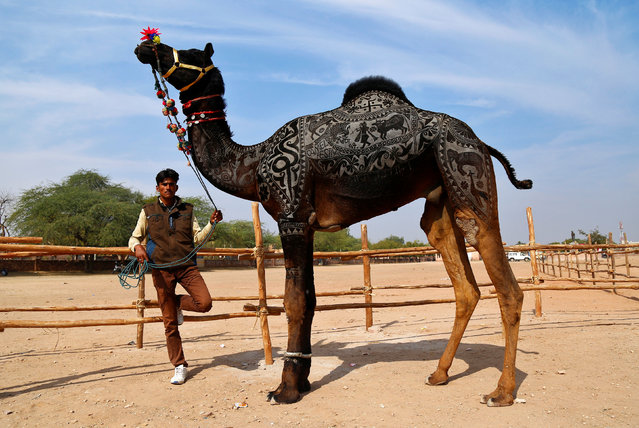
A man waits with his camel to take part in a camel decoration competition at the Nagaur Cattle Fair, where animals like camels, cows, horses, and bulls are brought to be sold or traded, in Nagaur, in the desert state of Rajasthan, India February 2, 2017. (Photo by Himanshu Sharma/Reuters)
An Iraqi military vehicle passes displaced Iraqi boys returning to their homes in West Mosul's Oreibi neighbourhood after government forces retook control of the area from the Islamic State (IS) group during the ongoing offensive against the jihadists on May 21, 2017. (Photo by Ahmad Al-Rubaye/AFP Photo)
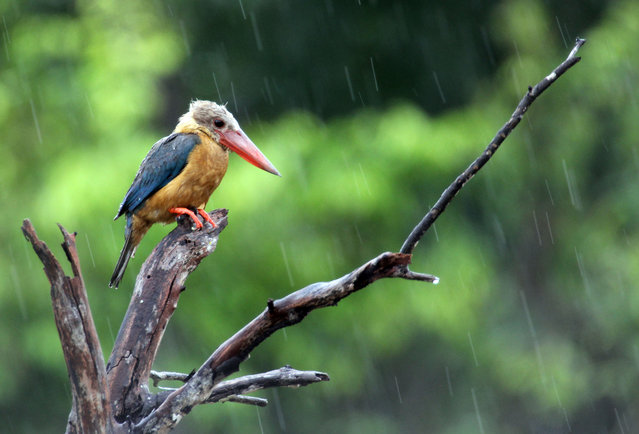
A stork-billed kingfisher (Pelargopsis capensis) is seen perched on a tree during monsoon rain on July 25, 2016 in Bintan, Indonesia. The stork-billed kingfisher is a tree species which is widely but sparsely distributed in the tropical Indian subcontinent and Southeast Asia, from India to Indonesia. This kingfisher is resident throughout its range. It is very large, measuring 35 to 38 cm (14 to 15 in) in length. The adult has a green back, blue wings and tail, and grey head. (Photo by Sijori Images/Barcroft Images)
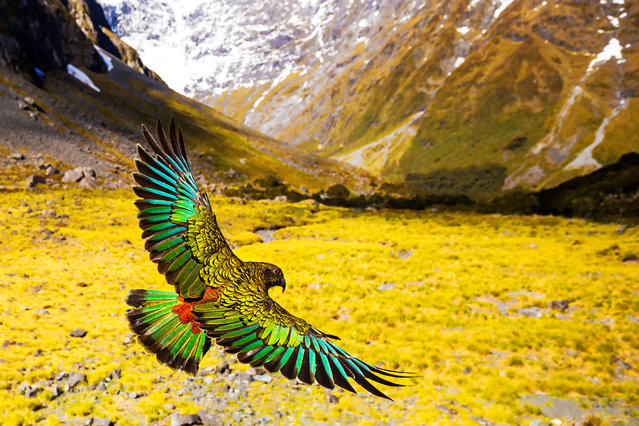
Kea are the only true alpine parrots in the world and thrive as cunning opportunists in the freezing conditions of the Southern Alps. Kea are thought to have developed their wide array of food-finding strategies during the last great ice age, where they learned to adapt using their unusual powers of curiosity. (Photo by Tom Walker/BBC Pictures/The Guardian)