Loading...
Done
A woman, with her face covered with colored powders, dances during the Holi Festival of Colors in Lisbon, Sunday, September 15 2013. The festival, which is mainly celebrated during the Hindu spring festival Holi in some regions of India and Nepal, has become popular among people in other communities. (Photo by Francisco Seco/AP Photo)

A woman, with her face covered with colored powders, dances during the Holi Festival of Colors in Lisbon, Sunday, September 15 2013. The festival, which is mainly celebrated during the Hindu spring festival Holi in some regions of India and Nepal, has become popular among people in other communities. (Photo by Francisco Seco/AP Photo)
Details
21 Sep 2013 08:02:00
Runners gather at the start line for the annual “Santa Speedo Run”, a charity race through the streets of the Back Bay neighborhood of Boston. (Photo by Gretchen Ertl/Reuters)

Runners gather at the start line for the annual “Santa Speedo Run”, a charity race through the streets of the Back Bay neighborhood of Boston. (Photo by Gretchen Ertl/Reuters)
Details
15 Dec 2013 09:06:00
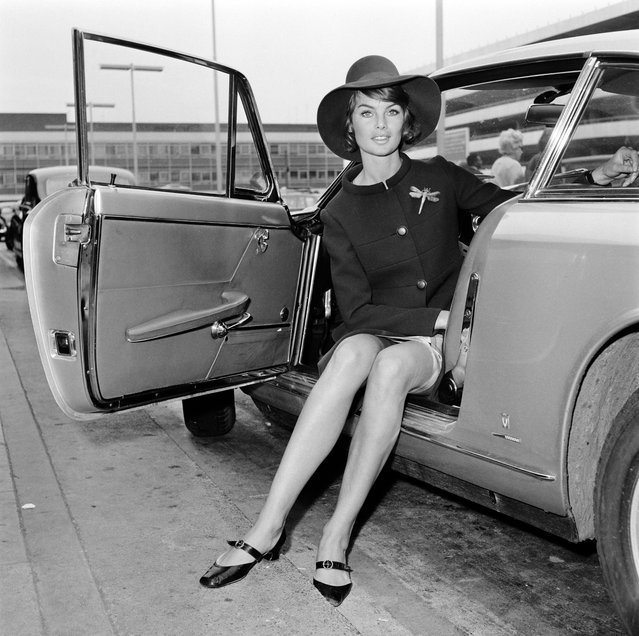
British model Jean Shrimpton at London Airport (now Heathrow), 5th June 1967. (Photo by Dove/Express/Getty Images)

British model Jean Shrimpton at London Airport (now Heathrow), 5th June 1967. (Photo by Dove/Express/Getty Images)
Details
28 Feb 2014 08:43:00
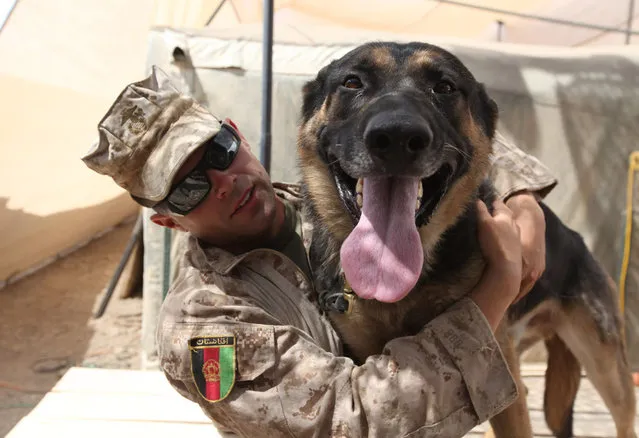
Afghanistan: Dogs of War Part 1

Throughout the course of the long war in Afghanistan, Coalition troops have relied on thousands of military working dogs to help keep them safe, and make their jobs easier. The dogs are trained to detect explosives, to find illegal drugs, to search for missing comrades, or target enemy combatants. Not only are they active on the front lines, but behind the lines they serve as therapy dogs, service dogs, and loyal companions. They also share the same risks as the ground troops, suffering injuries and sometimes death on the battlefields. Gathered here are images of these dogs and their handlers in Afghanistan and back home, from over the past several years, part of the ongoing series here on Afghanistan.
Details
03 Jun 2014 21:02:00
Julian Rodriguez, of Everson, Wash., holds his two-gram packet of recreational marijuana outside Top Shelf Cannabis, Tuesday, July 8, 2014, in Bellingham, Wash., on the first day of legal sales in the state. (Photo by Ted S. Warren/AP Photo)

Julian Rodriguez, of Everson, Wash., holds his two-gram packet of recreational marijuana outside Top Shelf Cannabis, Tuesday, July 8, 2014, in Bellingham, Wash., on the first day of legal sales in the state. (Photo by Ted S. Warren/AP Photo)
Details
09 Jul 2014 13:15:00
Little Red Riding Hood. “The moment I pulled this sweater out of the drawer for Frankie I knew what I wanted for my picture today. I envisioned the look, the style, and the composition. When working with a 2 year old it is never easy to actually get the shot you want, especially when they decide to skip nap time. But I really like how this one turned out” – Rich. (Photo by Rich)

«Little Red Riding Hood». “The moment I pulled this sweater out of the drawer for Frankie I knew what I wanted for my picture today. I envisioned the look, the style, and the composition. When working with a 2 year old it is never easy to actually get the shot you want, especially when they decide to skip nap time. But I really like how this one turned out” – Rich. (Photo by Rich)
Details
17 Sep 2012 12:51:00
Fr Pierre Pepper (C) warms up before his amateur boxing match in the town of Banagher in County Offaly March 15, 2015. (Photo by Cathal McNaughton/Reuters)

Fr Pierre Pepper (C) warms up before his amateur boxing match in the town of Banagher in County Offaly March 15, 2015. Fr Pepper has spent the last two months training for an amateur boxing match to raise proceeds for charity. (Photo by Cathal McNaughton/Reuters)
Details
17 Mar 2015 12:08:00
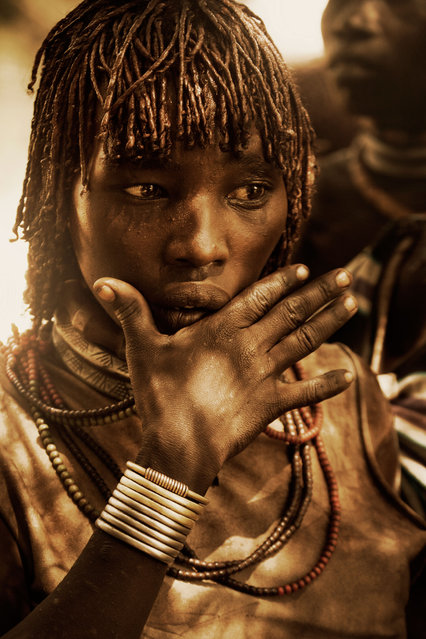
The Hamar people traditionally use red ocher clay to braid the hair of their women. (Photo by Diego Arroyo)

During his time in Ethiopia, New York-based art director and photographer Diego Arroyo spent time with the Hamar, Mursi, Dassanech, and Arbore Tribes. They, along with several others tribes, make up the 200,000 people situated in Africa’s Great Rift Valley. The people of the Omo Valley are still primarily herders and farmers, living an isolated and simple life. While they have yet to be truly touched by globalization, they could soon disappear. Their way of life is being threatened by a massive hydroelectric dam. (Photo by Diego Arroyo)
Details
13 Aug 2014 10:00:00