Loading...
Done
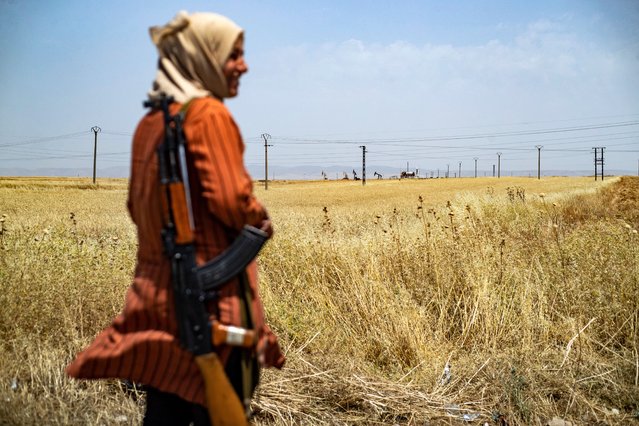
A volunteer in the Kurdish Community Protection Forces guards wheat fields from fire or looting around the town of Tarbesbeyeh, also known as al-Qahtaniyah in Arabic, in northeastern Syria's Hasakeh Governorate near the Turkish border on May 30, 2024. (Photo by Delil Souleiman/AFP Photo)

A volunteer in the Kurdish Community Protection Forces guards wheat fields from fire or looting around the town of Tarbesbeyeh, also known as al-Qahtaniyah in Arabic, in northeastern Syria's Hasakeh Governorate near the Turkish border on May 30, 2024. (Photo by Delil Souleiman/AFP Photo)
Details
20 Sep 2025 03:51:00
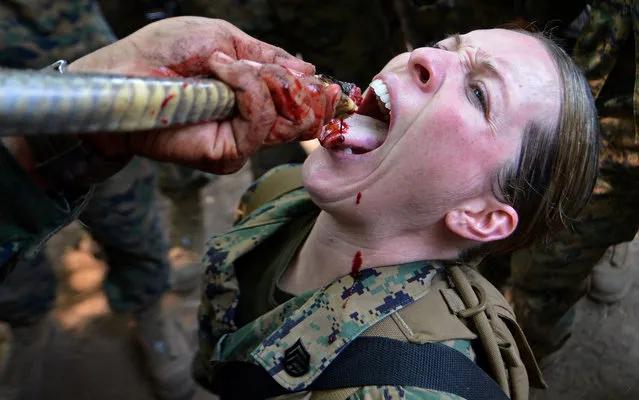
In a military base in the Thai province of Chon Buri February 20 U.S. Marines Navy with Thailand began their studies in jungle survival. The event is held in joint military exercises “Cobra Gold 2013”. During a jungle survival program February 20, 2013 taught by Royal Thai Special Forces in Sannapit, Thailand, U.S. Marines learned to catch cobras and drink their fresh blood, not to mention eat forest insects and pull the heads off of chicken. The training was part of Operation Cobra Gold 13, the 32nd edition of international military exercises hosted by the Thai. According to a U.S. Marines press release, Cobra Gold is the largest exercise of its kind in Asia and incorporates troops from five other nations in addition to the U.S. and Thailand. The Daily Mail reports that the Marines were invited to experience the local custom of drinking cobra blood after being taught to catch and kill cobras in the wild. As CNN notes, Cobra blood is believed to be a panacea and aphrodiasic in parts of Southeast Asia. In Jakarta, vendors can earn over $100 a night selling shots of cobra blood mixed with liquor. (Photo by Pornchai Kittiwongsakul/AFP Photo)

During a jungle survival program February 20, 2013 taught by Royal Thai Special Forces in Sannapit, Thailand, U.S. Marines learned to catch cobras and drink their fresh blood, not to mention eat forest insects and pull the heads off of chicken. The training was part of Operation Cobra Gold 13, the 32nd edition of international military exercises hosted by the Thai. According to a U.S. Marines press release, Cobra Gold is the largest exercise of its kind in Asia and incorporates troops from five other nations in addition to the U.S. and Thailand. The Daily Mail reports that the Marines were invited to experience the local custom of drinking cobra blood after being taught to catch and kill cobras in the wild. As CNN notes, Cobra blood is believed to be a panacea and aphrodiasic in parts of Southeast Asia. In Jakarta, vendors can earn over $100 a night selling shots of cobra blood mixed with liquor. (Photo by Pornchai Kittiwongsakul/AFP Photo)
Details
23 Feb 2013 11:52:00
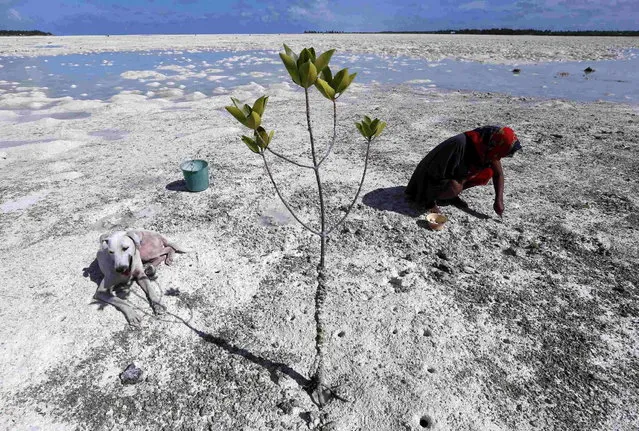
A dog sits in the shade of a mangrove tree as a woman uses a fork to dig for shellfish on the reef-mud flats of a lagoon located at South Tarawa in the central Pacific island nation of Kiribati May 23, 2013. (Photo by David Gray/Reuters)

A dog sits in the shade of a mangrove tree as a woman uses a fork to dig for shellfish on the reef-mud flats of a lagoon located at South Tarawa in the central Pacific island nation of Kiribati May 23, 2013. Kiribati consists of a chain of 33 atolls and islands that stand just metres above sea level, spread over a huge expanse of otherwise empty ocean. With surrounding sea levels rising, Kiribati President Anote Tong has predicted his country will likely become uninhabitable in 30-60 years because of inundation and contamination of its freshwater supplies. (Photo by David Gray/Reuters)
Details
13 Jun 2013 09:23:00
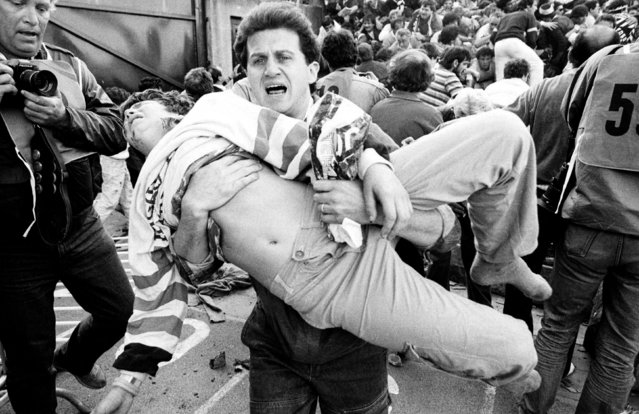
An injured soccer fan is carried to safety by a friend after a wall collapsed during violence between fans before the European Cup final between Juventus and Liverpool at the Heysel stadium in Brussels, May 29, 1985. 39 people died, and a further 600 were injured. (Photo by Nick Didlick/Reuters)

Reuters multi-award winning photographers are celebrated here in a three part retrospective on the 30th anniversary of the service's launch. They have captured dramatic images illustrating the human tragedy of natural disaster and war as well as the fallout of economic events across the continents, creating iconic images, recognised around the world. Here: an injured soccer fan is carried to safety by a friend after a wall collapsed during violence between fans before the European Cup final between Juventus and Liverpool at the Heysel stadium in Brussels, May 29, 1985. 39 people died, and a further 600 were injured. (Photo by Nick Didlick/Reuters)
Details
15 Feb 2015 13:43:00
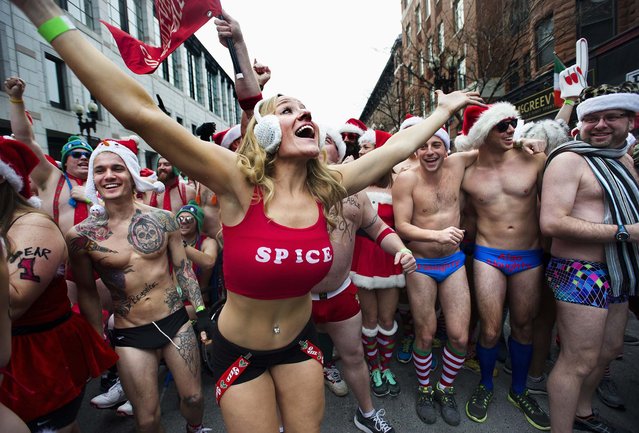
Runners gather at the start line for the annual “Santa Speedo Run”, a charity race through the streets of the Back Bay neighborhood of Boston. (Photo by Gretchen Ertl/Reuters)

Runners gather at the start line for the annual “Santa Speedo Run”, a charity race through the streets of the Back Bay neighborhood of Boston. (Photo by Gretchen Ertl/Reuters)
Details
15 Dec 2013 09:06:00
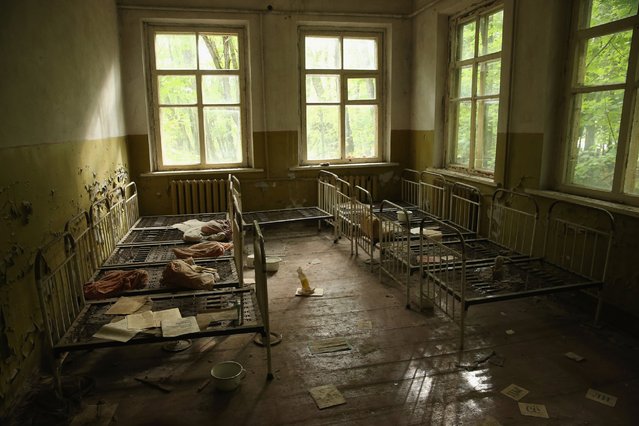
The 30th anniversary of the meltdown at the Chernobyl nuclear plant that caused large amounts of radioactive particles to be released into the air will be commemorated on April 26, 2016. Photojournalist Sean Gallup returned to the area to document the lasting effects of the world's worst nuclear power plant accident. Pictured, children's beds are seen in an abandoned kindergarten in Kopachi village located inside the Chernobyl exclusion zone, Sept. 29, 2015, near Chernobyl, Ukraine. (Photo by Sean Gallup/Getty Images)

The 30th anniversary of the meltdown at the Chernobyl nuclear plant that caused large amounts of radioactive particles to be released into the air will be commemorated on April 26, 2016. Photojournalist Sean Gallup returned to the area to document the lasting effects of the world's worst nuclear power plant accident. Pictured, children's beds are seen in an abandoned kindergarten in Kopachi village located inside the Chernobyl exclusion zone, September 29, 2015, near Chernobyl, Ukraine. (Photo by Sean Gallup/Getty Images)
Details
14 Apr 2016 12:01:00
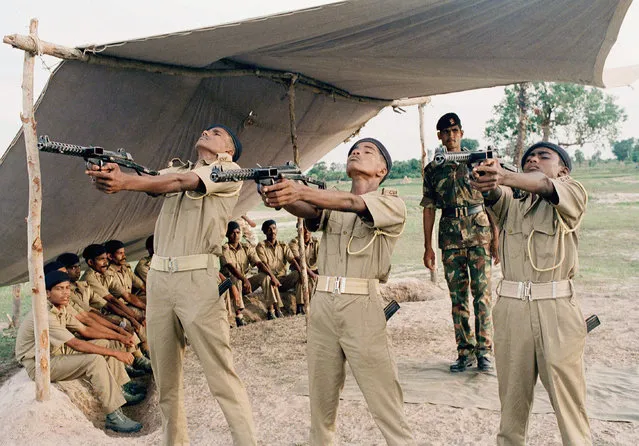
An Indian soldier from the international peace keeping force (IPKF) instructs young Sri Lankan recruits in shooting, part of the training given to the citizen's volunteer force in the North-Eastern Sri Lankan city of Batticaloa, September 28, 1989. (Photo by Barbara Walton/AP Photo)

An Indian soldier from the international peace keeping force (IPKF) instructs young Sri Lankan recruits in shooting, part of the training given to the citizen's volunteer force in the North-Eastern Sri Lankan city of Batticaloa, September 28, 1989. (Photo by Barbara Walton/AP Photo)
Details
29 Sep 2015 08:03:00
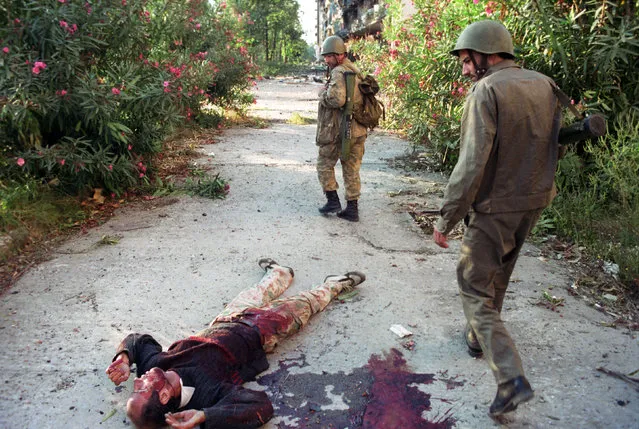
Abkhazia. Sukhumi, 1993. A house-to-house combat. (Photo by Andrei Solovyov/ITAR-TASS)

The War in Abkhazia from 1992 to 1993 was fought between Georgian government forces for the most part, and Abkhaz separatist forces, Russian armed forces and North Caucasian militants. Ethnic Georgians who lived in Abkhazia fought largely on the side of Georgian government forces. Ethnic Armenians and Russians within Abkhazia's population largely supported the Abkhazians, and many fought on their side. The separatists received support from thousands of North Caucasus and Cossack militants and from the Russian Federation forces stationed in and near Abkhazia. Here: Abkhazia. Sukhumi, 1993. A house-to-house combat. (Photo by Andrei Solovyov/ITAR-TASS)
Details
29 Sep 2017 07:31:00