Loading...
Done
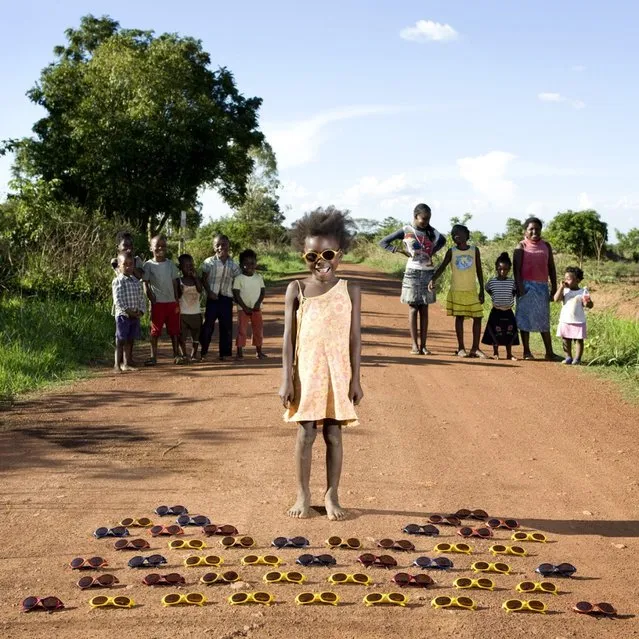
Maudy – Kalulushi, Zambia. Maudy was born in a hut in a small village close to Kalulushi, in Zambia. She grew up playing in the street with the other children in the village, who all attend the same school, where students ages 3 to 10 years old are in the same class. The village has no shops, restaurants or hotels, and just a few children are lucky enough to have toys. Maudy and her friends found a box full of sunglasses on the street, which quickly became their favorite toys. “Toy Stories” project. (Gabriele Galimberti)

Maudy – Kalulushi, Zambia. Maudy was born in a hut in a small village close to Kalulushi, in Zambia. She grew up playing in the street with the other children in the village, who all attend the same school, where students ages 3 to 10 years old are in the same class. The village has no shops, restaurants or hotels, and just a few children are lucky enough to have toys. Maudy and her friends found a box full of sunglasses on the street, which quickly became their favorite toys. “Toy Stories” project. (Photo and caption by Gabriele Galimberti)
Details
05 Dec 2013 07:54:00
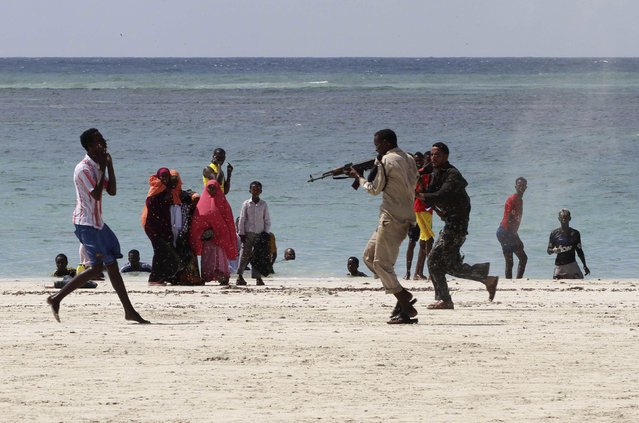
A Somali police officer arrests a suspected rebel member of the al Qaeda-affiliated al Shabaab among beach goers in Mogadishu. Al Shabaab claimed responsibility for today's pre-dawn attack on a Kenyan university campus near the Somali border.  (Photo by Feisal Omar/Reuters)

A Somali police officer arrests a suspected rebel member of the al Qaeda-affiliated al Shabaab among beach goers in Mogadishu. Al Shabaab claimed responsibility for today's pre-dawn attack on a Kenyan university campus near the Somali border. The following gallery examines who is al Shabaab. Here: Somali police officer (R) arrests a suspected rebel member (L) of the Al Qaeda-affiliated al Shabaab among beach goers at the Lido beach north of Somalia's capital Mogadishu March 23, 2012. (Photo by Feisal Omar/Reuters)
Details
03 Apr 2015 13:15:00
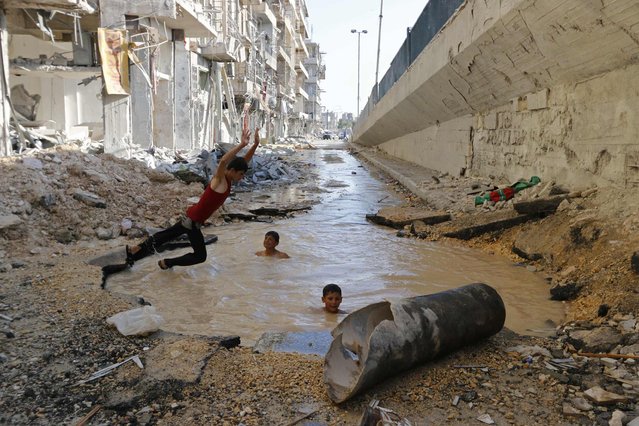
A youth dives into a crater filled with water in Aleppo's al-Shaar district, in this July 10, 2014 file photo. (Photo by Hosam Katan/Reuters)

A youth dives into a crater filled with water in Aleppo's al-Shaar district, in this July 10, 2014 file photo. (Photo by Hosam Katan/Reuters)
Details
04 Dec 2014 12:02:00
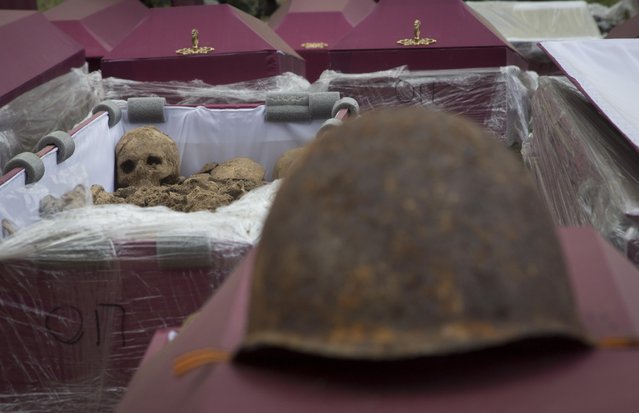
In this photo taken Thursday, May 7, 2015 photo,  remains of Soviet soldiers killed during World War II lay in a coffin prior to a reburial ceremony at the Sinyavino Heights memorial near the village of Sinyavino, 50 km (31 miles) east of  St. Petersburg, Russia. Hundreds of people came to a World War II battleground outside St. Petersburg this week to bury the remains of 964 Soviet soldiers recovered by volunteer search teams. (Photo by Dmitry Lovetsky/AP Photo)

In this photo taken Thursday, May 7, 2015 photo, remains of Soviet soldiers killed during World War II lay in a coffin prior to a reburial ceremony at the Sinyavino Heights memorial near the village of Sinyavino, 50 km (31 miles) east of St. Petersburg, Russia. Hundreds of people came to a World War II battleground outside St. Petersburg this week to bury the remains of 964 Soviet soldiers recovered by volunteer search teams. Fifty crimson coffins containing skulls and bones were solemnly buried at the Sinyavino Heights memorial as Russian war songs played and an honor guard fired a salute. (Photo by Dmitry Lovetsky/AP Photo)
Details
10 May 2015 11:12:00
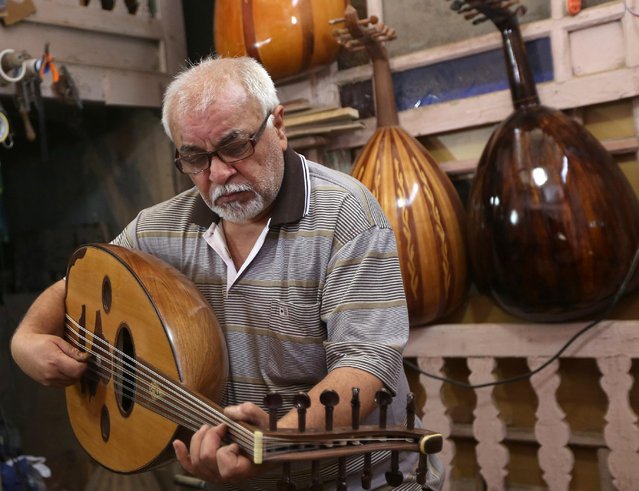
In this photo taken Saturday, June 20, 2015, Mahmoud Abdulnabi tries out an oud, an Arabic instrument related to the lute, at his workshop in Baghdad, Iraq. “The oud is different than other musical instruments”, said Abdulnabi, who has crafted ouds played by some of Iraq's best known musicians, many of whom look down from headshots on the walls. “If you feel joyful, it can play your joy. If the circumstances are sad it can play your sorrow and... help to empty whatever is in your chest”. (Photo by Hadi Mizban/AP Photo)

In this photo taken Saturday, June 20, 2015, Mahmoud Abdulnabi tries out an oud, an Arabic instrument related to the lute, at his workshop in Baghdad, Iraq. “The oud is different than other musical instruments”, said Abdulnabi, who has crafted ouds played by some of Iraq's best known musicians, many of whom look down from headshots on the walls. “If you feel joyful, it can play your joy. If the circumstances are sad it can play your sorrow and... help to empty whatever is in your chest”. (Photo by Hadi Mizban/AP Photo)
Details
05 Jul 2015 10:32:00
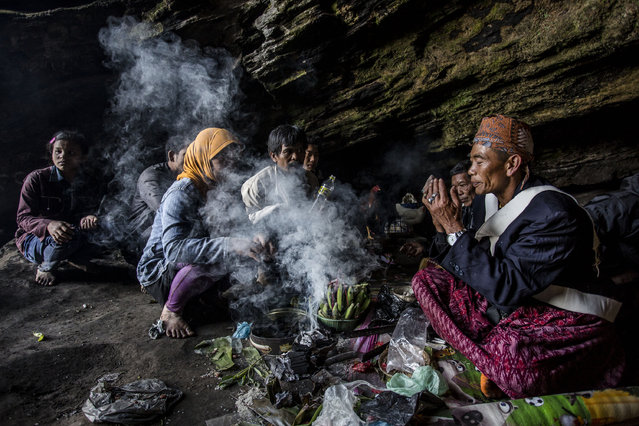
A Tenggerese shaman praying for worshippers at Widodaren cave during the Tenggerese Hindu Yadnya Kasada festival on July 31, 2015 in Probolinggo, East Java, Indonesia. The festival is the main festival of the Tenggerese people and lasts about a month. On the fourteenth day, the Tenggerese make the journey to Mount Bromo to make offerings of rice, fruits, vegetables, flowers and livestock to the mountain gods by throwing them into the volcano's caldera. (Photo by Ulet Ifansasti/Getty Images)

A Tenggerese shaman praying for worshippers at Widodaren cave during the Tenggerese Hindu Yadnya Kasada festival on July 31, 2015 in Probolinggo, East Java, Indonesia. The festival is the main festival of the Tenggerese people and lasts about a month. On the fourteenth day, the Tenggerese make the journey to Mount Bromo to make offerings of rice, fruits, vegetables, flowers and livestock to the mountain gods by throwing them into the volcano's caldera. The origin of the festival lies in the 15th century when a princess named Roro Anteng started the principality of Tengger with her husband Joko Seger, and the childless couple asked the mountain Gods for help in bearing children. The legend says the Gods granted them 24 children but on the provision that the 25th must be tossed into the volcano in sacrifice. The 25th child, Kesuma, was finally sacrificed in this way after initial refusal, and the tradition of throwing sacrifices into the caldera to appease the mountain Gods continues today. (Photo by Ulet Ifansasti/Getty Images)
Details
01 Aug 2015 12:07:00
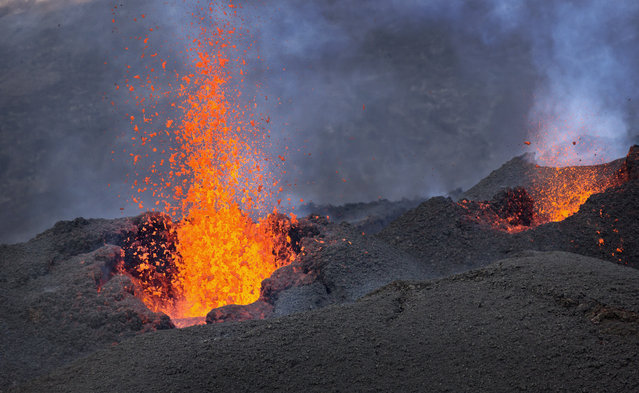
Lava erupts from the Piton de la Fournaise “Peak of the Furnace” volcano, on the southeastern corner of the Indian Ocean island of Reunion Saturday, August 1, 2015. Spewing red-hot lava, one of the most active volcanoes in the world is currently erupting on this Indian Ocean island, where the world's attention has been focused since a wing fragment believed to be from the missing Malaysian jet was discovered washed up on a beach. (Photo by Ben Curtis/AP Photo)

Lava erupts from the Piton de la Fournaise “Peak of the Furnace” volcano, on the southeastern corner of the Indian Ocean island of Reunion Saturday, August 1, 2015. Spewing red-hot lava, one of the most active volcanoes in the world is currently erupting on this Indian Ocean island, where the world's attention has been focused since a wing fragment believed to be from the missing Malaysian jet was discovered washed up on a beach. The lava fountains are shooting as high as 40 meters (44 yards) and are creating cones that are about 20 meters high after only one day of eruption, said Peltier. The volcano is in the Reunion National Park – a world heritage site. The volcano is not seen as dangerous because the lava flows down the east side of the mountain through an uninhabited area called the Grand Brule, or the Big Burned, toward the sea. The last times the volcano threatened the population was in 1977 and 1986. (Photo by Ben Curtis/AP Photo)
Details
03 Aug 2015 12:23:00
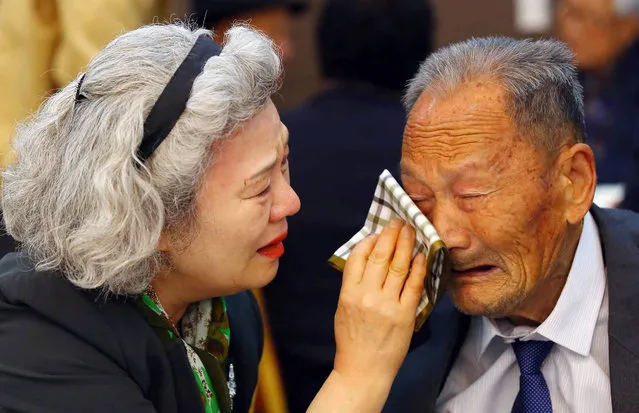
South Korean Lee Jung-sook (L), 68, wipes the tears from her North Korean father Lee Heung-jong, 88, as they bid each other a sad farewell at a resort on Mount Kumgang, North Korea, 22 October 2015. About 390 South Koreans arrived at the resort two days ago for the first face-to-face reunion of families separated by the 1950-53 Korean War in nearly 20 months. A second group of some 260 South Koreans will do the same for three days starting on 24 October. (Photo by Yonhap/EPA)

South Korean Lee Jung-sook (L), 68, wipes the tears from her North Korean father Lee Heung-jong, 88, as they bid each other a sad farewell at a resort on Mount Kumgang, North Korea, 22 October 2015. About 390 South Koreans arrived at the resort two days ago for the first face-to-face reunion of families separated by the 1950-53 Korean War in nearly 20 months. A second group of some 260 South Koreans will do the same for three days starting on 24 October. (Photo by Yonhap/EPA)
Details
24 Oct 2015 08:06:00