Loading...
Done
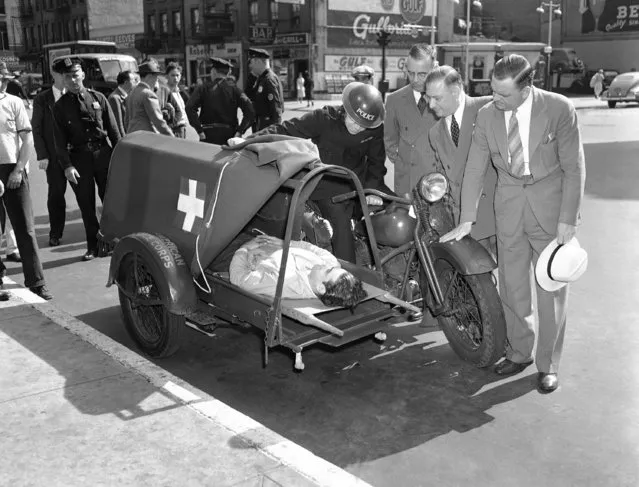
Developed for the British American Ambulance Corps, this new motorcycle ambulance is capable of speeding wounded soldiers 90 miles an hour from the front lines to field hospitals. Its springs are synchronized with the patient?s heartbeat to avoid increasing fever when traveling over various Terrain. Viewing it in New York  August 27, 1941, are left to right: constable Herbert Scott of England, driver; William E. Detlor, whose firm developed the vehicle; M. W. Stand, inspector-general of Civilian Defense, and Maj. Edward Riekert, also. (Photo by AP Photo)

Developed for the British American Ambulance Corps, this new motorcycle ambulance is capable of speeding wounded soldiers 90 miles an hour from the front lines to field hospitals. Its springs are synchronized with the patient's heartbeat to avoid increasing fever when traveling over various Terrain. Viewing it in New York August 27, 1941, are left to right: constable Herbert Scott of England, driver; William E. Detlor, whose firm developed the vehicle; M. W. Stand, inspector-general of Civilian Defense, and Maj. Edward Riekert, also. (Photo by AP Photo)
Details
28 Aug 2015 11:51:00
Mrs. Marie Graskamp of Milwaukee shows the different positions one might assume when entering the bomb shelter in Milwaukee  September 3, 1958. This circular entrance is about three feet in diameter. This is the entrance (according to the builders) that would connect to the cellar of a home assuming the shelter was in the ground for added protection. (Photo by AP Photo)

Mrs. Marie Graskamp of Milwaukee shows the different positions one might assume when entering the bomb shelter in Milwaukee September 3, 1958. This circular entrance is about three feet in diameter. This is the entrance (according to the builders) that would connect to the cellar of a home assuming the shelter was in the ground for added protection. If a bombing should occur, all members of family would proceed to the cellar and then through the circular port into the shelter. (Photo by AP Photo)
Details
04 Sep 2015 12:44:00
Khadjou Sambe, 25, surfs off the coast of Ngor, Dakar, Senegal, August 18, 2020. Growing up in the coastal capital of Dakar, Sambe never saw a Black woman surfing the Atlantic swells. As Senegal's first female professional surfer, Sambe is now inspiring the next generation to defy cultural norms and take to the waves as a surfing coach for local girls. “When I am in the water I feel something extraordinary, something special in my heart”, Sambe said. (Photo by Zohra Bensemra/Reuters)

Khadjou Sambe, 25, surfs off the coast of Ngor, Dakar, Senegal, August 18, 2020. Growing up in the coastal capital of Dakar, Sambe never saw a Black woman surfing the Atlantic swells. As Senegal's first female professional surfer, Sambe is now inspiring the next generation to defy cultural norms and take to the waves as a surfing coach for local girls. “When I am in the water I feel something extraordinary, something special in my heart”, Sambe said. (Photo by Zohra Bensemra/Reuters)
Details
18 Sep 2020 00:01:00
Alejandro Zelayaran, 43, dressed as Santa Claus, wears a protective face shield as he poses for a photograph on a street in Mexico City, Mexico, December 3, 2020. “Faith and hope must move the heart of the humanity”, said Zelayaran, who will don a face shield when he distributes dolls and other gifts at an orphanage in Mexico City. “I want to see families taking care of each other and knowing that even from afar, love and hope always survive”. (Photo by Edgard Garrido/Reuters)

Alejandro Zelayaran, 43, dressed as Santa Claus, wears a protective face shield as he poses for a photograph on a street in Mexico City, Mexico, December 3, 2020. “Faith and hope must move the heart of the humanity”, said Zelayaran, who will don a face shield when he distributes dolls and other gifts at an orphanage in Mexico City. “I want to see families taking care of each other and knowing that even from afar, love and hope always survive”. (Photo by Edgard Garrido/Reuters)
Details
28 Feb 2021 09:51:00
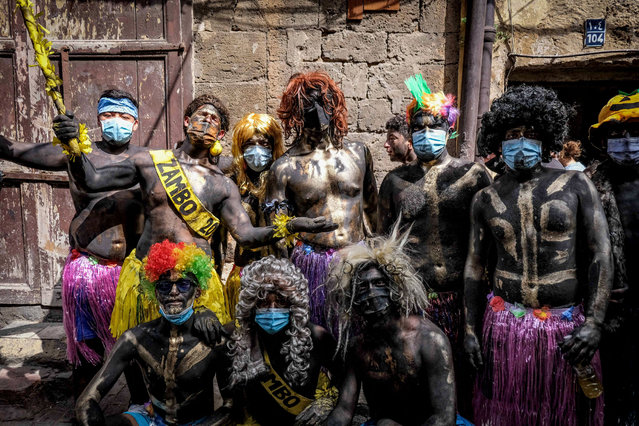
Carnival participants dressed in costume and wearing body paint pose for a group picture during the annual Zambo carnival held in Lebanon's northern city of Tripoli on March 14, 2021, marking the last period of excess on the eve of the Christian Greek Orthodox lent. The inspiration of the annual Zambo celebration is unclear, despite it being a tradition that stretches back over a century to when an emigrant to Brazil returned to his native Tripoli bringing the carnival with him. (Photo by Ibrahim Chalhoub/AFP Photo)

Carnival participants dressed in costume and wearing body paint pose for a group picture during the annual Zambo carnival held in Lebanon's northern city of Tripoli on March 14, 2021, marking the last period of excess on the eve of the Christian Greek Orthodox lent. The inspiration of the annual Zambo celebration is unclear, despite it being a tradition that stretches back over a century to when an emigrant to Brazil returned to his native Tripoli bringing the carnival with him. (Photo by Ibrahim Chalhoub/AFP Photo)
Details
27 Mar 2021 08:59:00
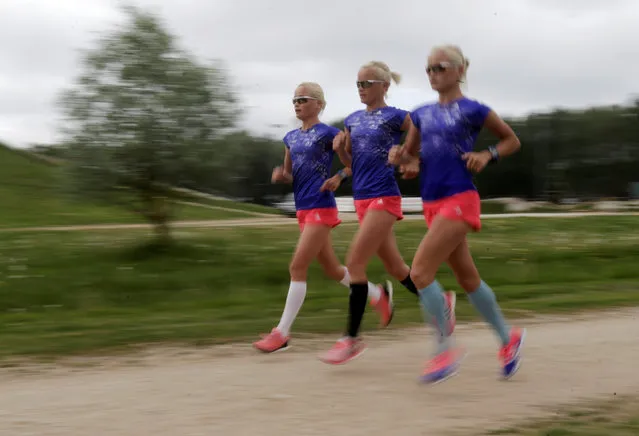
Estonia's olympic team female marathon runners triplets (L-R) Lily, Liina and Leila Luik run during a training session in Tartu, Estonia, May 26, 2016. Leila, Liina and Lily Luik will make Olympics history as the first identical triplets to compete against each other when they cross the start line for the women's marathon in Rio. (Photo by Ints Kalnins/Reuters)

Estonia's olympic team female marathon runners triplets (L-R) Lily, Liina and Leila Luik run during a training session in Tartu, Estonia, May 26, 2016. Leila, Liina and Lily Luik will make Olympics history as the first identical triplets to compete against each other when they cross the start line for the women's marathon in Rio. (Photo by Ints Kalnins/Reuters)
Details
27 May 2016 13:04:00
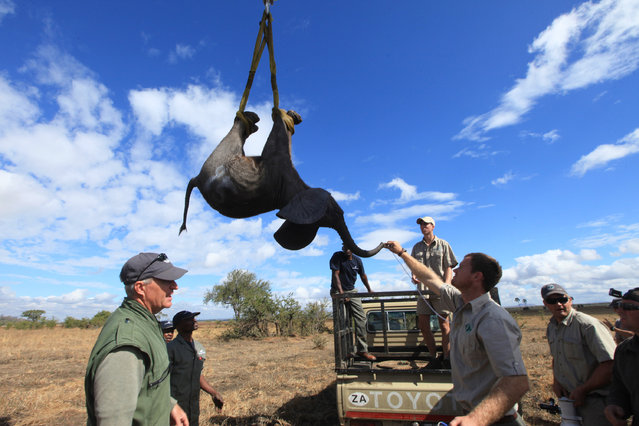
In this Tuesday July 12, 2016 photo, an elephant is lifted by a crane in an upside down position in Lilongwe, Malawi, in the first step of an assisted migration of 500 of the threatened species. African Parks, which manages three Malawian reserves is moving the 500 elephants from Liwonde National Park, this month and next, and again next year when vehicles can maneuver on the rugged terrain during Southern Africa's dry winter. (Photo by Tsvangirayi Mukwazhi/AP Photo)

In this Tuesday July 12, 2016 photo, an elephant is lifted by a crane in an upside down position in Lilongwe, Malawi, in the first step of an assisted migration of 500 of the threatened species. African Parks, which manages three Malawian reserves is moving the 500 elephants from Liwonde National Park, this month and next, and again next year when vehicles can maneuver on the rugged terrain during Southern Africa's dry winter. (Photo by Tsvangirayi Mukwazhi/AP Photo)
Details
20 Jul 2016 10:19:00
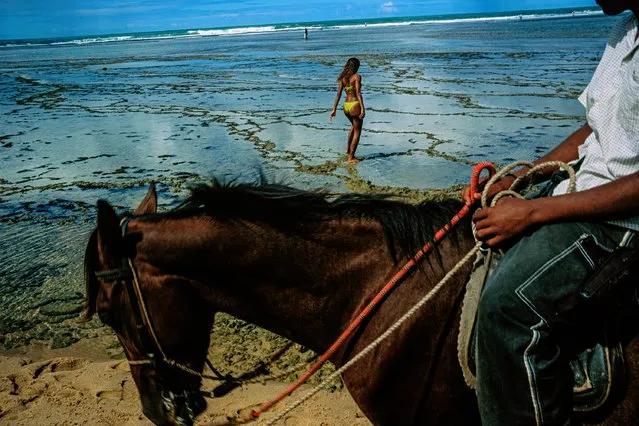
Praia du Forte, Bahia. “This was the lead picture for a National Geographic story on Bahia, because it was both mysterious as well as a “geography” picture showing where the slaves arrived from Nigeria. Beach pictures seem like they should be easy to take, but for me they are actually quite difficult. Too easy to fall into cliche. When I saw the kid coming on the horse, I quickly ran to see if I could make something with a woman in a bikini that was not a bikini shot”. (Photo by David Alan Harvey/The Guardian)

Praia du Forte, Bahia. “This was the lead picture for a National Geographic story on Bahia, because it was both mysterious as well as a “geography” picture showing where the slaves arrived from Nigeria. Beach pictures seem like they should be easy to take, but for me they are actually quite difficult. Too easy to fall into cliche. When I saw the kid coming on the horse, I quickly ran to see if I could make something with a woman in a bikini that was not a bikini shot”. (Photo by David Alan Harvey/The Guardian)
Details
20 Aug 2016 11:35:00