Loading...
Done
Make Your Franklin By Martin Joubert Part 1

Having $100 in your pocket would be so much cooler if it was designed by Martin Joubert. He went all out and created a number of different designs for the 100 USD banknotes, ranging from silly to witty. We especially liked the one with “That’s right. This is real money” written on it, showing just how many cups of coffee, basketballs, and guns you can buy with 100 dollars. All in all, even the currency that we have today is nothing but paper, even though it looks official and strict. There is nothing backing it up except for our noble military that ensures that Gulf States sell their oil using only the “green” kind of currency. (Photo by Martin Joubert)
Details
17 Dec 2014 11:19:00
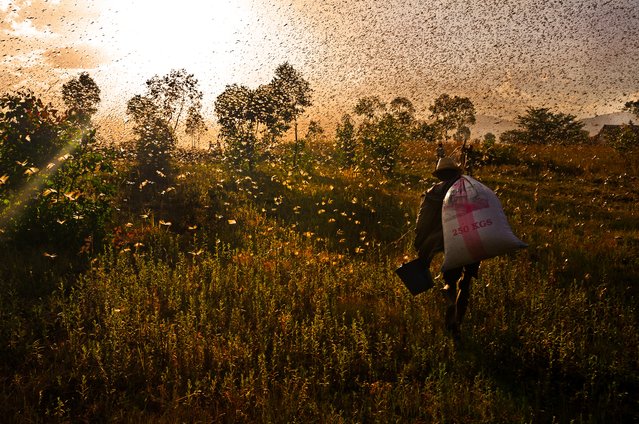
“Locusts & Men”. Oppression, interaction, collaboration. In the life cycle of nature nothing is lost, but the coexistence of different species is sometimes difficult. In Madagascar periodically returns the archaic antagonism between man and the migratory locust, in a circle of life where the two species are looking for space and food for their survival. Photo location: Madagascar, 2013. (Photo and caption by Michele Martinelli/National Geographic Photo Contest)

“Locusts & Men”. Oppression, interaction, collaboration. In the life cycle of nature nothing is lost, but the coexistence of different species is sometimes difficult. In Madagascar periodically returns the archaic antagonism between man and the migratory locust, in a circle of life where the two species are looking for space and food for their survival. At the end of the day a man walks home carrying on his shoulders the heavy bag which contains the locusts captured during the day. The insects provide nutritious meals for the man and his family. Photo location: Madagascar, 2013. (Photo and caption by Michele Martinelli/National Geographic Photo Contest)

ATTENTION! All pictures are presented in high resolution. To see Hi-Res images – just TWICE click on any picture. In other words, click small picture – opens the BIG picture. Click BIG picture – opens VERY BIG picture.
Details
03 Dec 2013 10:59:00
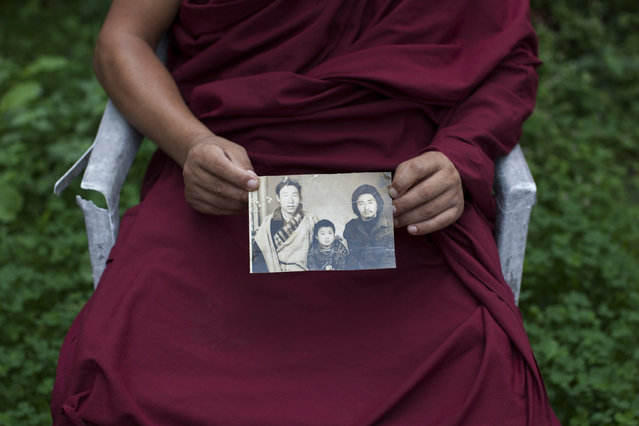
In this Saturday, September 27, 2014 photo, Tibetan monk Dorjee, 38, displays a photograph of his father, left, and himself, center, taken in Tibet, in Dharamsala, India. Dorjee said he held back his tears when he spoke with his parents on the phone after a separation period of 27 years. He exchanged a few words with his father but said his mother fainted on hearing his voice. (Photo by Tsering Topgyal/AP Photo)

“When I was 8 years old, my parents paid a smuggler to take me across the Himalayas, a weekslong walk over the mountains from Tibet to India. It was a trek that tens of thousands of other Tibetans have taken since the Dalai Lama fled a failed 1959 uprising against Chinese rule. My parents must have had their reasons to send me here; they must have had the best of intentions. But 18 years later, I still don't know why they did it. They are not political people. They are small farmers who raise barley and a few yak in a rural area not far from Lhasa, the Tibetan capital. I have not seen them since I left...”. – Tsering Topgyal via The Associated Press. (Photo by Tsering Topgyal/AP Photo)
Details
05 Nov 2014 12:27:00
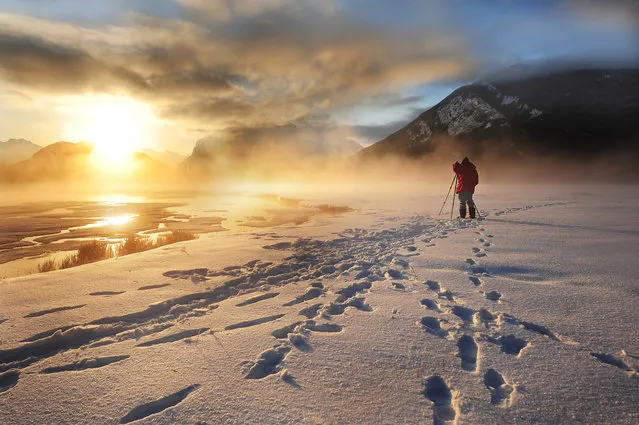
“Artist of the light”. While shooting sunrise in the Vermilion lakes area of Banff national park, Canada, I met a fellow photographer on the scene. Most of the time, we tried not to get in each other's way, however, just by accident, I snapped a picture with him in it working on his tripod settings, and it turned out to be a great photo compared to my sunrise shots. (Photo and caption by Victor Liu/National Geographic Traveler Photo Contest)

“Artist of the light”. While shooting sunrise in the Vermilion lakes area of Banff national park, Canada, I met a fellow photographer on the scene. Most of the time, we tried not to get in each other's way, however, just by accident, I snapped a picture with him in it working on his tripod settings, and it turned out to be a great photo compared to my sunrise shots. (Photo and caption by Victor Liu/National Geographic Traveler Photo Contest)

ATTENTION! All pictures are presented in high resolution. To see Hi-Res images – just TWICE click on any picture. In other words, click small picture – opens the BIG picture. Click BIG picture – opens VERY BIG picture.
Details
27 Jun 2013 13:11:00
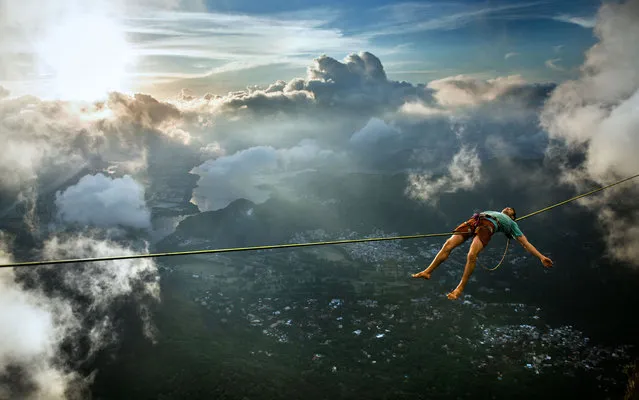
Pedra da Gavea highline, 850 meters above the city, 100 meters direct exposure, March 24, 2013. Brian Mosbaugh on the line. Carefully tiptoeing almost 3000 metres above Rio de Janeiro on a thin wire got a bit too much for this adrenaline junkie – so he decided to have a LIE DOWN. Fearless Brian Mosbaugh is so used to the perilous heights he decided he deserved a short break and proceeded to kick back and relax over the famous Brazilian city. (Photo by Scott Rogers/Caters)

Pedra da Gavea highline, 850 meters above the city, 100 meters direct exposure, March 24, 2013. Brian Mosbaugh on the line. Carefully tiptoeing almost 3000 metres above Rio de Janeiro on a thin wire got a bit too much for this adrenaline junkie – so he decided to have a LIE DOWN. Fearless Brian Mosbaugh is so used to the perilous heights he decided he deserved a short break and proceeded to kick back and relax over the famous Brazilian city. (Photo by Scott Rogers/Caters)

P.S. All pictures are presented in high resolution. To see Hi-Res images – just TWICE click on any picture. In other words, click small picture – opens the BIG picture. Click BIG picture – opens VERY BIG picture (if available; this principle works anywhere on the site AvaxNews).
Details
30 Mar 2013 12:00:00
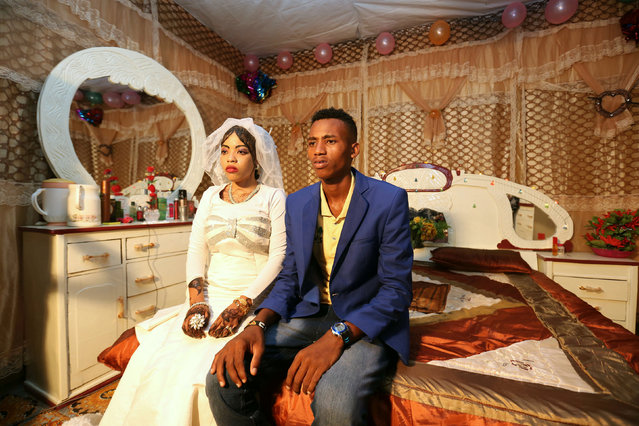
Somali couple Mohamed Noor (L) and Huda Omar pose for a photograph at their makeshift home during their wedding ceremony in Mogadishu's Rajo camp, Somalia August 17, 2016. Having met two years ago, the pair have just married at Rajo camp, where some 400 families live. Most, like Noor's parents, came here in the early 1990s to flee famine. They stayed on as years of conflict ravaged the Horn of Africa nation. As at any wedding, there is plenty of dancing and sweet treats for the young couple as they start married life in Noor's simple home, made of iron and plastic sheets. Noor works as a mason with his father. Others here are builders or sell sweets, nuts and stick toothbrushes to make money. Some beg around the seaside city, which like the rest of Somalia has been gripped by violence since the toppling of dictator Mohamed Siad Barre in 1991. (Photo by Feisal Omar/Reuters)

Somali couple Mohamed Noor (L) and Huda Omar pose for a photograph at their makeshift home during their wedding ceremony in Mogadishu's Rajo camp, Somalia August 17, 2016. Having met two years ago, the pair have just married at Rajo camp, where some 400 families live. Most, like Noor's parents, came here in the early 1990s to flee famine. (Photo by Feisal Omar/Reuters)
Details
14 Sep 2016 10:35:00
A performer wearing a lion mask performs the Ise Daikagura lion dance at the remote village of Yamanawa on February 08, 2021 in Ryuo, Japan. Ise Daikagura is a group of traditional Lion Dance performers who pray in front of farmers houses and businesses for good grain harvests and disease-free lives. Performers play sacred music using drums and flutes with two lion mask dancers. A lion mask is considered a symbol of God, who enters the house and performs in front of the Shinto God, a statue placed inside the house, mostly in the kitchen. These prayers are called “Kamodo Barai”. After the prayers, they are gifted with money, rice, sake and Japanese sweets from the householders. A group can travel for more than one hundred days to thousands of households and businesses throughout rural-villages in western Japan, and pray to those who are unable to visit the country’s most sacred shrine, the Grand Ise Shrine in Mie Prefecture. The group started its performance in the Edo era between 1603 to 1868 according to Japanese history. The Japanese government designated it as an important folk cultural national property in 1981. (Photo by Buddhika Weerasinghe/Getty Images)

A performer wearing a lion mask performs the Ise Daikagura lion dance at the remote village of Yamanawa on February 08, 2021 in Ryuo, Japan. Ise Daikagura is a group of traditional Lion Dance performers who pray in front of farmers houses and businesses for good grain harvests and disease-free lives. (Photo by Buddhika Weerasinghe/Getty Images)
Details
18 Feb 2021 09:27:00
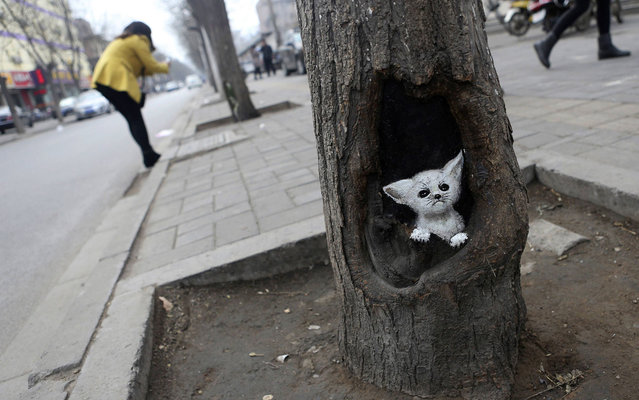
An image of a Fennec fox painted on a tree hole by Wang Yue is seen in Shijiazhuang, on March 13, 2013. Wang Yue, a senior at Dalian Industry University, uses her paintbrush to turn ugly tree holes into lovely views in Shijiazhuang, capital city of Hebei Province, China. Wang and her companions call the tree-hole paintings “meitu”, which means “beautiful journey”. The paintings on the trees have brightened the city during the dull, grey winter. (Photo by Pillar Lee/Reuters)

An image of a Fennec fox painted on a tree hole by Wang Yue is seen in Shijiazhuang, on March 13, 2013. Wang Yue, a senior at Dalian Industry University, uses her paintbrush to turn ugly tree holes into lovely views in Shijiazhuang, capital city of Hebei Province, China. Wang and her companions call the tree-hole paintings “meitu”, which means “beautiful journey”. The paintings on the trees have brightened the city during the dull, grey winter. (Photo by Pillar Lee/Reuters)

P.S. All pictures are presented in high resolution. To see Hi-Res images – just TWICE click on any picture. In other words, click small picture – opens the BIG picture. Click BIG picture – opens VERY BIG picture (if available; this principle works anywhere on the site AvaxNews).
Details
16 Mar 2013 11:27:00