Loading...
Done
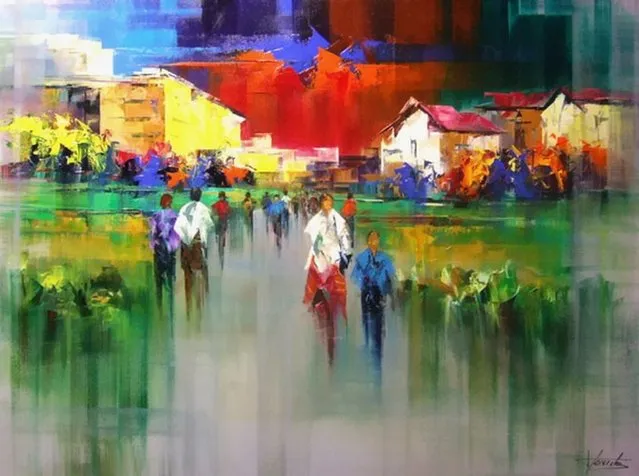
Painting By Josep Teixido

I was born in Calella (Barcelona) in 1956, and nowadays I live in Vilassar de Mar (Barcelona). Since I was a child I have been fascinated by painting and I think I'm a self-taught painter because, despite I was taught drawing at Primary School, I have acquired my knowledge thanks to my environment. Painting is my own way to express myself. I can shape my inward in the canvas with the essential help of the palette knife and the colours. As a nature’s lover and great observant, my environment has always been my source of inspiration. At present I devote myself exclusively to painting, my true passion, and that is why I feel extremely fortunate.

Josep Teixido
Details
18 Sep 2013 09:45:00


“Henri Marie Raymond de Toulouse-Lautrec-Monfa or simply Henri de Toulouse-Lautrec (24 November 1864 – 9 September 1901) was a French painter, printmaker, draughtsman, and illustrator, whose immersion in the colourful and theatrical life of fin de siècle Paris yielded an œuvre of exciting, elegant and provocative images of the modern and sometimes decadent life of those times. Toulouse-Lautrec is known along with Cézanne, Van Gogh, and Gauguin as one of the greatest painters of the Post-Impressionist period. In a 2005 auction at Christie's auction house a new record was set when “La blanchisseuse”, an early painting of a young laundress, sold for $22.4 million U.S” – Wikipedia.

Photo: Full-length portrait of French artist Henri Toulouse-Lautrec wearing an overcoat, a bowler hat, and pince-nez eyeglasses while holding a cane. (Photo by Hulton Archive/Getty Images). Circa 1895
Details
20 Mar 2011 09:28:00
A believer dressed as a “diablo” (devil) jumps at the San Blas' (Saint Blaise) procession during the “Endiablada” festival in Almonacid del Marquesado, in central Spain February 3, 2015. In the “Endiablada”, an undated traditional festival in honour of the Candelaria Virgin and San Blas. (Photo by Susana Vera/Reuters)

A believer dressed as a “diablo” (devil) jumps at the San Blas' (Saint Blaise) procession during the “Endiablada” festival in Almonacid del Marquesado, in central Spain February 3, 2015. In the “Endiablada”, an undated traditional festival in honour of the Candelaria Virgin and San Blas, believers are dressed in colourful costumes, wear a mitre with lead cowbells tied to their waists that ring as they wander around the village and in front of the saints' statues during their processions. (Photo by Susana Vera/Reuters)
Details
05 Feb 2015 12:02:00
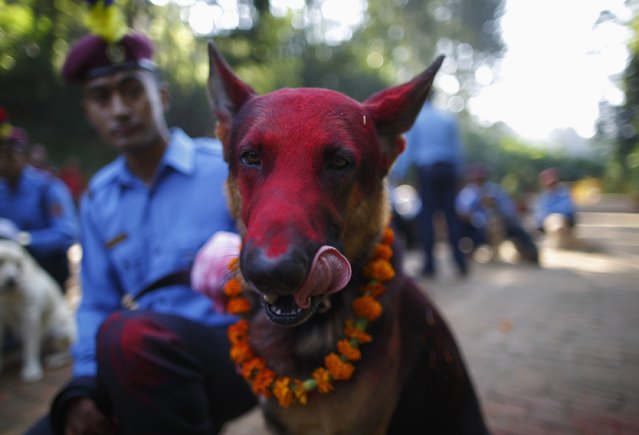
A police dog licks its face after receiving food during the dog festival, as part of celebrations of Tihar at Nepal Police Academy in Kathmandu October 22, 2014. Hindus all over Nepal are celebrating the Tihar festival, also called Diwali, during which they worship cows, which are considered a maternal figure, and other animals. (Photo by Navesh Chitrakar/Reuters)

A police dog licks its face after receiving food during the dog festival, as part of celebrations of Tihar at Nepal Police Academy in Kathmandu October 22, 2014. Hindus all over Nepal are celebrating the Tihar festival, also called Diwali, during which they worship cows, which are considered a maternal figure, and other animals. Also known as the festival of lights, devotees also worship the goddess of wealth Laxmi by illuminating and decorating their homes using garlands, oil lamps, candles and colourful light bulbs. (Photo by Navesh Chitrakar/Reuters)
Details
23 Oct 2014 11:57:00
“Eye of a toad”. Animal Portraits, Łukasz Bożycki, Poland.  (Photo by Łukasz Bożycki)

“Eye of a toad”. Animal Portraits, Łukasz Bożycki, Poland. Early spring sees a pond near Łukasz’s home city of Warsaw, Poland, full of mating frogs and a few toads. On this March day, Łukasz shared the pond with them for an evening, sitting in the icy water in his chest-high waders, keeping as still as possible, despite the numbing cold, so that the amphibians could get used to him. “I wanted to find a fresh way of portraying the amphibians”, he says, “at water level”. Using a telephoto lens, he focused on one lone toad and waited for the sun to dip almost below the horizon before pressing the shutter, using flash to bring out the details in the shadow. His prize was “the glorious pool of sunset colour” and fiery glow of the toad’s eye. Nikon D80 + 70-300mm f4.5-5.6 lens + extension tube; 1/125 sec at f9 (-2.3 e/v); ISO 100; built-in flash. (Photo by Łukasz Bożycki)
Details
28 Aug 2013 11:45:00


“Echus Chasma is a chasma in the Lunae Planum high plateau north of the Valles Marineris canyon system of Mars. Clay has been found in Echus Chasma that means that water once sat there for a time. Echus Chasma is approximately 100 km long and 10 km wide, with valleys ranging in depth from around 1 km to 4 km”. – Wikipedia

Photo: In this handout image supplied by the European Space Agency (ESA) on July 16, 2008, The Echus Chasma, one of the largest water source regions on Mars, is pictured from ESA's Mars Express. The data was acquired on September 25, 2005. The dark material shows a network of light-coloured, incised valleys that look similar to drainage networks known on Earth. It is still debated whether the valleys originate from precipitation, groundwater springs or liquid or magma flows on the surface. (Photo by ESA via Getty Images)
Details
18 Jul 2011 11:47:00
Dancers wait backstage during a dress rehearsal for the new “THE ONE Grand Show” at Friedrichstadt-Palast in Berlin, Germany, September 21, 2016. (Photo by Hannibal Hanschke/Reuters)

Dancers wait backstage during a dress rehearsal for the new “THE ONE Grand Show” at Friedrichstadt-Palast in Berlin, Germany, September 21, 2016. From silver body suits with giant mohawks to revealing fishnet tops with huge feathers, colourful, extravagant costumes take centre stage at a new theatrical show in Berlin. French couturier Jean Paul Gaultier has swapped the Paris runway for the German stage to create some 500 costumes for “THE ONE Grand Show”, an 11-million euro ($12.2 million) production showcasing plenty of singing, dancing and acrobatics. (Photo by Hannibal Hanschke/Reuters)
Details
08 Oct 2016 12:09:00
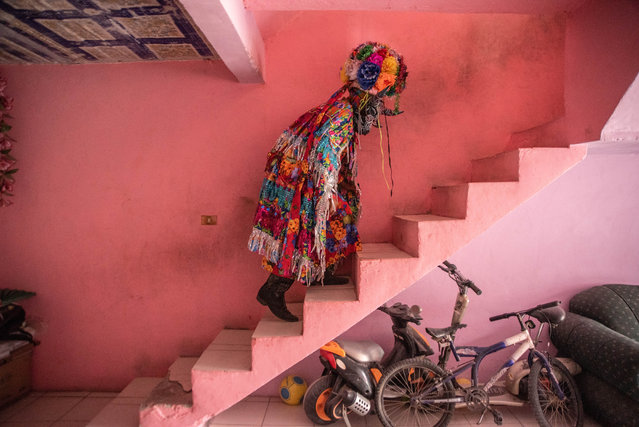
Inhabitants of the community of Coyolillo celebrate their Afro-descendant carnival in Veracruz, Mexico on February 25, 2020. This carnival has more than 100 years of history and is the heritage of the African workers who arrived in that area more than 300 years ago to work in the sugar cane fields. The event is known for the colourful robes, capes and animal masks – of bulls, deer, goats and cows – worn by participants. As such, the carnival is a unique expression of African-Mexican folk art. (Photo by Hector Adolfo Quintanar Perez/ZUMA Wire/Rex Features/Shutterstock)

Inhabitants of the community of Coyolillo celebrate their Afro-descendant carnival in Veracruz, Mexico on February 25, 2020. This carnival has more than 100 years of history and is the heritage of the African workers who arrived in that area more than 300 years ago to work in the sugar cane fields. (Photo by Hector Adolfo Quintanar Perez/ZUMA Wire/Rex Features/Shutterstock)
Details
05 Mar 2020 00:03:00