Loading...
Done
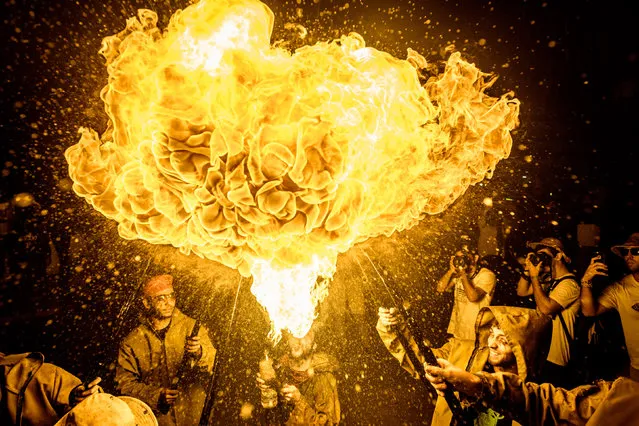
A fire-eater of the “Diables de Terrassa” performs during Sitges' little “Festa Major”, “Santa Tecla” in Sitges, Spain on September 19, 2016. This celebration brings together some of Catalonia’s most emblematic festive traditions. The central axis of the celebrations is the traditional parade, made up of “big-head” carnival figures and characters who dance to music played on different traditional instruments. One of the most popular events is the Correfoc or fire-running, which is also the closing event of the fiesta. The people run and jump over characters dressed up as devils and dragons, carrying fire. (Photo by Matthias Oesterle/ZUMA Press/Splash News)

A fire-eater of the “Diables de Terrassa” performs during Sitges' little “Festa Major”, “Santa Tecla” in Sitges, Spain on September 19, 2016. This celebration brings together some of Catalonia’s most emblematic festive traditions. The central axis of the celebrations is the traditional parade, made up of “big-head” carnival figures and characters who dance to music played on different traditional instruments. One of the most popular events is the Correfoc or fire-running, which is also the closing event of the fiesta. The people run and jump over characters dressed up as devils and dragons, carrying fire. (Photo by Matthias Oesterle/ZUMA Press/Splash News)
Details
20 Sep 2016 09:28:00
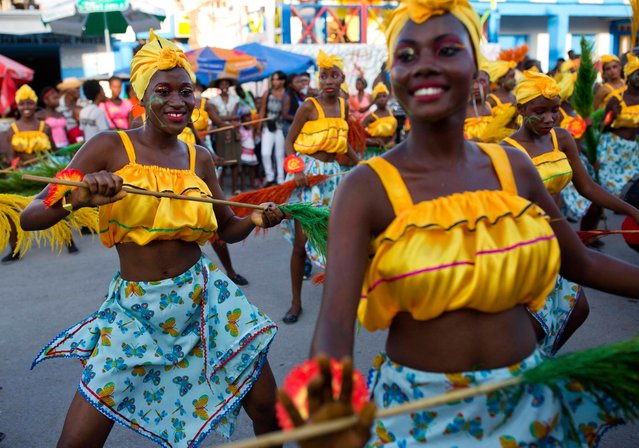
Dancers perform at a Carnival parade in Les Cayes, Haiti, Tuesday, February 28, 2017. (Photo by Dieu Nalio Chery/AP Photo)

Dancers perform at a Carnival parade in Les Cayes, Haiti, Tuesday, February 28, 2017. Haiti's three-day Carnival festivities have brought rum-fueled parties, imaginative costumes and high-energy dance music to a southern city that's still recovering from last year's punishing Hurricane Matthew. (Photo by Dieu Nalio Chery/AP Photo)
Details
03 Mar 2017 00:02:00
Lido cabaret dancers perform during a demonstration outside the cabaret as dancers, other employees and union activists are gathering to try to save their jobs and the history of the cabaret, known for its dinner theater and its “Bluebell Girls” revue, Saturday, May 28, 2022 in Paris. Amid financial troubles and changing times, the venue's new corporate owner is ditching most of the Lido's staff and its high-kicking, high-glamour dance shows – which date back decades and inspired copycats from Las Vegas to Beirut – in favor of more modest musical revues. (Photo by Thomas Padilla/AP Photo)

Lido cabaret dancers perform during a demonstration outside the cabaret as dancers, other employees and union activists are gathering to try to save their jobs and the history of the cabaret, known for its dinner theater and its “Bluebell Girls” revue, Saturday, May 28, 2022 in Paris. Amid financial troubles and changing times, the venue's new corporate owner is ditching most of the Lido's staff and its high-kicking, high-glamour dance shows – which date back decades and inspired copycats from Las Vegas to Beirut – in favor of more modest musical revues. (Photo by Thomas Padilla/AP Photo)
Details
17 Jul 2023 03:07:00
A performer wearing a lion mask performs the Ise Daikagura lion dance at the remote village of Yamanawa on February 08, 2021 in Ryuo, Japan. Ise Daikagura is a group of traditional Lion Dance performers who pray in front of farmers houses and businesses for good grain harvests and disease-free lives. Performers play sacred music using drums and flutes with two lion mask dancers. A lion mask is considered a symbol of God, who enters the house and performs in front of the Shinto God, a statue placed inside the house, mostly in the kitchen. These prayers are called “Kamodo Barai”. After the prayers, they are gifted with money, rice, sake and Japanese sweets from the householders. A group can travel for more than one hundred days to thousands of households and businesses throughout rural-villages in western Japan, and pray to those who are unable to visit the country’s most sacred shrine, the Grand Ise Shrine in Mie Prefecture. The group started its performance in the Edo era between 1603 to 1868 according to Japanese history. The Japanese government designated it as an important folk cultural national property in 1981. (Photo by Buddhika Weerasinghe/Getty Images)

A performer wearing a lion mask performs the Ise Daikagura lion dance at the remote village of Yamanawa on February 08, 2021 in Ryuo, Japan. Ise Daikagura is a group of traditional Lion Dance performers who pray in front of farmers houses and businesses for good grain harvests and disease-free lives. (Photo by Buddhika Weerasinghe/Getty Images)
Details
18 Feb 2021 09:27:00
PSY performs at his concert “Happening” in Seoul, on April 13, 2013. The South Korean pop star's first new single since his viral hit “Gangnam Style” is stealing attention from inter-Korean tensions. (Photo by Kin Cheung/Associated Press)

“Gangnam Style” star PSY's new music video had been watched more than 10 million times on YouTube less than 24 hours after he unveiled his much-anticipated new dance in Seoul, the website showed Sunday. Photo: PSY performs at his concert “Happening” in Seoul, on April 13, 2013. The South Korean pop star's first new single since his viral hit “Gangnam Style” is stealing attention from inter-Korean tensions. (Photo by Kin Cheung/Associated Press)
Details
14 Apr 2013 11:08:00
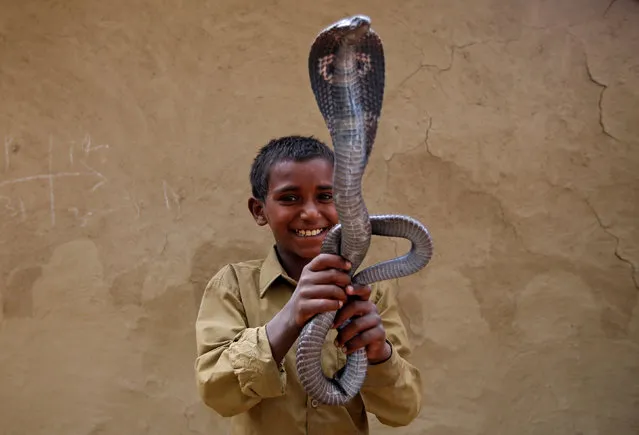
Ravi Nath poses for a photograph with a cobra snake in Jogi Dera (Snake charmers settlement), in the village of Baghpur, in the central state of Uttar Pradesh, India November 10, 2016. (Photo by Adnan Abidi/Reuters)

Ravi Nath poses for a photograph with a cobra snake in Jogi Dera (Snake charmers settlement), in the village of Baghpur, in the central state of Uttar Pradesh, India November 10, 2016. An ancient tribe of snake charmers, known as Saperas, have thrived over the generations by catching venomous snakes and making them dance to their music. Snakes are revered by Hindus in India and snake charmers are considered the followers of Lord Shiva, the blue-skinned Hindu god who is usually portrayed wearing a king cobra around his neck. (Photo by Adnan Abidi/Reuters)
Details
26 Jan 2017 13:06:00
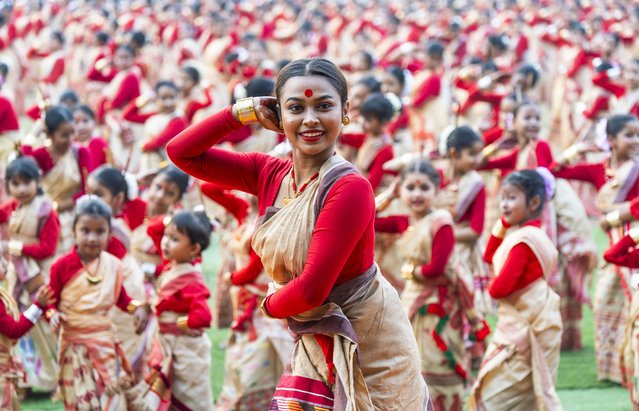
An instructor dances as participants follow the dance steps in a Bihu dance workshop ahead of the Rongali Bihu Festival in Guwahati, India, on April 8, 2025. (Photo by David Talukdar/NurPhoto/Rex Features/Shutterstock)

An instructor dances as participants follow the dance steps in a Bihu dance workshop ahead of the Rongali Bihu Festival in Guwahati, India, on April 8, 2025. (Photo by David Talukdar/NurPhoto/Rex Features/Shutterstock)
Details
28 Apr 2025 02:52:00


Отава Ё – Яблочко (Otava Yo – Yablochko; Russian: Яблочко, “Little Apple”). Yablochko is a Russian folk song of chastushka style and dance, traditionally presented as sailors' dance. The choreographed version of the dance first appeared in the 1926 Reinhold Glière ballet The Red Poppy and from there is known in the West as the Russian Sailors Dance.
Details
17 Aug 2019 00:03:00