Loading...
Done
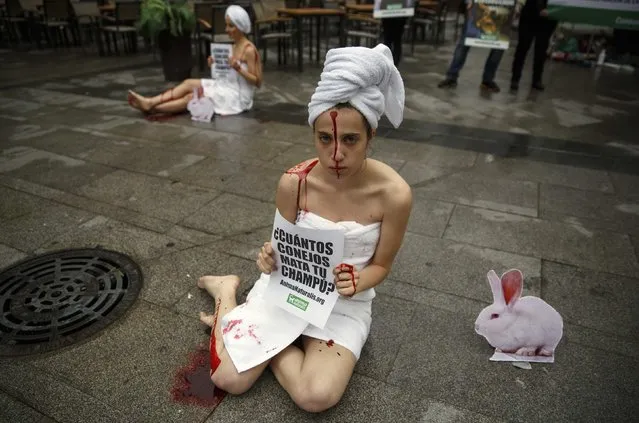
Animal rights activists covered with fake blood sit on the floor during a protest against the use of animals in research to mark World Day for Animals in Laboratories in central Madrid April 24, 2014. The sign reads, “How many rabbits do your shampoo kill?”. (Photo by Andrea Comas/Reuters)

Animal rights activists covered with fake blood sit on the floor during a protest against the use of animals in research to mark World Day for Animals in Laboratories in central Madrid April 24, 2014. The sign reads, “How many rabbits do your shampoo kill?”. (Photo by Andrea Comas/Reuters)
Details
26 Apr 2014 11:44:00
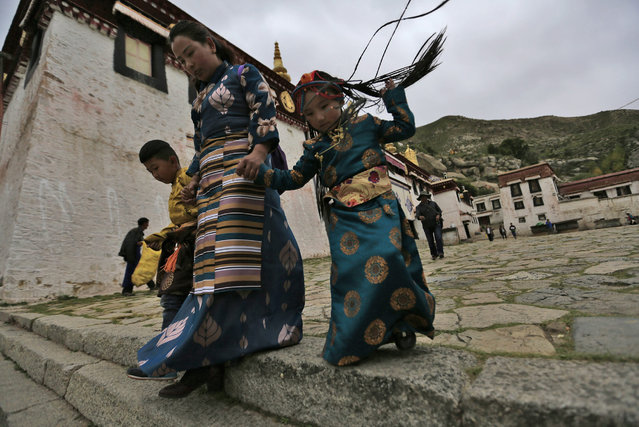
Tibetan pilgrims walk outside the Sera Monastery in Lhasa, Tibet Autonomous Region, China, 11 September 2016. Sera Monastery is known as one of the “great three” Gelug university monasteries of Tibet founded in 1419. (Photo by How Hwee Young/EPA)

Tibetan pilgrims walk outside the Sera Monastery in Lhasa, Tibet Autonomous Region, China, 11 September 2016. Sera Monastery is known as one of the “great three” Gelug university monasteries of Tibet founded in 1419. (Photo by How Hwee Young/EPA)
Details
22 Sep 2016 09:59:00
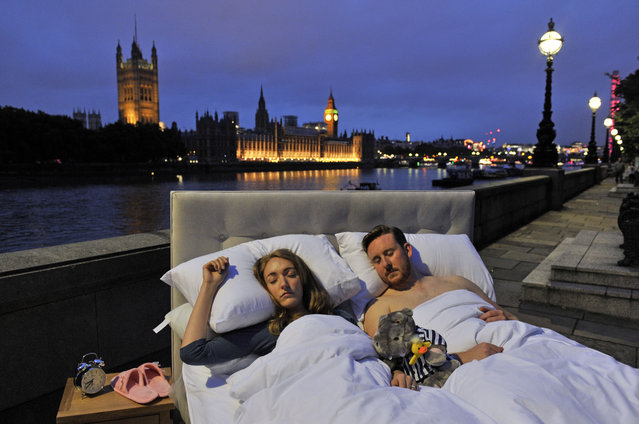
Londoners enjoy a “Silent Night” as Big Ben falls silent, London, UK on August 21, 2017. Londoners snuggle up to enjoy the city's first silent night as Big Ben chimed its last for four years. As the sun set over London last night the city bid a temporary farewell to the chimes of its beloved Big Ben. Londoners were testing out the new quiet of the Southbank in an unusual fashion. A luxurious bed, courtesy of bed firm, Silentnight, complete with fluffy white duvet, plump pillows, a hot water bottle and a cuddly toy, emerged in the heart of the city, just in time for bed. It didn't take local residents and workers long to make the most of the peace and quiet with the city's tired workers climbing in for a nap. Rose Allerston from Clapham, London said “After a stressful day in the office, I couldn't think of anything better than going home and climbing into bed - but when I saw this bed opposite Big Ben I just couldn't resist getting in for a snuggle”. (Photo by Imagewise Ltd/Rex Features/Shutterstock)

Londoners enjoy a “Silent Night” as Big Ben falls silent, London, UK on August 21, 2017. ose Allerston from Clapham, London said “After a stressful day in the office, I couldn't think of anything better than going home and climbing into bed – but when I saw this bed opposite Big Ben I just couldn't resist getting in for a snuggle”. (Photo by Imagewise Ltd/Rex Features/Shutterstock)
Details
23 Aug 2017 08:44:00
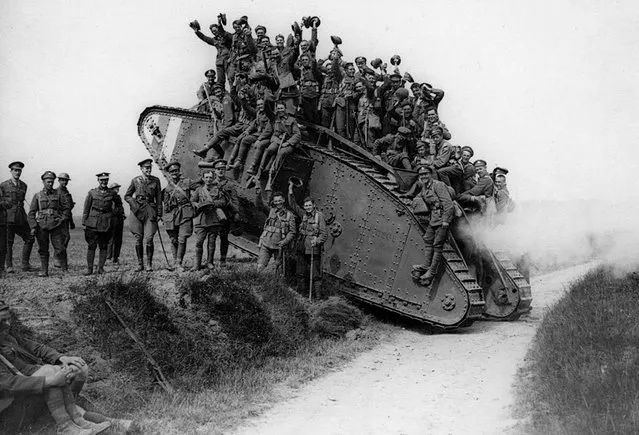
These black-and-white photos are taken from the new book “Armoured Warfare in the First World War 1916 – 1918” by Anthony Tucker-Jones and published by Pen & Sword Military. “Interestingly the British, French and Germans took completely different approaches with varying results”. The British military produced “Little Willie” in Autumn 1915 weighing 18 tonnes, which had a crew of two plus four gunners. “Inspired by a tracked artillery tractor “Little Willie” was referred to as a water tank – hence the name tank – to ensure secrecy”, said Anthony. “This led to the strange looking Mark I with its peculiar rhomboid shape, designed to cross trenches with guns in sponsons on either side. The Germans saw the tank as unchivalrous and were slow to grasp its utility. They favoured the Stormtrooper (specialist soldiers used to infiltrate enemy trenches) and artillery, not the tank”, said Anthony. “However, they didn’t hesitate to make use of captured British tanks. Although the tank helped secure victory and German soldiers dubbed it “Germany’s Downfall” the country was ultimately brought to its knees by the Allies blockade”. Here: British troops hitch a ride on a Mark IV after the massed tank fleet spearheading attack at Cambrai on November 20, 1917. (Photo by Anthony Tucker-Jones/Mediadrumworld.com)

These black-and-white photos are taken from the new book “Armoured Warfare in the First World War 1916 – 1918” by Anthony Tucker-Jones and published by Pen & Sword Military. Here: British troops hitch a ride on a Mark IV after the massed tank fleet spearheading attack at Cambrai on November 20, 1917. (Photo by Anthony Tucker-Jones/Mediadrumworld.com)
Details
23 Feb 2017 00:02:00
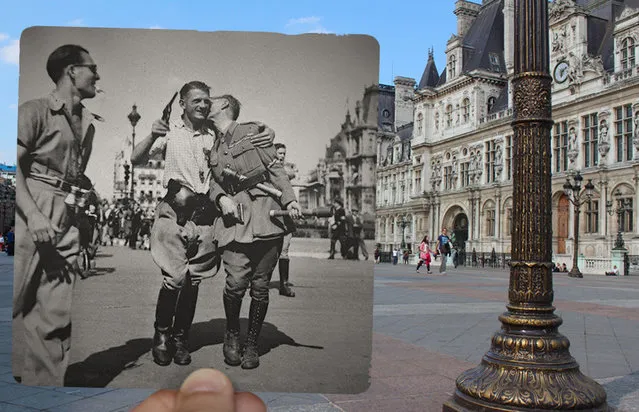
Soldiers outside the Hotel De Ville in the 1940s. (Photo by Julien Knez/Caters News)

It is already one of the world’s most iconic cities, but this incredible collection shows how much Paris has changed over the course of the past century. The collection, by French photographer Julien Knez, shows Paris in the 1940s against a backdrop of how the same places look today. Knez says he put the striking collection together to celebrate the 71st anniversary of the city’s liberation from Nazi control in August 1944. Here: Soldiers outside the Hotel De Ville in the 1940s. (Photo by Julien Knez/Caters News)
Details
07 May 2015 13:16:00
Bullet the bulldog skateboards in a seafront area in the city of Vladivostok, on Russia's Pacific coast on August 9, 2021. The 6-year-old dog learnt how to skateboard two years ago thanks to his owner, Sergei Shukshuyev. (Photo by Yuri Smityuk/TASS)

Bullet the bulldog skateboards in a seafront area in the city of Vladivostok, on Russia's Pacific coast on August 9, 2021. The 6-year-old dog learnt how to skateboard two years ago thanks to his owner, Sergei Shukshuyev. (Photo by Yuri Smityuk/TASS)
Details
26 Aug 2021 08:30:00
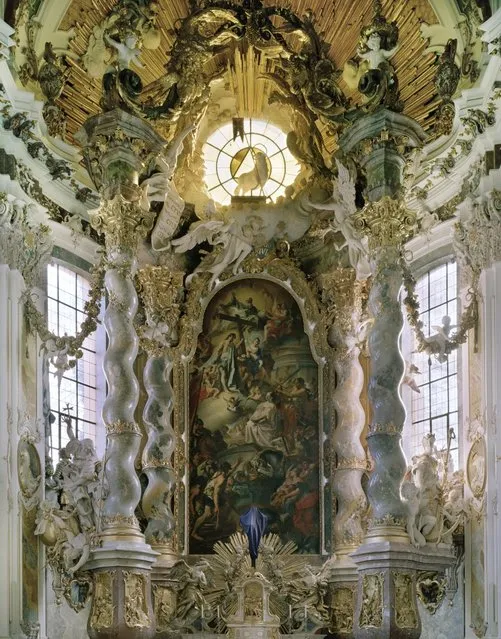
Church Altars By Cyril Porchet

Young Swiss photographer Cyril Porchet’s final year show included this awesome series of the most opulent Baroque church altars he could find in Spain, Austria and Germany. His intention was to explore the seductive power of display. What is extraordinary is how much you lose all sense of perspective and depth, such is the overabundance of detail. I like how the odd feature confuses all the more; like the red rope of the ornamental light in the image below for instance which neatly splices the image in half. I could pore over these for hours and hours.
Details
04 Jul 2014 12:46:00
Motorhead fans. (Photo by James Mollison)

“Over three years I photographed fans outside different concerts. I was fascinated by the different tribes of people that attended them, and how people emulated celebrity to form their identity. As I photographed the project I began to see how the concerts became events for people to come together with surrogate “families”, a chance to relive their youth or try and be part of a scene that happened before they were born” – James Mollison.

Photo: Madonna fans. (Photo by James Mollison)
Details
25 Jun 2015 12:45:00