Loading...
Done
Iranian actress Zar Amir-Ebrahimi poses during a photocall for the film “Holy Spider” at the 75th edition of the Cannes Film Festival in Cannes, southern France, on May 23, 2022. (Photo by Stephane Mahe/Reuters)

Cast member, Iranian actress Zar Amir-Ebrahimi poses during a photocall for the film “Holy Spider” at the 75th edition of the Cannes Film Festival in Cannes, southern France, on May 23, 2022. (Photo by Stephane Mahe/Reuters)
Details
25 May 2022 05:14:00
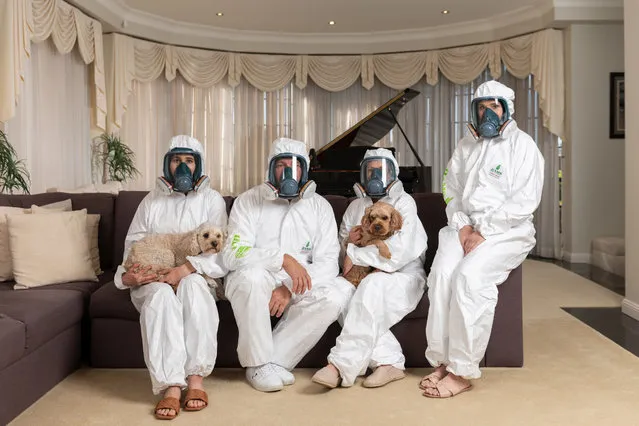
The Zammitt Family. “A portrait of the Zammitt family at their western Sydney home, with their dogs, Benji and Beau. Brian Zammitt (second from left) is the head of his booming family business, BAMS Hygiene Management, one of Australia’s leading deep cleaning companies, which specialises in disinfecting workplaces and locations contaminated with Covid-19. His wife, Sandra, and daughters Natalie and Louisa all play key frontline roles in the business”. (Photo by John Janson-Moore/Australia’s National Photographic Portrait Prize 2022)

The Zammitt Family. “A portrait of the Zammitt family at their western Sydney home, with their dogs, Benji and Beau. Brian Zammitt (second from left) is the head of his booming family business, BAMS Hygiene Management, one of Australia’s leading deep cleaning companies, which specialises in disinfecting workplaces and locations contaminated with Covid-19. His wife, Sandra, and daughters Natalie and Louisa all play key frontline roles in the business”. (Photo by John Janson-Moore/Australia’s National Photographic Portrait Prize 2022)
Details
09 Aug 2022 05:04:00
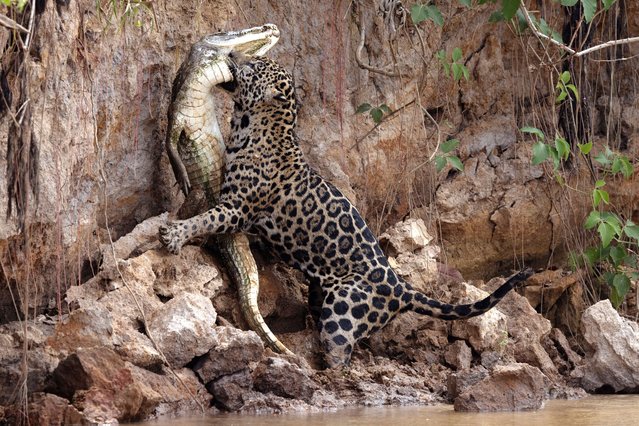
A female jaguar named Ti, by the NGO Jaguar ID, bites an alligator at Encontro das Aguas State Park, in the Pantanal, the largest wetland in the world, in Pocone, Mato Grosso, Brazil, on October 10, 2024. (Photo by Sergio Moraes/Reuters)

A female jaguar named Ti, by the NGO Jaguar ID, bites an alligator at Encontro das Aguas State Park, in the Pantanal, the largest wetland in the world, in Pocone, Mato Grosso, Brazil, on October 10, 2024. (Photo by Sergio Moraes/Reuters)
Details
10 Nov 2024 04:10:00
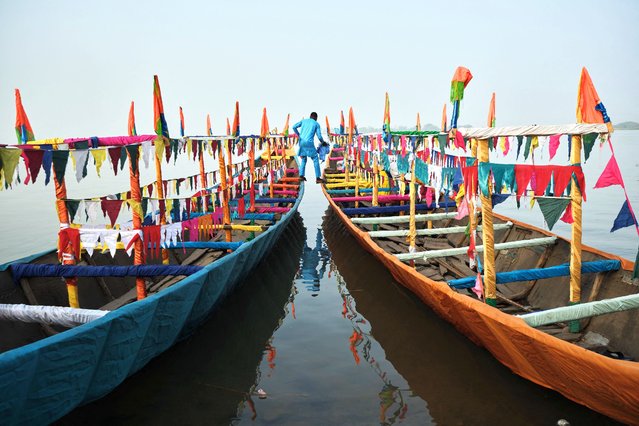
A man crosses from a pirogue to another pirogue during the annual boat regatta in Yauri, Kebbi State, on February 15, 2025. The regatta festival started about 200 years ago as a display of naval strength of the Gungu people, where the Gungu warriors annually attacked dangerous hippopotamus that were destroying farmlands. Warriors would board various sizes of canoes with different types of weapons to attack the animal on the River Niger. This required expertise in canoe paddling and naval warfare. It also served as training exercise for upcoming Gungu warriors. (Photo by Toyin Adedokun/AFP Photo)

A man crosses from a pirogue to another pirogue during the annual boat regatta in Yauri, Kebbi State, on February 15, 2025. The regatta festival started about 200 years ago as a display of naval strength of the Gungu people, where the Gungu warriors annually attacked dangerous hippopotamus that were destroying farmlands. Warriors would board various sizes of canoes with different types of weapons to attack the animal on the River Niger. This required expertise in canoe paddling and naval warfare. It also served as training exercise for upcoming Gungu warriors. (Photo by Toyin Adedokun/AFP Photo)
Details
25 Feb 2025 01:59:00
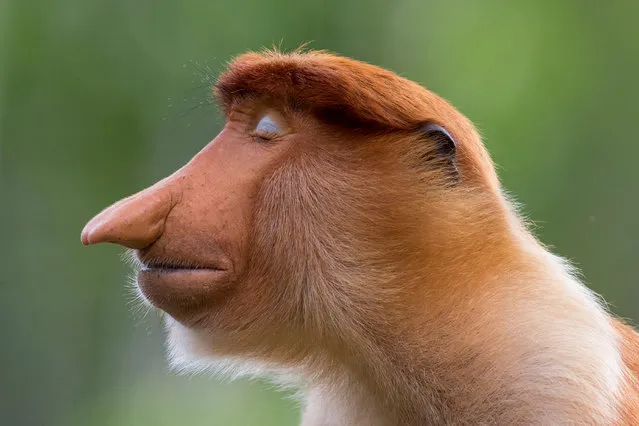
Winner – Animal Portraits: The pose by Mogens Trolle, Denmark. A young male proboscis monkey cocks his head slightly and closes his eyes. Unexpected pale blue eyelids now complement his immaculately groomed auburn hair. He poses for a few seconds as if in meditation. He is a wild visitor to the feeding station at Labuk Bay Proboscis Monkey Sanctuary in Sabah, Borneo – “the most laid-back character”, says Trolle, “quite unlike anything I’ve ever seen on another monkey” – connects us, he hopes, with a fellow primate. (Photo by Mogens Trolle/Wildlife Photographer of the Year 2020)

Winner – Animal Portraits: The pose by Mogens Trolle, Denmark. A young male proboscis monkey cocks his head slightly and closes his eyes. Unexpected pale blue eyelids now complement his immaculately groomed auburn hair. He poses for a few seconds as if in meditation. He is a wild visitor to the feeding station at Labuk Bay Proboscis Monkey Sanctuary in Sabah, Borneo – “the most laid-back character”, says Trolle, “quite unlike anything I’ve ever seen on another monkey” – connects us, he hopes, with a fellow primate. (Photo by Mogens Trolle/Wildlife Photographer of the Year 2020)
Details
16 Oct 2020 00:03:00
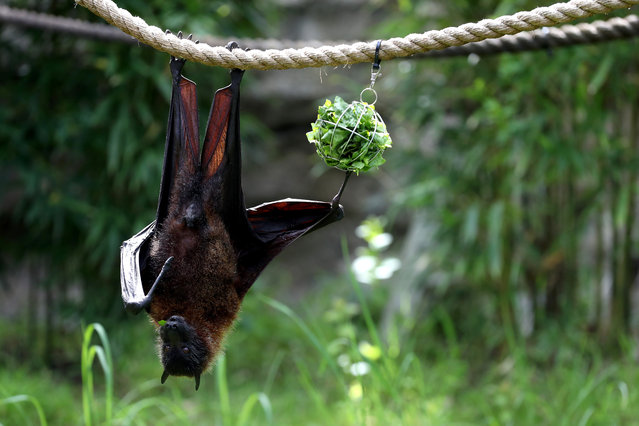
A fruit bat eats lettuce as it hangs from a rope during a behind the scenes interactive live stream from the Oakland Zoo on April 16, 2020 in Oakland, California. Since the Oakland Zoo has been closed to the public during the shelter in place, they are offering a subscription based service that will feature five weekly behind the scenes live streamed interactive programs that will feature animal keepers and their animals. Viewers are able to interact with the keepers by submitting questions to about the animals. (Photo by Justin Sullivan/Getty Images)

A fruit bat eats lettuce as it hangs from a rope during a behind the scenes interactive live stream from the Oakland Zoo on April 16, 2020 in Oakland, California. Since the Oakland Zoo has been closed to the public during the shelter in place, they are offering a subscription based service that will feature five weekly behind the scenes live streamed interactive programs that will feature animal keepers and their animals. Viewers are able to interact with the keepers by submitting questions to about the animals. (Photo by Justin Sullivan/Getty Images)
Details
19 Apr 2020 00:05:00
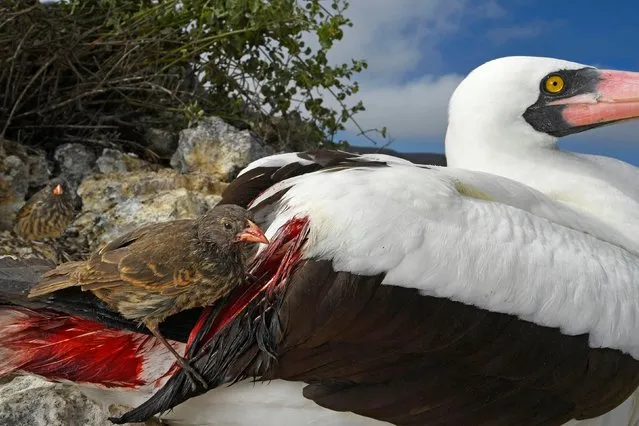
Bloodthirsty by Thomas P Peschak, Germany/South Africa — winner, Behaviour: birds. When rations run short on Wolf Island, in the remote northern Galápagos, the sharp-beaked ground finches become vampires. Their sitting targets are Nazca boobies and other large birds. The finches rely on a scant diet of seeds and insects, which regularly dries up, so they drink blood to survive. ‘I’ve seen more than half a dozen finches drinking from a single Nazca booby,’ says Tom. Rather than leave their nests the boobies tolerate the vampires, and the blood loss doesn’t seem to cause permanent harm. (Photo by Thomas P Peschak/2018 Wildlife Photographer of the Year)

Bloodthirsty by Thomas P. Peschak, Germany/South Africa — winner, Behaviour: birds. When rations run short on Wolf Island, in the remote northern Galápagos, the sharp-beaked ground finches become vampires. Their sitting targets are Nazca boobies and other large birds. The finches rely on a scant diet of seeds and insects, which regularly dries up, so they drink blood to survive. ‘I’ve seen more than half a dozen finches drinking from a single Nazca booby,’ says Tom. Rather than leave their nests the boobies tolerate the vampires, and the blood loss doesn’t seem to cause permanent harm. (Photo by Thomas P. Peschak/2018 Wildlife Photographer of the Year)
Details
19 Oct 2018 00:05:00
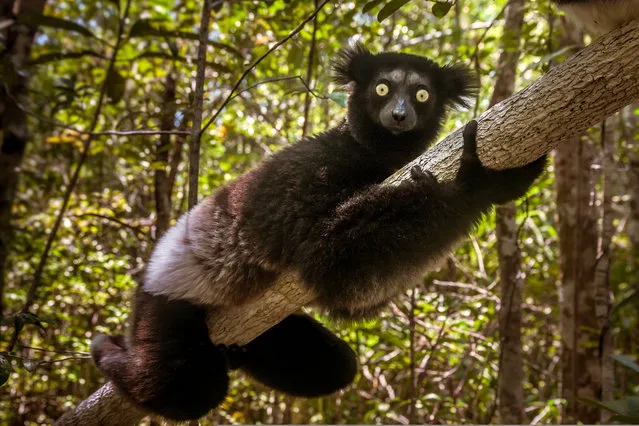
The secretive indri (Indri indri) of Madagascar, the largest living lemur. It is also critically endangered and highly evolutionarily distinct with no close relatives, which makes its branch one of most precarious on the mammal evolutionary tree. In the likely event that the indri goes extinct, we will lose 19m years of unique evolutionary history from the mammal tree of life. (Photo by Pierre-Yves Babelon/Aarhus University)

The secretive indri (Indri indri) of Madagascar, the largest living lemur. It is also critically endangered and highly evolutionarily distinct with no close relatives, which makes its branch one of most precarious on the mammal evolutionary tree. In the likely event that the indri goes extinct, we will lose 19m years of unique evolutionary history from the mammal tree of life. (Photo by Pierre-Yves Babelon/Aarhus University)
Details
18 Nov 2018 00:02:00