Loading...
Done
Cropped shot of a woman flirtatiously touching leg of man in a suit with her foot under the table. (Photo by LightField Studios/Skyfish Digital Media/Getty Images)

Cropped shot of a woman flirtatiously touching leg of man in a suit with her foot under the table. (Photo by LightField Studios/Skyfish Digital Media/Getty Images)
Details
20 Mar 2018 00:05:00
Women hold hands during the Tokyo Rainbow Pride parade celebrating lesbian, gay, bisexual, and transgender (LGBT) culture in Tokyo, Japan, May 8, 2016. (Photo by Thomas Peter/Reuters)

Women hold hands during the Tokyo Rainbow Pride parade celebrating lesbian, gay, bisexual, and transgender (LGBT) culture in Tokyo, Japan, May 8, 2016. (Photo by Thomas Peter/Reuters)
Details
09 May 2016 09:25:00
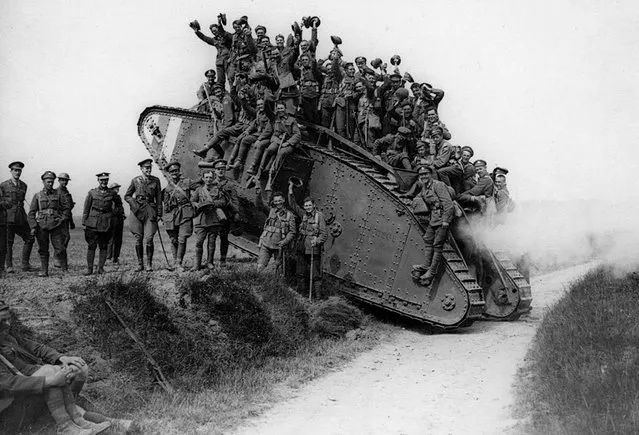
These black-and-white photos are taken from the new book “Armoured Warfare in the First World War 1916 – 1918” by Anthony Tucker-Jones and published by Pen & Sword Military. “Interestingly the British, French and Germans took completely different approaches with varying results”. The British military produced “Little Willie” in Autumn 1915 weighing 18 tonnes, which had a crew of two plus four gunners. “Inspired by a tracked artillery tractor “Little Willie” was referred to as a water tank – hence the name tank – to ensure secrecy”, said Anthony. “This led to the strange looking Mark I with its peculiar rhomboid shape, designed to cross trenches with guns in sponsons on either side. The Germans saw the tank as unchivalrous and were slow to grasp its utility. They favoured the Stormtrooper (specialist soldiers used to infiltrate enemy trenches) and artillery, not the tank”, said Anthony. “However, they didn’t hesitate to make use of captured British tanks. Although the tank helped secure victory and German soldiers dubbed it “Germany’s Downfall” the country was ultimately brought to its knees by the Allies blockade”. Here: British troops hitch a ride on a Mark IV after the massed tank fleet spearheading attack at Cambrai on November 20, 1917. (Photo by Anthony Tucker-Jones/Mediadrumworld.com)

These black-and-white photos are taken from the new book “Armoured Warfare in the First World War 1916 – 1918” by Anthony Tucker-Jones and published by Pen & Sword Military. Here: British troops hitch a ride on a Mark IV after the massed tank fleet spearheading attack at Cambrai on November 20, 1917. (Photo by Anthony Tucker-Jones/Mediadrumworld.com)
Details
23 Feb 2017 00:02:00
Guests arrive at the red carpet for the movie “The Truth” (La Verite) presented in competition at the 76th Venice Film Festival, in Venice, Italy, August 28, 2019. (Photo by Yara Nardi/Reuters)

Guests arrive at the red carpet for the movie “The Truth” (La Verite) presented in competition at the 76th Venice Film Festival, in Venice, Italy, August 28, 2019. (Photo by Yara Nardi/Reuters)
Details
31 Aug 2019 00:03:00
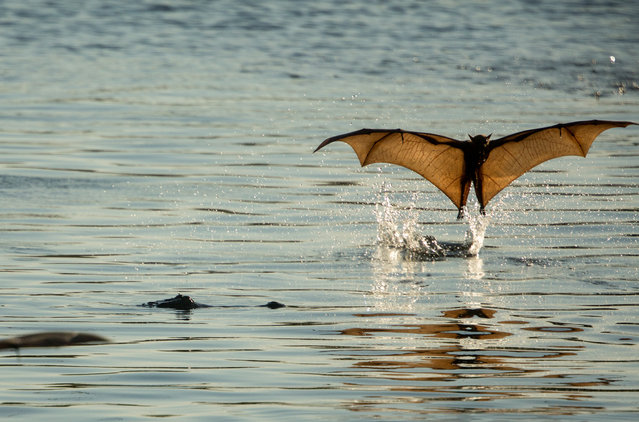
A little red flying fox dips a toe in a lake at the mouth of Katherine gorge in the Northern Territory, Nitmiluk national park, Australia on September 20, 2017. (Photo by Glenn Campbell/AAP)

A little red flying fox dips a toe in a lake at the mouth of Katherine gorge in the Northern Territory, Nitmiluk national park, Australia on September 20, 2017. (Photo by Glenn Campbell/AAP)
Details
24 Sep 2017 06:28:00
A woman cries near the flowers, brought to  the destroyed Amstor shopping mall in Kremenchuk, Ukraine, 28 June 2022. At least 18 people died following Russian airstrikes on the crowded shopping mall, the State Emergency Service (SES) of Ukraine said in a Telegram post. The Amstor shopping center one-story building was hit by Russian rockets on 27 June afternoon. (Photo by Oleg Petrasyuk/EPA/EFE)

A woman cries near the flowers, brought to the destroyed Amstor shopping mall in Kremenchuk, Ukraine, 28 June 2022. At least 18 people died following Russian airstrikes on the crowded shopping mall, the State Emergency Service (SES) of Ukraine said in a Telegram post. The Amstor shopping center one-story building was hit by Russian rockets on 27 June afternoon. (Photo by Oleg Petrasyuk/EPA/EFE)
Details
30 Jun 2022 05:13:00
The eruption of Cordon Caulle began on June 4, 2011, located in the Region of Los Rios in Chile. For about 12 months, people and animals became accustomed to living with the daily fall of ash, which also caused problems in the air traffic in South America. The explosions and lightning during first days of the eruption could be seen from hundreds of miles around. This photograph was taken on the second night of eruption from the town of Lago Ranco. (Photo and caption by Francisco Negroni/National Geographic Traveler Photo Contest)

The eruption of Cordon Caulle began on June 4, 2011, located in the Region of Los Rios in Chile. For about 12 months, people and animals became accustomed to living with the daily fall of ash, which also caused problems in the air traffic in South America. The explosions and lightning during first days of the eruption could be seen from hundreds of miles around. This photograph was taken on the second night of eruption from the town of Lago Ranco. (Photo and caption by Francisco Negroni/National Geographic Traveler Photo Contest)

ATTENTION! All pictures are presented in high resolution. To see Hi-Res images – just TWICE click on any picture. In other words, click small picture – opens the BIG picture. Click BIG picture – opens VERY BIG picture.
Details
23 Jun 2013 11:24:00
Conservation staff members move the eight-years-old White Rhino Seha into a truck in Johannesburg, South Africa, 28 July 2017. (Photo by Kim Ludbrook/EPA/EFE)

Conservation staff members move the eight-years-old White Rhino Seha into a truck in Johannesburg, South Africa, 28 July 2017. Seha is the only survivor after five rhinos where poached on the same game farm. South Africa has the world's largest population of Rhinos in the world. (Photo by Kim Ludbrook/EPA/EFE)
Details
06 Oct 2017 06:36:00