Contrasted against the white flowers in a cotton field, a brown bear is out for a ramble just after midnight in the second decade of July 2023 in Kainuu, Finland, where the sun does not fully set for more than 70 days in the summer months. (Photo by Jane Jeffrey/Animal News Agency)
Duncan Fenton from the Society of William Wallace stands next to a 700-year-old letter believed to have been in the possession of William Wallace, which has returned to National Records of Scotland on January 12, 2012 in Edinburgh, Scotland. (Photo by Jeff J. Mitchell/Getty Images)
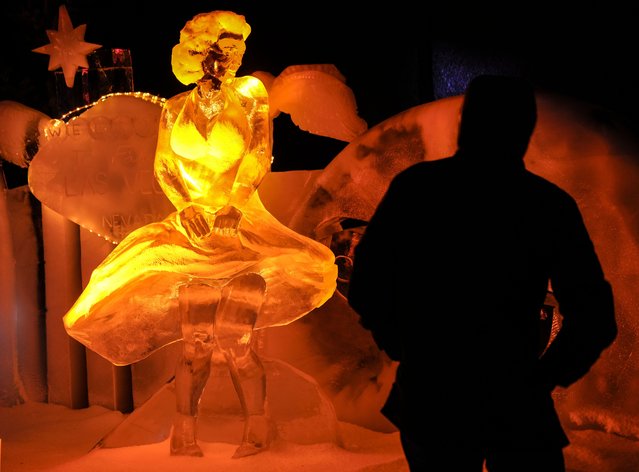
Visitors watch ice-cold artworks, depicting Marilyn Monroe, at an ice and snow sculpture exhibition made by 35 international artists, who worked 4 months at minus eight degrees Celsius in Oberhausen, Germany, on the 1st of Advent, Sunday, December 1, 2024. (Photo by Martin Meissner/AP Photo)
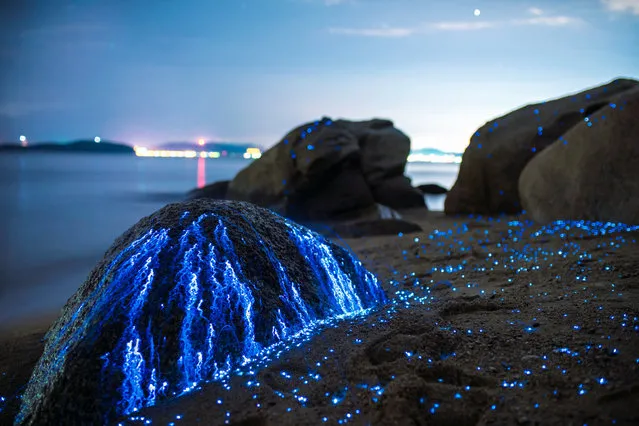
Those lights are actually bioluminescent shrimp, better known as sea fireflies, or, in Japan, as “umibotaru”. Visible every year from May until the end of October, they live in the sand around very shallow sea water and are often seen floating between the extremes of high and low tides. Here: Bioluminescent sea fireflies glittering like diamonds on the rocks and sand. Okayama, Japan. July 2016. (Photo by Trevor Williams/Jonathan Galione/Getty Images)
A man gives a dollar note to a performer during spring break festivities, amid the coronavirus disease (COVID-19) outbreak in Miami Beach, Florida, U.S., March 6, 2021. (Photo by Marco Bello/Reuters)
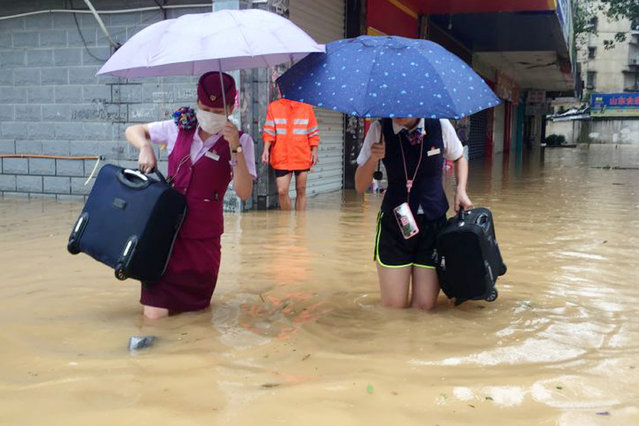
Train attendants carry their luggage as they walk through a flooded street in Fuzhou in southeastern China's Fujian Province Wednesday, September 28, 2016. The massive typhoon made landfall in eastern China Wednesday, a day after carrying strong winds over Taiwan that felled trees and scattered debris, killing several people and injuring hundreds. (Photo by Chinatopix via AP Photo)