Loading...
Done
Yalena Leuliette, 7, of Greenbelt, Md., throws seeds from a cattail plant up in the air as she plays while visiting the Kenilworth Aquatic Gardens in northeast Washington, on Sunday, August 9, 2015. Leuliette visits the public garden with her parents a few times a year. (Photo by Jacquelyn Martin/AP Photo)

Yalena Leuliette, 7, of Greenbelt, Md., throws seeds from a cattail plant up in the air as she plays while visiting the Kenilworth Aquatic Gardens in northeast Washington, on Sunday, August 9, 2015. Leuliette visits the public garden with her parents a few times a year. (Photo by Jacquelyn Martin/AP Photo)
Details
06 Sep 2015 13:07:00
Arachnids category 3rd place: dancing spider by Raed Ammari. Male jumping spiders (in this case a Phidippus insignarius) perform a courtship dance in which they almost form a heart shape with their legs. This one was shot in Colorado. (Photo by Raed Ammari/Luminar Bug Photographer of the Year 2020)

Arachnids category 3rd place: dancing spider by Raed Ammari. Male jumping spiders (in this case a Phidippus insignarius) perform a courtship dance in which they almost form a heart shape with their legs. This one was shot in Colorado. (Photo by Raed Ammari/Luminar Bug Photographer of the Year 2020)
Details
24 Oct 2020 00:03:00
Tropical acrobatics by Adrià López Baucells in Manaus, Brazil. An unidentified South American marsupial, although the characteristic black markings on its face indicate it may be a mouse opossum. These small creatures are nocturnal and feed on bugs, fruit and bird eggs. (Photo by Adrià López Baucells/2019 Royal Society of Biology Photography Competition)

Tropical acrobatics by Adrià López Baucells in Manaus, Brazil. An unidentified South American marsupial, although the characteristic black markings on its face indicate it may be a mouse opossum. These small creatures are nocturnal and feed on bugs, fruit and bird eggs. (Photo by Adrià López Baucells/2019 Royal Society of Biology Photography Competition)
Details
10 Oct 2019 00:03:00
A golden huddle by Minqiang Lu, China. Two females and a male golden snub-nosed monkey huddle together to keep warm in the extreme cold. Threatened by forest loss and fragmentation, this endangered species is confined to central China. Restricted to living high up in the temperate forests, these monkeys – here in the Qinling mountains in Shaanxi province – feed mostly in the trees, on leaves, bark, buds and lichen. In heavy wind and snow, Minqiang walked up the mountain carrying his equipment. He stayed for half an hour in temperatures of –10C opposite the tree where the group was huddled before achieving this eye-level composition. (Photo by Minqiang Lu/Wildlife Photographer of the Year)

A golden huddle by Minqiang Lu, China. Two females and a male golden snub-nosed monkey huddle together to keep warm in the extreme cold. Threatened by forest loss and fragmentation, this endangered species is confined to central China. Restricted to living high up in the temperate forests, these monkeys – here in the Qinling mountains in Shaanxi province – feed mostly in the trees, on leaves, bark, buds and lichen. In heavy wind and snow, Minqiang walked up the mountain carrying his equipment. He stayed for half an hour in temperatures of –10C opposite the tree where the group was huddled before achieving this eye-level composition. (Photo by Minqiang Lu/Wildlife Photographer of the Year)
Details
12 Jan 2023 01:19:00
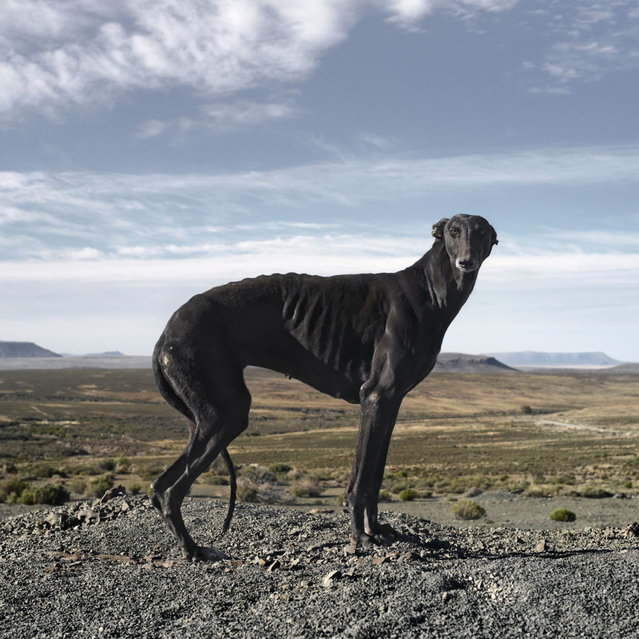
Africanis 18. Murraysburg, Western Cape, May 10, 2010. (Photo by Daniel Naudé)

“The Africanis is a landrace of South African dogs. It is believed to be of ancient origin, directly descended from hounds and pariah dogs of ancient Africa, introduced into the Nile Valley from the Levant. The Swahili name for the breed is umbwa wa ki-shenzi meaning common or mongrel or “traditional dog”. Africanis is also an umbrella name for all the aboriginal dogs in southern Africa”. – Wikipedia. Photo: Africanis 18. Murraysburg, Western Cape, May 10, 2010. (Photo by Daniel Naudé)
Details
19 May 2013 11:51:00
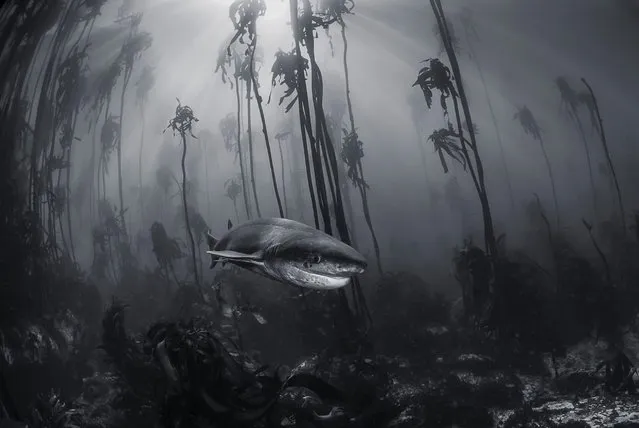
Mystical Forest. Tracey Jennings photographed this seven-gill shark in a kelp forest just off the shore of Simon's Town near Cape Town, South Africa. You don't need to travel far from cities to visit Narnia. This 7 gill shark was photographed in a kelp forest just off the shore of Simonstown near Cape Town, South Africa. (Photo by Tracey Jennings/National Geographic Travel Photographer of the Year Contest)

Mystical Forest. Tracey Jennings photographed this seven-gill shark in a kelp forest just off the shore of Simon's Town near Cape Town, South Africa. You don't need to travel far from cities to visit Narnia. This 7 gill shark was photographed in a kelp forest just off the shore of Simonstown near Cape Town, South Africa. (Photo by Tracey Jennings/National Geographic Travel Photographer of the Year Contest)
Details
24 May 2016 09:32:00
“Wild Africa”. (Photo by Alex Bernasconi)

Award-winning photographer Alex Bernasconi has captured thousands of images – from hiding hippos to wandering zebras – in his travels across Africa. His amazing work features in a new edition of his book Wild Africa. These amazing pictures create a snapshot of the life of some of the planet’s most spectacular animals and natural habitats. Photo: “Wild Africa”. (Photo by Alex Bernasconi)
Details
15 Sep 2013 10:12:00
A waterfall is seen at the end of the rainy season, in August, when the water level finally decreases, in the Cano Cristales RIver in the Sierra de la Macarena in Colombia. It has become covered with a bright pink endemic aquatic plant, Macarenia Clavigera. (Photo by Olivier Grunewald)

“El rio mas bonito del Mundo”, the most beautiful river of the world, the “River of five colors”, the “Rainbow River”, or even the “Escaped from Paradise”, are the shimmering appellations that Colombians give to Cano Cristales, a small stream located in the heart of the Macarena National Park, 150 km (93 miles) south of Bogota. Photo: A waterfall is seen at the end of the rainy season, in August, when the water level finally decreases, in the Cano Cristales RIver in the Sierra de la Macarena in Colombia. It has become covered with a bright pink endemic aquatic plant, Macarenia Clavigera. (Photo by Olivier Grunewald)
Details
25 Mar 2014 15:15:00