Loading...
Done
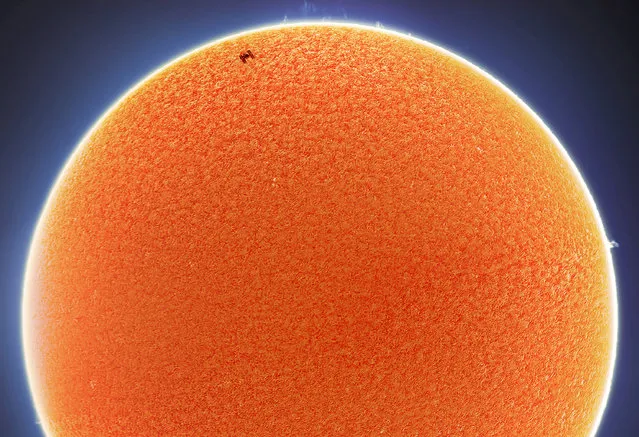
The International Space Station (ISS) moving in front of the sun in November 2020 by astrophotographer Andrew McCarthy. These incredible photos capture the clearest images ever taken of the International Space Station (ISS) moving in front of both the moon and the sun. The photos, taken within days of one another, were captured in the space of less than a second, as the space station could be clearly seen zooming across against the bright backdrops of both moon and sun. Photographer Andrew McCarthy, from California, USA, said the photo of the ISS in front of the sun, in broad daylight, was “one of my trickiest shots ever”. (Photo by Andrew McCarthy/South West News Service)

The International Space Station (ISS) moving in front of the sun in November 2020 by astrophotographer Andrew McCarthy. These incredible photos capture the clearest images ever taken of the International Space Station (ISS) moving in front of both the moon and the sun. The photos, taken within days of one another, were captured in the space of less than a second, as the space station could be clearly seen zooming across against the bright backdrops of both moon and sun. Photographer Andrew McCarthy, from California, USA, said the photo of the ISS in front of the sun, in broad daylight, was “one of my trickiest shots ever”. (Photo by Andrew McCarthy/South West News Service)
Details
28 Nov 2020 00:05:00
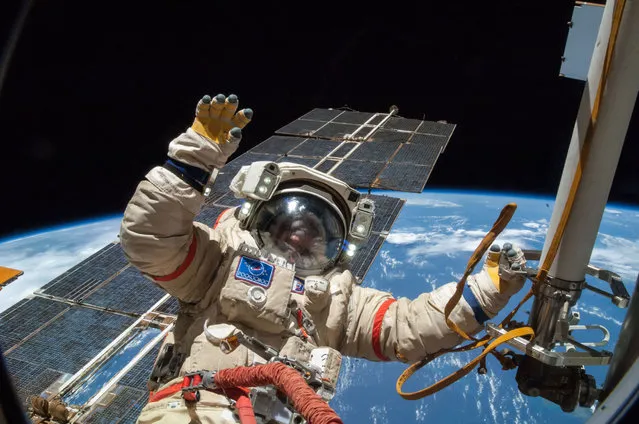
Russian cosmonaut Alexander Skvortsov, Expedition 40 flight engineer, attired in a Russian Orlan spacesuit, participates in a session of extravehicular activity (EVA) in support of science and maintenance on the International Space Station on August 18, 2014. During the five-hour, 11-minute spacewalk, Skvortsov and cosmonaut Oleg Artemyev (out of frame) deployed a small science satellite, retrieved and installed experiment packages and inspected components on the exterior of the orbital laboratory. (Photo by NASA)

Russian cosmonaut Alexander Skvortsov, Expedition 40 flight engineer, attired in a Russian Orlan spacesuit, participates in a session of extravehicular activity (EVA) in support of science and maintenance on the International Space Station on August 18, 2014. During the five-hour, 11-minute spacewalk, Skvortsov and cosmonaut Oleg Artemyev (out of frame) deployed a small science satellite, retrieved and installed experiment packages and inspected components on the exterior of the orbital laboratory. (Photo by NASA)
Details
13 Apr 2022 06:53:00
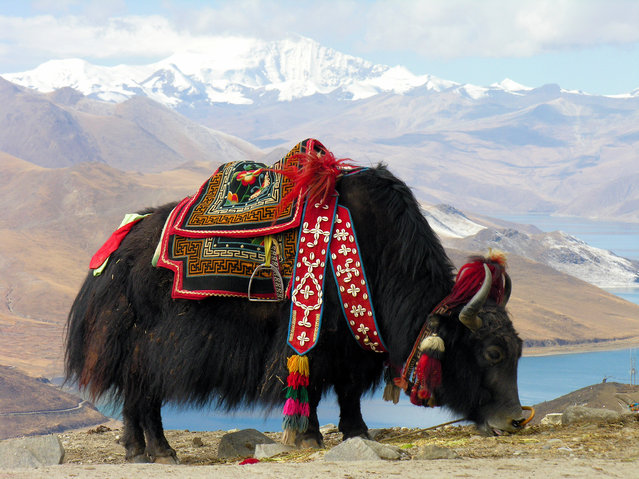
Yak near Yamdrok lake, Tibet. It is a long-haired bovinae found throughout the Himalayan region of south Central Asia, the Tibetan Plateau and as far north as Mongolia and Russia. The Tibetan economy is dominated by subsistence agriculture. Due to limited arable land, the primary occupation of the Tibetan Plateau is raising livestock, such as sheep, cattle, goats, camels, yaks, dzo, and horses. The Tibetan yak is an integral part of Tibetan life. (Photo by Dennis Jarvis)

Yak near Yamdrok lake, Tibet. It is a long-haired bovinae found throughout the Himalayan region of south Central Asia, the Tibetan Plateau and as far north as Mongolia and Russia. The Tibetan economy is dominated by subsistence agriculture. Due to limited arable land, the primary occupation of the Tibetan Plateau is raising livestock, such as sheep, cattle, goats, camels, yaks, dzo, and horses. The Tibetan yak is an integral part of Tibetan life. (Photo by Dennis Jarvis)
Details
10 Jun 2015 10:48:00
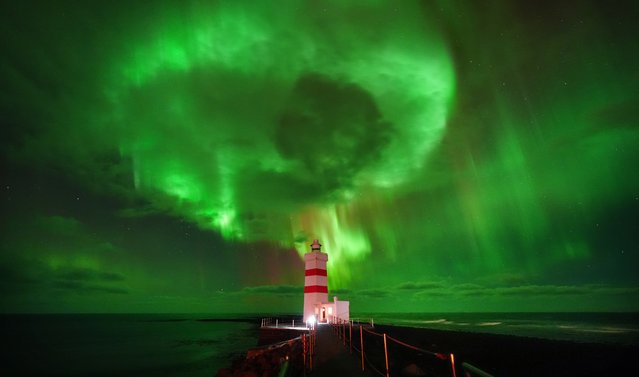
The aurora borealis, also known as the northern lights, visible above Old Gardur Lighthouse on the northern point of the Reykjanes peninsula in Iceland on Sunday, November 24, 2024. The lighthouse dates to 1897, and was one of the first built in Iceland. (Photo by Owen Humphreys/PA Images via Getty Images)

The aurora borealis, also known as the northern lights, visible above Old Gardur Lighthouse on the northern point of the Reykjanes peninsula in Iceland on Sunday, November 24, 2024. The lighthouse dates to 1897, and was one of the first built in Iceland. (Photo by Owen Humphreys/PA Images via Getty Images)
Details
07 Apr 2025 02:54:00
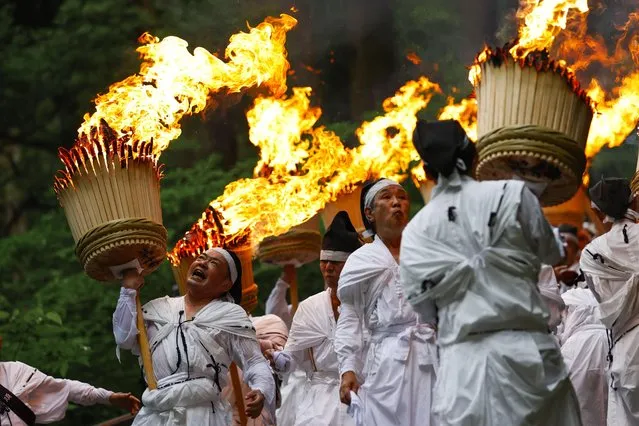
White-robed men hold up flaming torches during an annual fire festival at the World Heritage-listed Kumano Nachi Taisha shrine in the Wakayama Prefecture town of Nachikatsuura, western Japan on July 14, 2022. (Photo by Kyodo News/Newscom/Avalon)

White-robed men hold up flaming torches during an annual fire festival at the World Heritage-listed Kumano Nachi Taisha shrine in the Wakayama Prefecture town of Nachikatsuura, western Japan on July 14, 2022. (Photo by Kyodo News/Newscom/Avalon)
Details
30 Jul 2022 04:14:00
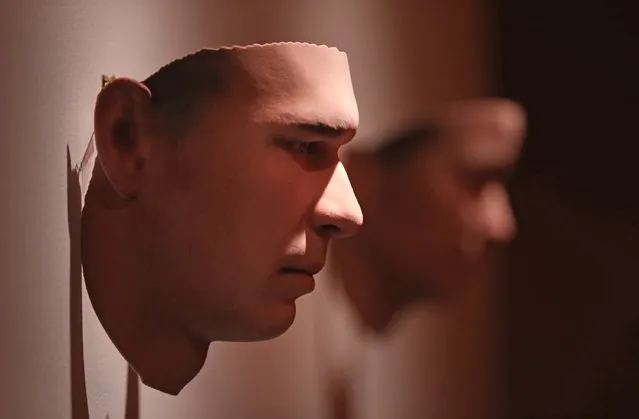
Artist Heather Dewey-Hagborg's 'Stranger Visions', comprising of 3D printed faces extracted from DNA taken from discarded cigarette butts and chewing gum, is displayed at the Big Bang Data exhibition at Somerset House on December 2, 2015 in London, England. (Photo by Peter Macdiarmid/Getty Images for Somerset House)

Artist Heather Dewey-Hagborg's 'Stranger Visions', comprising of 3D printed faces extracted from DNA taken from discarded cigarette butts and chewing gum, is displayed at the Big Bang Data exhibition at Somerset House on December 2, 2015 in London, England. The show highlights the data explosion that's radically transforming our lives. It opens on December 3, 2015 and runs until February 28, 2016 at Somerset House. (Photo by Peter Macdiarmid/Getty Images for Somerset House)
Details
04 Dec 2015 08:03:00
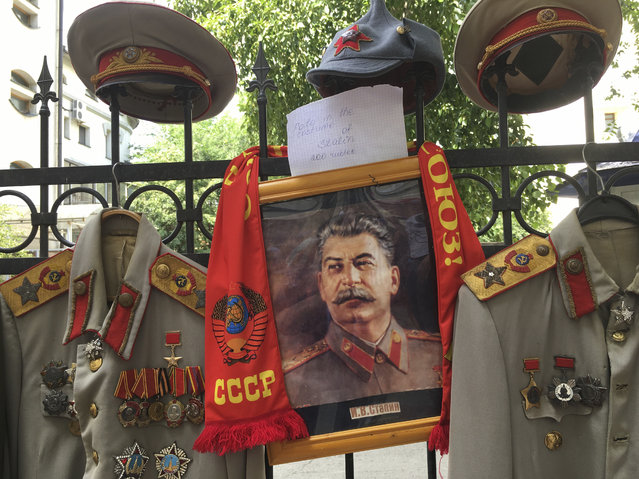
Replicas of Joseph Stalin uniforms are offered to tourists who can rent them and wear them for a picture outside Stalin's bunker in Samara, Russia, on Tuesday, June 26, 2018. Stalin's secret WWII bunker has become the unlikely meeting point for thousands of cheerful fans who have arrived to the city during the World Cup days. (Photo by Luis Andres Henao/AP Photo)

Replicas of Joseph Stalin uniforms are offered to tourists who can rent them and wear them for a picture outside Stalin's bunker in Samara, Russia, on Tuesday, June 26, 2018. Stalin's secret WWII bunker has become the unlikely meeting point for thousands of cheerful fans who have arrived to the city during the World Cup days. (Photo by Luis Andres Henao/AP Photo)
Details
11 Jul 2018 00:03:00
Astronomy Photographer Of The Year 2013 Part1

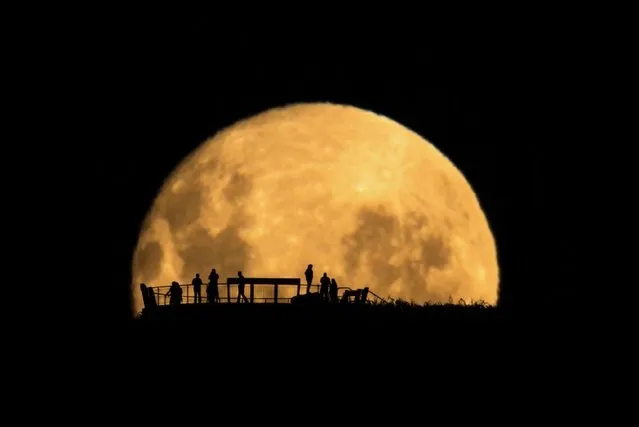
The Royal Observatory just announced its Astronomy Photographer Of The Year 2013 winners. Australian photographer Mark Gee was chosen among a thousand amateur and professional photographers around the globe to win the top title. His work is part of an exhibition of the winning photographers, which opened on Sept. 19 at the Royal Observatory Greenwich. The Royal Observatory shared with us the winners and notable mentions of the competition. Their descriptions of the prizewinners can be found below the images.
Details
04 Oct 2013 11:45:00