Loading...
Done
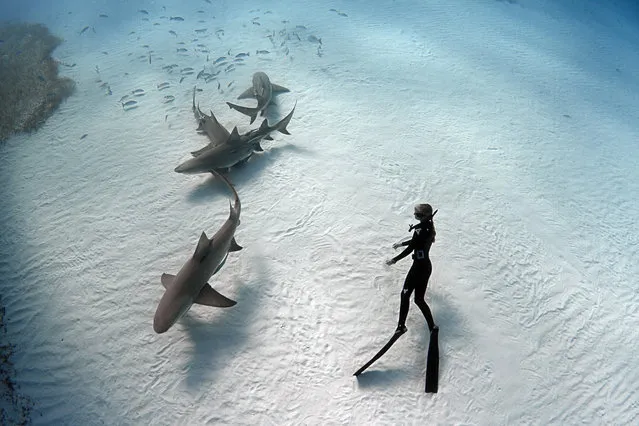
A group of daredevil divers get perilously close to a school of deadly sharks – and one even lies on his back with his arm folded.  The relaxed diver swims on his back and almost hugs the shark who is floating directly above him. The freedivers – Carlos Estrabeau, 28, and 29-year-old Ocean Ramsey – are friends with photographer Raul Boesel Jr. Photographer Raul Boesel Jr from Curitiba, Brazil, travelled to West End in the Bahamas to capture images of the giant sharks. (Photo by Raul Boesel/Solent News & Photo Agency)

A group of daredevil divers get perilously close to a school of deadly sharks – and one even lies on his back with his arm folded. The relaxed diver swims on his back and almost hugs the shark who is floating directly above him. The freedivers – Carlos Estrabeau, 28, and 29-year-old Ocean Ramsey – are friends with photographer Raul Boesel Jr. Photographer Raul Boesel Jr from Curitiba, Brazil, travelled to West End in the Bahamas to capture images of the giant sharks. (Photo by Raul Boesel/Solent News & Photo Agency)
Details
09 Sep 2014 08:27:00
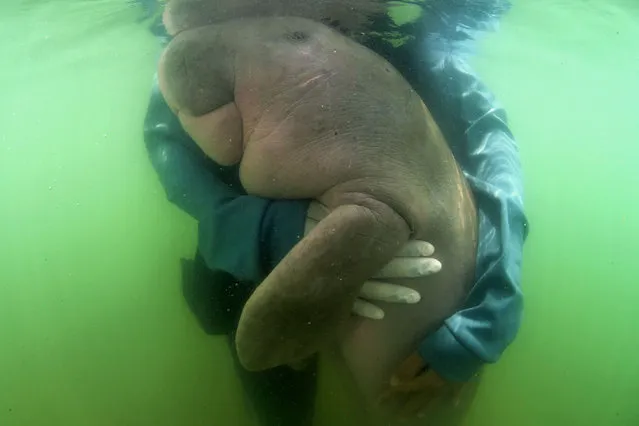
This picture taken on May 24, 2019 shows Mariam the dugong as she is cared for by park officials and veterinarians from the Phuket Marine Biological Centre on Libong island, Trang province in southern Thailand. An orphaned baby dugong rescued off a beach in Krabi province is Thailand's newest star, capturing the hearts of millions on social media and igniting an awarness for ocean conservation as authorities hand-raise the young mammal. (Photo by Sirachai Sirachai Arunrugstichai/AFP Photo)

This picture taken on May 24, 2019 shows Mariam the dugong as she is cared for by park officials and veterinarians from the Phuket Marine Biological Centre on Libong island, Trang province in southern Thailand. An orphaned baby dugong rescued off a beach in Krabi province is Thailand's newest star, capturing the hearts of millions on social media and igniting an awarness for ocean conservation as authorities hand-raise the young mammal. (Photo by Sirachai Sirachai Arunrugstichai/AFP Photo)
Details
07 Jul 2019 00:03:00
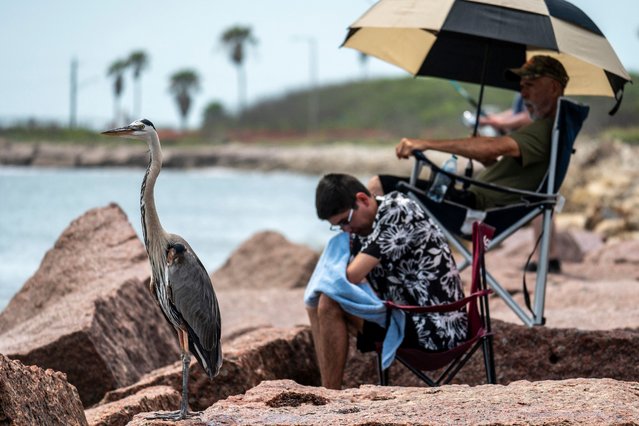
A bird stands near people waiting on South Padre Island to watch the SpaceX Starship rocket launch from Starbase, Texas, on May 27, 2025. SpaceX mission control lost contact with the upper stage of Starship as it leaked fuel, spun out of control, and made an uncontrolled reentry after flying halfway around the world, likely disintegrating over the Indian Ocean, officials said. (Photo by Sergio Flores/AFP Photo)

A bird stands near people waiting on South Padre Island to watch the SpaceX Starship rocket launch from Starbase, Texas, on May 27, 2025. SpaceX mission control lost contact with the upper stage of Starship as it leaked fuel, spun out of control, and made an uncontrolled reentry after flying halfway around the world, likely disintegrating over the Indian Ocean, officials said. (Photo by Sergio Flores/AFP Photo)
Details
17 Jul 2025 03:17:00
The Northern lights (aurora borealis) lights up the night sky above the Molenviergang in Aarlanderveen, the Netherlands, early on 11 May 2024. The National Oceanic and Atmospheric Administration (NOAA) of America has warned that the strongest geomagnetic storm for 20 years is set to hit Earth, making the Aurora Borealis, or Northern Lights, visible at much lower geomagnetic latitudes than usual. (Photo by Josh Walet/EPA/EFE/Rex Features/Shutterstock)

The Northern lights (aurora borealis) lights up the night sky above the Molenviergang in Aarlanderveen, the Netherlands, early on 11 May 2024. The National Oceanic and Atmospheric Administration (NOAA) of America has warned that the strongest geomagnetic storm for 20 years is set to hit Earth, making the Aurora Borealis, or Northern Lights, visible at much lower geomagnetic latitudes than usual. (Photo by Josh Walet/EPA/EFE/Rex Features/Shutterstock)
Details
17 Aug 2024 04:31:00
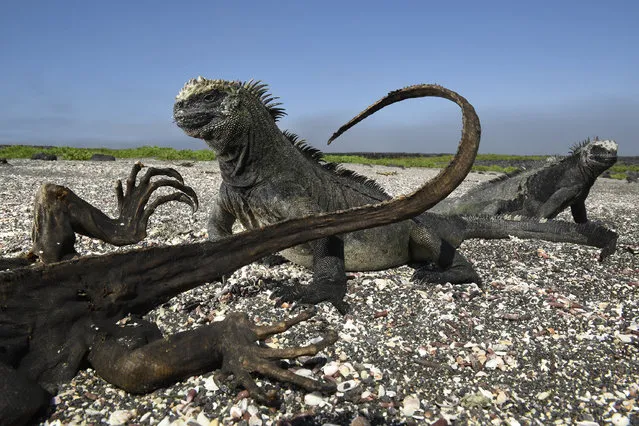
Galapagos – Rocking the Cradle: Four major ocean currents converge along the Galapagos archipelago, creating the conditions for an extraordinary diversity of animal life, April 25, 2016. The islands are home to at least 7,000 flora and fauna species, of which 97 percent of the reptiles, 80 percent of the land birds, 50 percent of the insects and 30 percent of the plants are endemic. The local ecosystem is highly sensitive to the changes in temperature, rainfall and ocean currents that characterize the climatic events known as El Niño and La Niña. These changes cause marked fluctuations in weather and food availability. Many scientists expect the frequency of El Niño and La Niña to increase as a result of climate change, making the Galapagos a possible early-warning location for its effects. (Photo by Thomas P. Peschak for National Geographic/World Press Photo)

Galapagos – Rocking the Cradle: Four major ocean currents converge along the Galapagos archipelago, creating the conditions for an extraordinary diversity of animal life, April 25, 2016. The islands are home to at least 7,000 flora and fauna species, of which 97 percent of the reptiles, 80 percent of the land birds, 50 percent of the insects and 30 percent of the plants are endemic. (Photo by Thomas P. Peschak for National Geographic/World Press Photo)
Details
16 Apr 2018 00:01:00
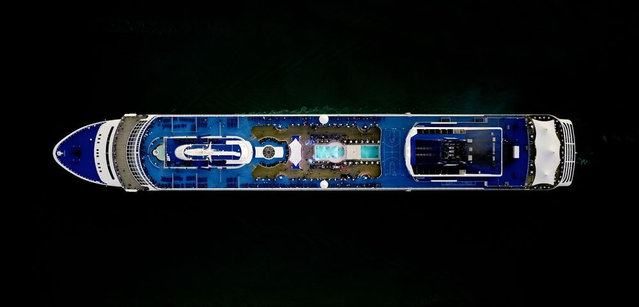
Biggest Cruise Ships By Jeffrey Milstein

These spectacular photographs give a stunning birds-eye of view of the decks from some of the world's biggest cruise liners. New York based Photographer Jeffrey Milstein spent months hovering over the oceans using high-resolution camera equipment to capture views from a helicopter.
Details
06 Apr 2016 21:18:00
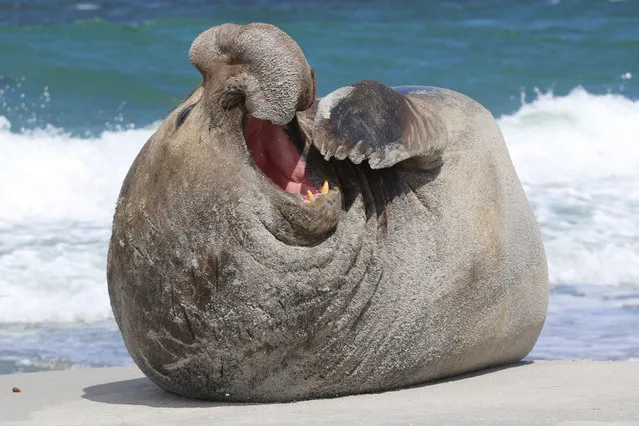
Elephant Seal. (Photo by David Crocker/Caters News Agency)

These hilarious photos show some of nature’s mightiest animals — yawning away! (Actually – not always; AvaxNews). The images were taken by photographers across the world, from the African savannas to the Pacific Ocean. Here: Elephant Seal. (Photo by David Crocker/Caters News Agency)
Details
20 Sep 2019 00:01:00
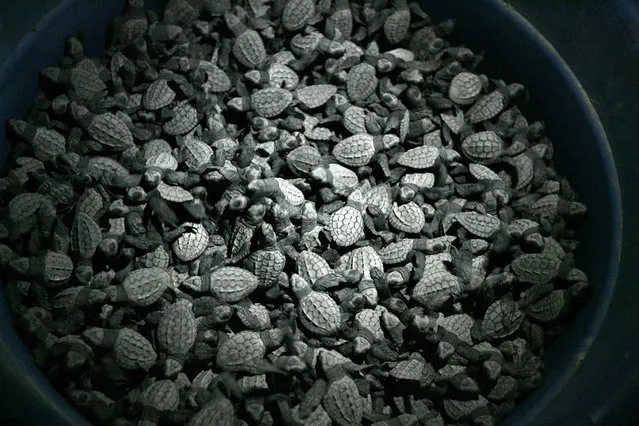
Olive Ridley turtle hatchlings (Lepidochelys olivacea) sit in baskets and trays at the turtle camp La Gloria, before their release into the ocean in Tomatlan November 15, 2013. (Photo by Alejandro Acosta/Reuters)

Olive Ridley turtle hatchlings (Lepidochelys olivacea) sit in baskets and trays at the turtle camp La Gloria, before their release into the ocean in Tomatlan November 15, 2013. Twenty years ago, Mexico's government implemented ecological plans to protect the sea turtles from being hunted for their leather and meat and established conservation areas and a pay system for local residents to protect turtle nests. Millions of baby turtles hatch on the shores in November and December, according to an environmental group. It is estimated that in 2012, there were 20 million newborns. Hatching season is still underway, but officials say they expect there will be even more turtles born this year. (Photo by Alejandro Acosta/Reuters)
Details
25 Nov 2013 08:54:00