Loading...
Done
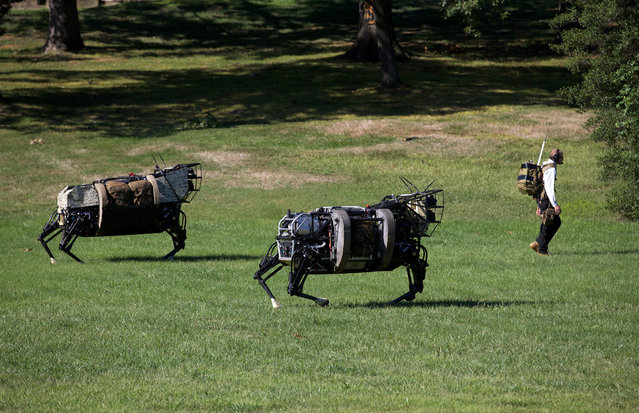
Two robotic legged squad support system (LS3) machines by the Defense Advanced Research Project Agency follow a technician during a demonstration at Joint Base Myer-Henderson Hall, Virginia, on September 10, 2012. (U.S. Marine Corps photo by Sgt. Mallory S. VanderSchans)

Two robotic legged squad support system (LS3) machines by the Defense Advanced Research Project Agency follow a technician during a demonstration at Joint Base Myer-Henderson Hall, Virginia, on September 10, 2012. (U.S. Marine Corps photo by Sgt. Mallory S. VanderSchans via The Atlantic)
Details
20 Oct 2012 10:30:00
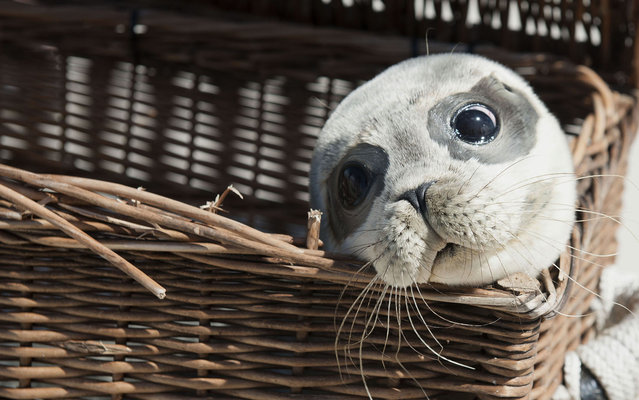
Seehund “Bruno” looks out of his transport box before making his way to the water on the beach of the island of Juist, Germany on August 14, 2013. Four young seals were released after six weeks of recovery at a rescue station in Norden-Norddeich. (Photo by Carmen Jaspersen/AFP Photo/DPA)

Seehund “Bruno” looks out of his transport box before making his way to the water on the beach of the island of Juist, Germany on August 14, 2013. Four young seals were released after six weeks of recovery at a rescue station in Norden-Norddeich. (Photo by Carmen Jaspersen/AFP Photo/DPA)
Details
31 Aug 2013 14:16:00
Atomic Annie at work during the Upshot-Knothole test series, 1953. (Photo by Los Alamos National Laboratory/US Army)

“A fter the former Soviet Union conducted its first nuclear test in August 1949, the US reevaluated its postwar defense policies. With the US monopoly on atomic weapons broken, military and political leaders chose to diversify the American stockpile by developing thermonuclear and tactical nuclear weapons. One of the more interesting concepts to come out of this period was atomic artillery, which was successfully tested at the Nevada Proving Grounds (now the Nevada Test Site) in May 1953”. – Alan Carr. Photo: Atomic Annie at work during the Upshot-Knothole test series, 1953. (Photo by Los Alamos National Laboratory/US Army)
Details
11 Mar 2013 11:43:00
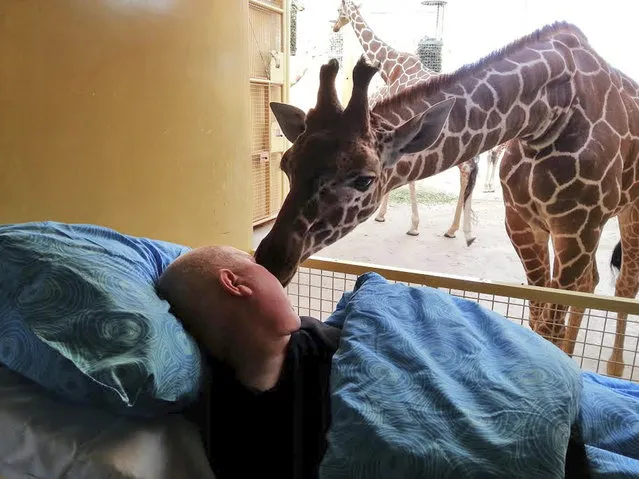
This photo released Saturday March 22, 2014 by Stichting Ambulance Wens or Ambulance Wish Foundation shows a giraffe at Blijdorp Zoo in Rotterdam giving a lick to terminally ill Mario Eijs on Wednesday March 19, 2014. The Stichting Ambulancewens “Ambulance Wish Foundation” offers transport for terminally ill patients who cannot walk to help fulfill a last wish, in Eijs' case to be taken to the Blijdorp Zoo in Rotterdam where he worked doing odd jobs for 25 years. (Photo by AP Photo/Stichting Ambulance Wens)

This photo released Saturday March 22, 2014 by Stichting Ambulance Wens or Ambulance Wish Foundation shows a giraffe at Blijdorp Zoo in Rotterdam giving a lick to terminally ill Mario Eijs on Wednesday March 19, 2014. The Stichting Ambulancewens “Ambulance Wish Foundation” offers transport for terminally ill patients who cannot walk to help fulfill a last wish, in Eijs' case to be taken to the Blijdorp Zoo in Rotterdam where he worked doing odd jobs for 25 years. Eijs, who has a mental handicap, is dying of a brain tumor and has difficulty walking or speaking. (Photo by AP Photo/Stichting Ambulance Wens)
Details
29 Mar 2014 14:20:00
A Sri Lankan activist, who wrapped himself with fire crackers, walks in Colombo on July 23, 2014 to symbolically demonstrate against people burned during Anti-Tamil riots on the island thirty-one years ago. Official accounts placed the death toll at 400 while human rights activists put the toll at thousands. (Photo by Ishara S.Kodikara/AFP Photo)

A Sri Lankan activist, who wrapped himself with fire crackers, walks in Colombo on July 23, 2014 to symbolically demonstrate against people burned during Anti-Tamil riots on the island thirty-one years ago. Official accounts placed the death toll at 400 while human rights activists put the toll at thousands. (Photo by Ishara S.Kodikara/AFP Photo)
Details
26 Jul 2014 12:00:00
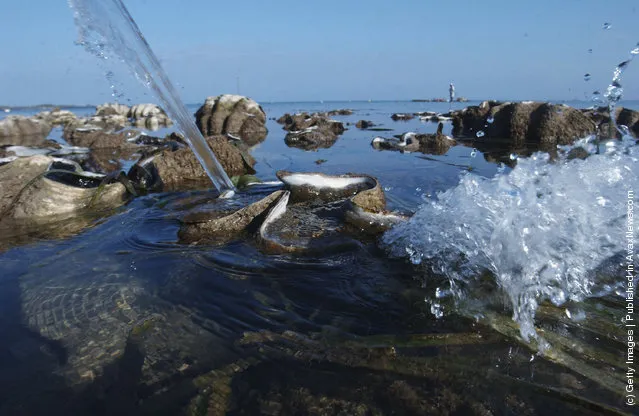
Tridacna Gigas, or Giant Clams

“The giant clam, Tridacna gigas (known as pā’ua in Cook Islands Māori), is the largest living bivalve mollusc. T. gigas is one of the most endangered clam species. It was mentioned as early as 1825 in scientific reports. One of a number of large clam species native to the shallow coral reefs of the South Pacific and Indian oceans, they can weigh more than 200 kilograms (440 lb) measure as much as 120 cm (47 in) across, and have an average lifespan in the wild of 100 years or more”. – Wikipedia

Photo: Tridacna Gigas, or Giant Clams spew water as a traditional fisherman passes by a small sanctuary on January 23, 2004 near Bolinao in the Northern Philippines. The clams, prime builders for coral reefs and providing shelter for spawning fish and other marine life, are exposed by low tides in the sanctuary. Overfishing and pollution throughout the country are not only threatening food security, but are also starting to choke one of the few working clam sanctuaries in the world. (Photo by David Greedy/Getty Images)

Details
01 Oct 2011 13:10:00
Members of a propaganda troupe perform in a public square in Pyongyang on April 12, 2017. (Photo by Ed Jones/AFP Photo)

Members of a propaganda troupe perform in a public square in Pyongyang on April 12, 2017. (Photo by Ed Jones/AFP Photo)
Details
13 Apr 2017 09:43:00
Chinese aids activists hand out condoms in a subway train in Wuhan, central China's Hubei province on December 1, 2014. The World Health Organization issued a call to action to China on December 1, 2014 over HIV/AIDS as government figures said nearly half a million people are living with the disease or its precursor, with hundreds of thousands more thought to be undiagnosed. (Photo by AFP Photo)

Chinese aids activists hand out condoms in a subway train in Wuhan, central China's Hubei province on December 1, 2014. The World Health Organization issued a call to action to China on December 1, 2014 over HIV/AIDS as government figures said nearly half a million people are living with the disease or its precursor, with hundreds of thousands more thought to be undiagnosed. (Photo by AFP Photo)
Details
06 Dec 2014 12:57:00