Loading...
Done
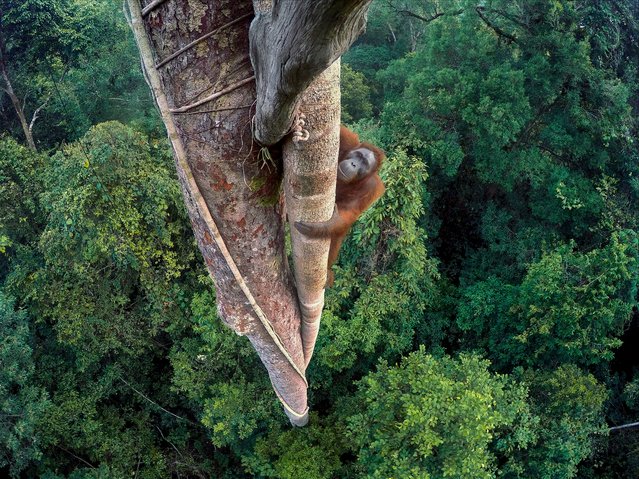
“Entwined Lives”. Tim Laman, US Winner, Wildlife photographer of the year. A young male orangutan makes the 30-metre climb up the thickest root of the strangler fig high above the canopy in Gunung Palung national park, one of the few protected orangutan strongholds in Indonesian Borneo. Laman had to do three days of climbing to position several GoPro cameras that he could trigger remotely. This shot was the one he had long visualised, looking down on the orangutan within its forest home. (Photo by Tim Laman/2016 Wildlife Photographer of the Year)

“Entwined Lives”. Tim Laman, US Winner, Wildlife photographer of the year. A young male orangutan makes the 30-metre climb up the thickest root of the strangler fig high above the canopy in Gunung Palung national park, one of the few protected orangutan strongholds in Indonesian Borneo. Laman had to do three days of climbing to position several GoPro cameras that he could trigger remotely. This shot was the one he had long visualised, looking down on the orangutan within its forest home. (Photo by Tim Laman/2016 Wildlife Photographer of the Year)
Details
19 Oct 2016 12:08:00
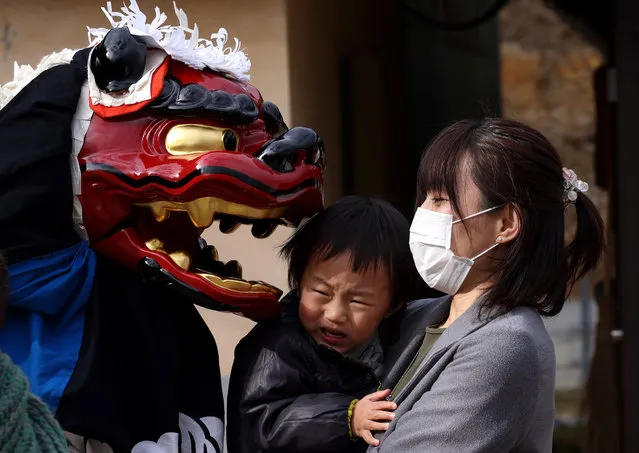
A performer wearing a lion mask performs the Ise Daikagura lion dance at the remote village of Yamanawa on February 08, 2021 in Ryuo, Japan. Ise Daikagura is a group of traditional Lion Dance performers who pray in front of farmers houses and businesses for good grain harvests and disease-free lives. Performers play sacred music using drums and flutes with two lion mask dancers. A lion mask is considered a symbol of God, who enters the house and performs in front of the Shinto God, a statue placed inside the house, mostly in the kitchen. These prayers are called “Kamodo Barai”. After the prayers, they are gifted with money, rice, sake and Japanese sweets from the householders. A group can travel for more than one hundred days to thousands of households and businesses throughout rural-villages in western Japan, and pray to those who are unable to visit the country’s most sacred shrine, the Grand Ise Shrine in Mie Prefecture. The group started its performance in the Edo era between 1603 to 1868 according to Japanese history. The Japanese government designated it as an important folk cultural national property in 1981. (Photo by Buddhika Weerasinghe/Getty Images)

A performer wearing a lion mask performs the Ise Daikagura lion dance at the remote village of Yamanawa on February 08, 2021 in Ryuo, Japan. Ise Daikagura is a group of traditional Lion Dance performers who pray in front of farmers houses and businesses for good grain harvests and disease-free lives. (Photo by Buddhika Weerasinghe/Getty Images)
Details
18 Feb 2021 09:27:00
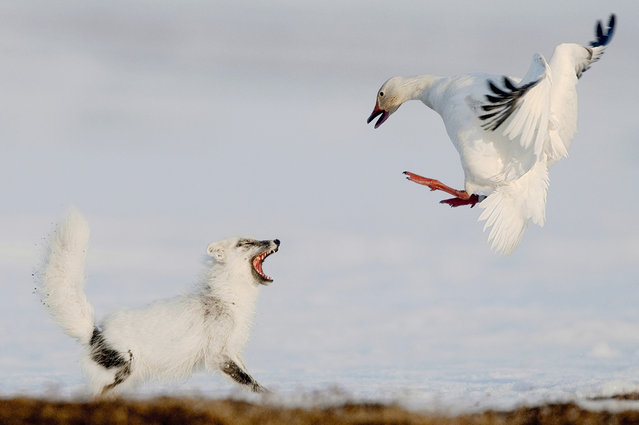
Commended. In late May, about a quarter of a million snow geese arrive from North America to nest on Wrangel Island, in northeastern Russia. They form the world's largest breeding colony of snow geese. Photographer Sergey Gorshkov spent two months on the remote island photographing the unfolding dramas. (Photo by Sergey Gorshkov/Veolia Environnement Wildlife Photographer)

Commended. In late May, about a quarter of a million snow geese arrive from North America to nest on Wrangel Island, in northeastern Russia. They form the world's largest breeding colony of snow geese. Photographer Sergey Gorshkov spent two months on the remote island photographing the unfolding dramas. Arctic foxes take advantage of the abundance of eggs, caching surplus eggs for leaner times. But a goose (here the gander) is easily a match for a fox, which must rely on speed and guile to steal eggs. “The battles were fairly equal”, notes Sergey, “and I only saw a fox succeed in grabbing an egg on a couple of occasions, despite many attempts”. Surprisingly, “the geese lacked any sense of community spirit”, he adds, “and never reacted when a fox harassed a neighboring pair nesting close by”. (Photo by Sergey Gorshkov/Veolia Environnement Wildlife Photographer)
Details
16 Jun 2015 12:30:00
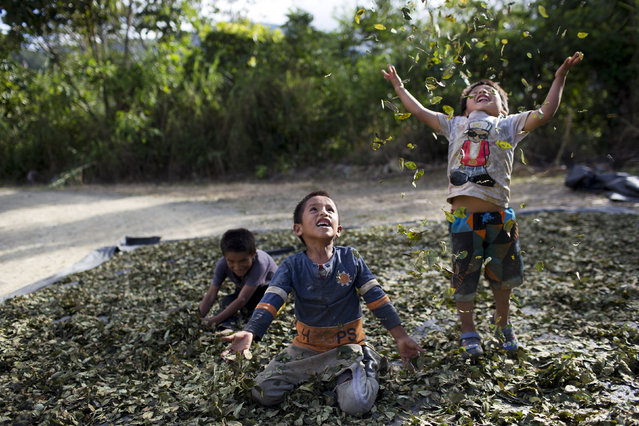
In this March 13, 2015 photo,  Yohan, 4, from left, Cristian, 7, and Angelo, 6, playfully toss coca leaves into the air, singing: “I have a lot of money, look at all the money I have”, in La Mar, province of Ayacucho, Peru. Hauling cocaine out of the remote valley is about the only way to earn decent cash in this region where a farmhand earns less than $10 a day. Beyond extinguishing young lives, the practice has packed Peru's highland prisons with cocaine backpackers while their bosses evade incarceration. (Photo by Rodrigo Abd/AP Photo)

In this March 13, 2015 photo, Yohan, 4, from left, Cristian, 7, and Angelo, 6, playfully toss coca leaves into the air, singing: “I have a lot of money, look at all the money I have”, in La Mar, province of Ayacucho, Peru. Hauling cocaine out of the remote valley is about the only way to earn decent cash in this region where a farmhand earns less than $10 a day. Beyond extinguishing young lives, the practice has packed Peru's highland prisons with cocaine backpackers while their bosses evade incarceration. (Photo by Rodrigo Abd/AP Photo)
Details
12 May 2015 12:40:00
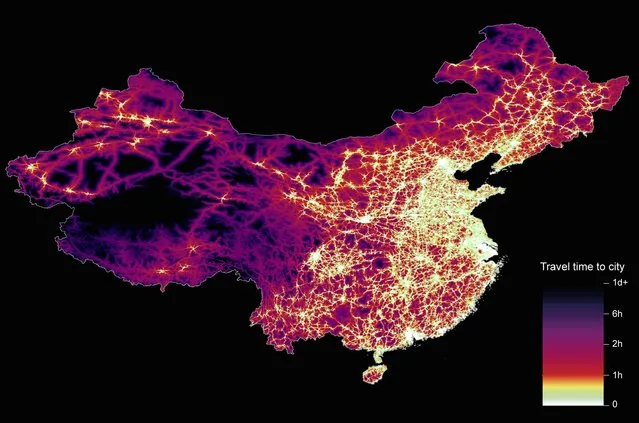
From Britain to China to Mali, new maps showing travel times to the nearest urban centre reveal huge differences between countries. Using Open Street Map and Google, a University of Oxford team have created a visual breakdown that suggests major inequalities when it comes to commuting. Here: China. The dataset used for China was unique as it relied solely on Open Street Map, due to restrictions on accessing Google data. The population is densely concentrated in the east and accessibility is increased, whereas rural provinces in the west remain remote. (Photo by Daniel Weiss/Jennifer Rozier/Malaria Atlas Project/University of Oxford )

From Britain to China to Mali, new maps showing travel times to the nearest urban centre reveal huge differences between countries. Using Open Street Map and Google, a University of Oxford team have created a visual breakdown that suggests major inequalities when it comes to commuting. Here: China. The dataset used for China was unique as it relied solely on Open Street Map, due to restrictions on accessing Google data. The population is densely concentrated in the east and accessibility is increased, whereas rural provinces in the west remain remote. (Photo by Daniel Weiss/Jennifer Rozier/Malaria Atlas Project/University of Oxford)
Details
12 Jan 2018 06:43:00
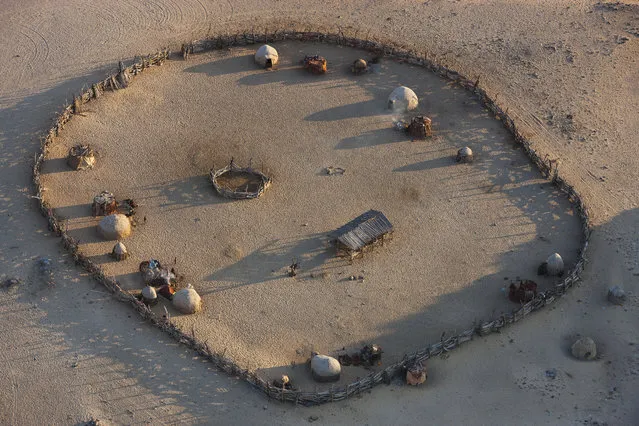
An aerial view of a livestock enclosure of the Himba people, in October, 2014, in the Namib Desert, Namibia. (Photo by Theo Allofs/Barcroft Media)

An aerial view of a livestock enclosure of the Himba people, in October, 2014, in the Namib Desert, Namibia. A photographer has captured a bird's eye view of the stunning Namib Desert from a paraglider. Theo Allofs travels the world taking stunning pictures of untouched landscapes from a unique perspective. Soaring 300 metres above ground, Theo shot the yellow sand dunes, dry red river beds and remote townships in Namibia. (Photo by Theo Allofs/Barcroft Media)
Details
24 Apr 2015 11:06:00
A bear that wandered into a University of Colorado Boulder dorm complex falls from a tree after being tranquilized by Colorado wildlife officials on April 26

A bear that wandered into a University of Colorado Boulder dorm complex falls from a tree after being tranquilized by Colorado wildlife officials on April 26, 2012. Colorado wildlife official Jennifer Churchill said that the 200-pound male bear was tagged and relocated to a remote Rocky Mountain area. The bear was hit by two cars on May 3 and died. (Photo by Andy Duann)
Details
08 May 2012 12:20:00
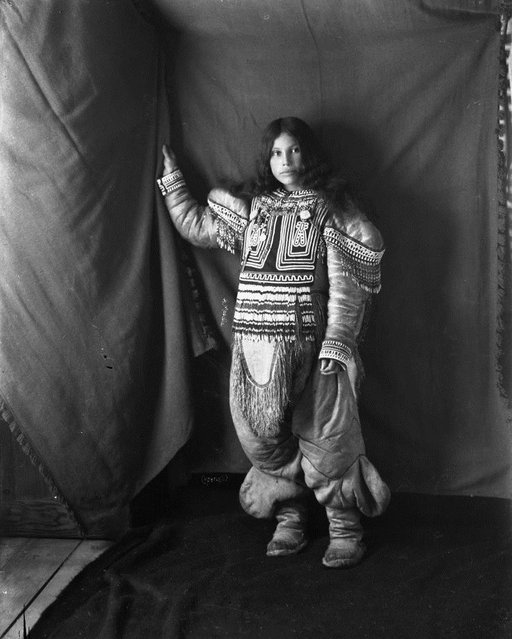
Moodie was born in 1854 in Toronto, and after a move to England she met and married John Douglas Moodie in 1878, and had six children. Here: Inuit woman, Kootucktuck, in her beaded attigi. Fullerton Harbour, Nunavut, February 1905. (Photo by Geraldine Moodie/The Guardian)

Geraldine Moodie overcame harsh conditions to become western Canada’s first professional female photographer, capturing beautiful images in the country’s most remote regions. An exhibition, “North of Ordinary: The Arctic Photographs of Geraldine and Douglas Moodie”, is at Glenbow, Calgary, 18 February – 10 September. Here: Inuit woman, Kootucktuck, in her beaded attigi. Fullerton Harbour, Nunavut, February 1905. (Photo by Geraldine Moodie/The Guardian)
Details
17 Feb 2017 00:04:00