Loading...
Done
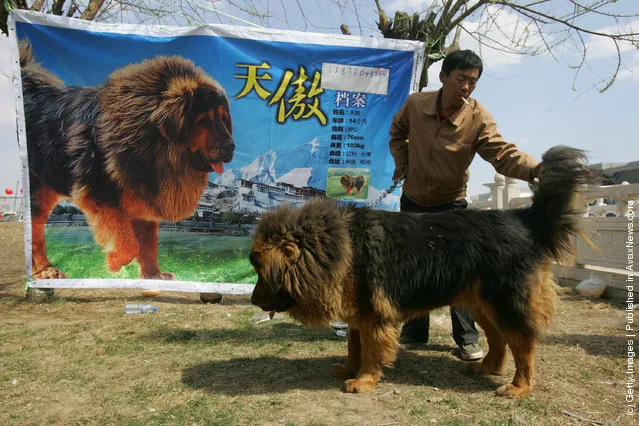
Tibetan Mastiff

“The Tibetan Mastiff also known as Do-khyi (variously translated as “home guard”, “door guard”, “dog which may be tied”, “dog which may be kept”), reflects its use as a guardian of herds, flocks, tents, villages, monasteries, and palaces, much as the old English ban-dog (also meaning tied dog) was a dog tied outside the home as a guardian. However, in nomad camps and in villages, the Do-khyi is traditionally allowed to run loose at night and woe be unto the stranger who walks abroad after dark”. – Wikipedia

Photo: A man displays a Tibetan Mastiff he raised during the Tibetan Mastiff exposition on April 7, 2007 in Langfang of Hebei Province, China. (Photo by China Photos/Getty Images)
Details
05 Oct 2011 14:27:00
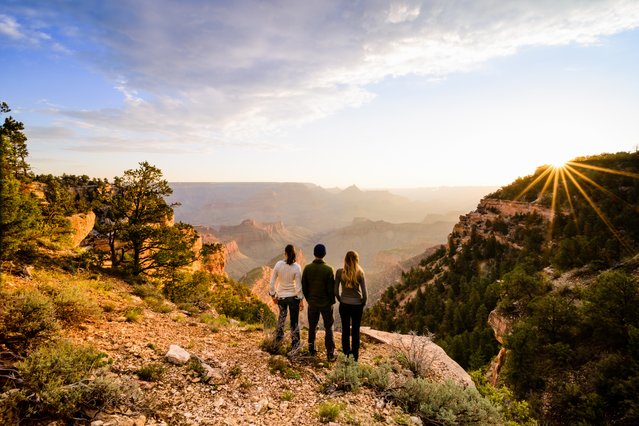
Winner of the National Park Foundation's photo contest; Honorable Mention: Fan Favorite. Grand Canyon National Park, Arizona. Three friends enjoy sunrise over the Grand Canyon. (Photo by Peter Blanchard)

Winner of the National Park Foundation's photo contest; Honorable Mention: Fan Favorite. Grand Canyon National Park, Arizona. Three friends enjoy sunrise over the Grand Canyon. (Photo by Peter Blanchard)
Details
02 May 2014 09:23:00


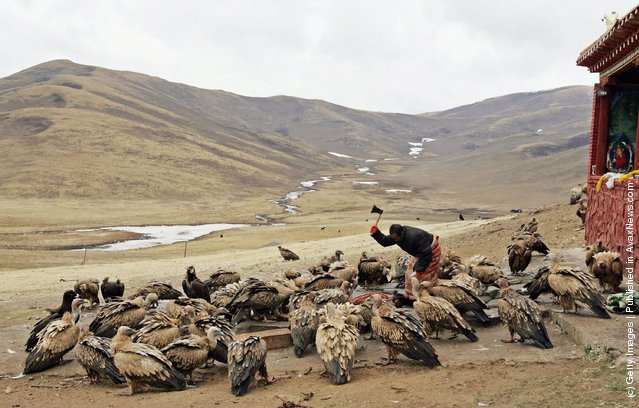
“Sky burial or ritual dissection was once a common funerary practice in Tibet wherein a human corpse is cut in specific locations and placed on a mountaintop, exposing it to the elements or the mahabhuta and animals – especially to birds of prey. The location of the sky burial preparation and place of execution are understood in the Vajrayana traditions as charnel grounds. In Tibet the practice is known as jhator, which literally means, «giving alms to the birds»”. – Wikipedia

Photo: A burial master chops bones of a body to feed vultures during a celestial burial ceremony on April 19, 2006 in Dari County of Guoluo Prefecture, Qinghai Province, northwest China. Celestial burial is a traditional funeral of Tibetan people, which began in the 7th century. (Photo by China Photos/Getty Images)
Details
18 Jun 2011 12:12:00
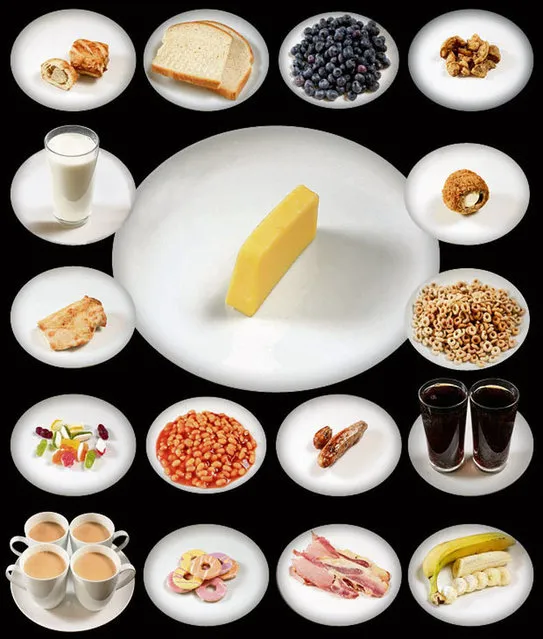
What 200 Calories Looks Like In Different Foods Part 2

Some foods have significantly more Calories than others but what does the difference actually look like. Each of the photographs below represents 200 Calories of the particular type of food; the images are sorted from low to high calorie density. When you consider that an entire plate of broccoli contains the same number of Calories as a small spoonful of peanut butter, you might think twice the next time you decide what to eat. According to the U.S. Department of Agriculture, the average adult needs to consume about 2000 – 2500 Calories to maintain their weight. In other words, you have a fixed amount of Calories to “spend” each day; based on the following pictures, which would you eat?


See Also: Ppart 1 _ Part 3
Details
01 Aug 2014 11:30:00
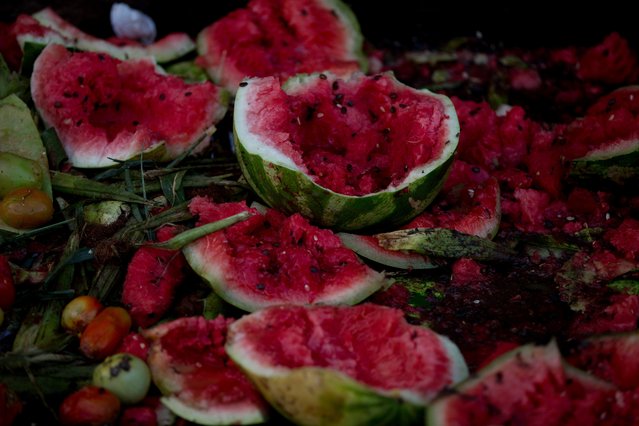
In this May 31, 2016 photo, pieces of watermelon litter the trash area of the Coche public market in Caracas, Venezuela. Staples such as corn flour and cooking oil are subsidized, costing pennies at the strongest of two official exchange rates. But fruit and vegetables have become an unaffordable luxury for many Venezuelan families. (Photo by Fernando Llano/AP Photo)

In this May 31, 2016 photo, pieces of watermelon litter the trash area of the Coche public market in Caracas, Venezuela. Staples such as corn flour and cooking oil are subsidized, costing pennies at the strongest of two official exchange rates. But fruit and vegetables have become an unaffordable luxury for many Venezuelan families. (Photo by Fernando Llano/AP Photo)
Details
08 Jun 2016 10:21:00
sniper

7th August 1941: A Soviet sniper targets the enemy with the telescopic sight on his rifle.
Details
16 Apr 2011 18:38:00
Marc Berthod of Switzerland during the Audi FIS Alpine Ski World Cup Men's Super Combined

Marc Berthod of Switzerland during the Audi FIS Alpine Ski World Cup Men's Super Combined on February 12, 2012 in Sochi, Russia. (Photo by Vianney Thibaut/Agence Zoom/Getty Images)
Details
13 Feb 2012 13:02:00
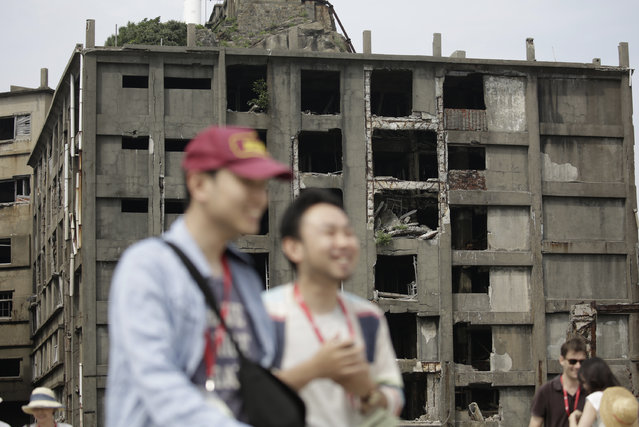
In this June 29, 2015 photo, forlorn buildings are seen at Hashima Island, commonly known as Gunkanjima, which means “Battleship Island”, off Nagasaki, Nagasaki Prefecture, southern Japan. (Photo by Eugene Hoshiko/AP Photo)

In this June 29, 2015 photo, forlorn buildings are seen at Hashima Island, commonly known as Gunkanjima, which means “Battleship Island”, off Nagasaki, Nagasaki Prefecture, southern Japan. The island is one of 23 old industrial facilities seeking UNESCO's recognition as world heritage “Sites of Japan's Meiji Industrial Revolution” meant to illustrate Japan's rapid transformation from a feudal farming society into an industrial power at the end of the 19th century. UNESCO's World Heritage Committee is expected to approve the proposal during a meeting being held in Bonn, Germany, through July 9. (Photo by Eugene Hoshiko/AP Photo)
Details
01 Jul 2015 13:41:00