Loading...
Done
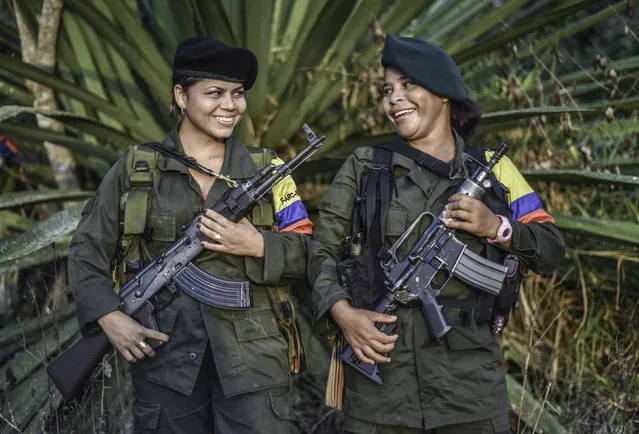
Manuela (L) and Marta, members of the Revolutionary Armed Forces of Colombia (FARC), pose for a picture at a camp in the Colombian mountains on February 18, 2016. Many of these women are willing to be reunited with the children they gave birth and then left under protection of relatives or farmers, whenever the peace agreement will put an end to the country's internal conflict. (Photo by Luis Acosta/AFP Photo)

Manuela (L) and Marta, members of the Revolutionary Armed Forces of Colombia (FARC), pose for a picture at a camp in the Colombian mountains on February 18, 2016. Many of these women are willing to be reunited with the children they gave birth and then left under protection of relatives or farmers, whenever the peace agreement will put an end to the country's internal conflict. (Photo by Luis Acosta/AFP Photo)
Details
27 Feb 2016 10:40:00
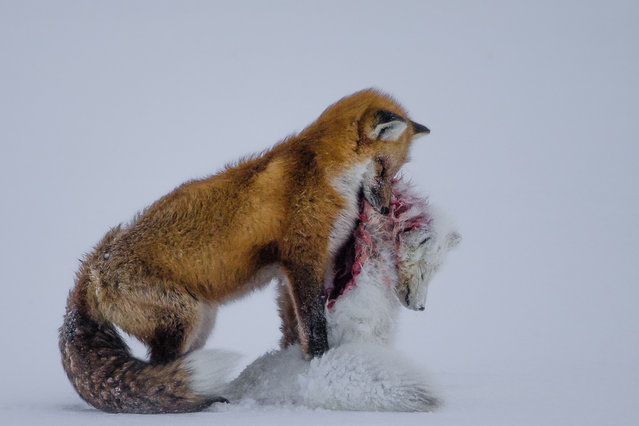
A tale of two foxes. Surprising behaviour, witnessed in Wapusk national park, on Hudson Bay, Canada, in early winter. Red foxes don’t actively hunt Arctic foxes, but where the ranges of two predators overlap, there can be conflict. Though the light was poor, the snow-covered tundra provided the backdrop for the moment that the red fox paused with the smaller fox in its mouth in a grim pose. (Photo by Don Gutoski/2015 Wildlife Photographer of the Year)

A tale of two foxes. Surprising behaviour, witnessed in Wapusk national park, on Hudson Bay, Canada, in early winter. Red foxes don’t actively hunt Arctic foxes, but where the ranges of two predators overlap, there can be conflict. Though the light was poor, the snow-covered tundra provided the backdrop for the moment that the red fox paused with the smaller fox in its mouth in a grim pose. (Photo by Don Gutoski/2015 Wildlife Photographer of the Year)
Details
20 Oct 2015 08:02:00
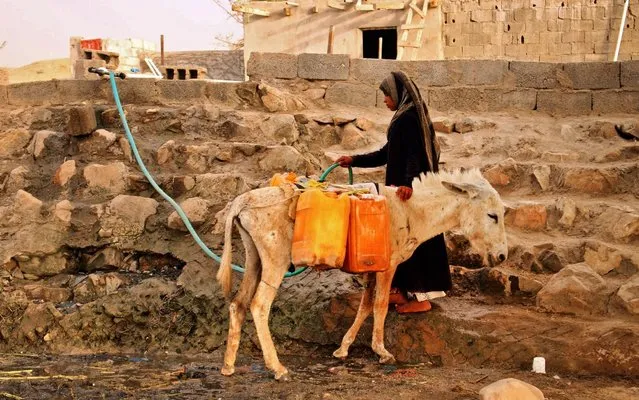
A displaced Yemeni woman from Hodeida fills water containers at a make-shift camp in a village in the northern district of Abs in the country's Hajjah province, on May 9, 2019. The Yemeni conflict has triggered what the United Nations describes as the world's worst humanitarian crisis, with 3.3 million people still displaced and 24.1 million in need of aid. (Photo by Essa Ahmed/AFP Photo)

A displaced Yemeni woman from Hodeida fills water containers at a make-shift camp in a village in the northern district of Abs in the country's Hajjah province, on May 9, 2019. The Yemeni conflict has triggered what the United Nations describes as the world's worst humanitarian crisis, with 3.3 million people still displaced and 24.1 million in need of aid. (Photo by Essa Ahmed/AFP Photo)
Details
13 May 2019 00:03:00
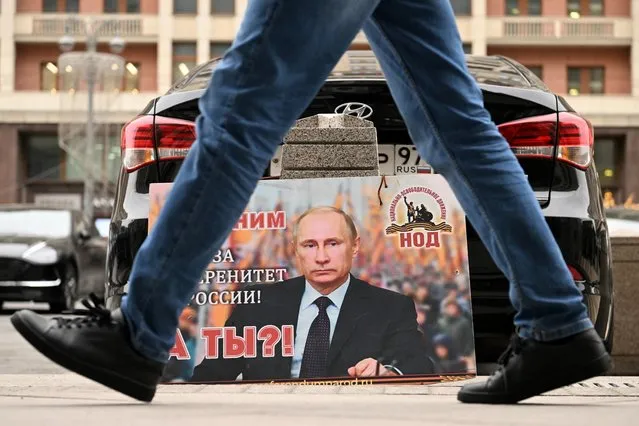
A placard featuring an image of Russian President Vladimir Putin and reading “We are with him for the sovereignty of Russia! And you?” is seen left in front of the Russian State Duma building in central Moscow on February 24, 2022. (Photo by Kirill Kudryavtsev/AFP Photo)

A placard featuring an image of Russian President Vladimir Putin and reading “We are with him for the sovereignty of Russia! And you?” is seen left in front of the Russian State Duma building in central Moscow on February 24, 2022. (Photo by Kirill Kudryavtsev/AFP Photo)
Details
01 Mar 2022 06:52:00
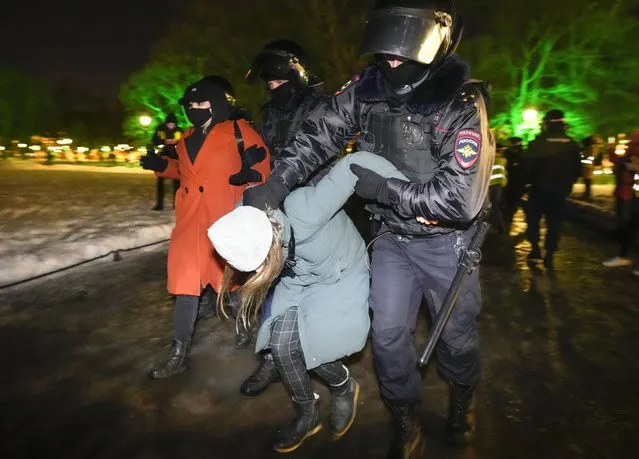
Police detain demonstrators during an action against Russia's attack on Ukraine in St. Petersburg, Russia, Monday, February 28, 2022. Protests against the Russian invasion of Ukraine resumed on Monday, with people taking to the streets of Moscow and St. Petersburg and other Russian towns despite mass arrests. (Photo by Dmitri Lovetsky/AP Photo)

Police detain demonstrators during an action against Russia's attack on Ukraine in St. Petersburg, Russia, Monday, February 28, 2022. Protests against the Russian invasion of Ukraine resumed on Monday, with people taking to the streets of Moscow and St. Petersburg and other Russian towns despite mass arrests. (Photo by Dmitri Lovetsky/AP Photo)
Details
01 Mar 2022 07:15:00
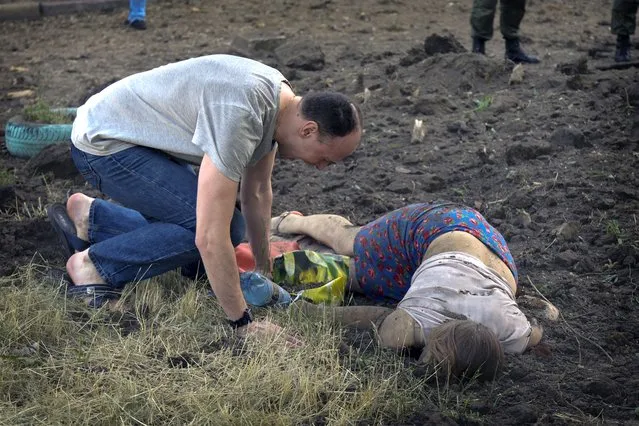
A man cries over the body of his girlfriend, who was killed by shelling in the Kalininsky district of Donetsk, territory under control of the pro-Russian Government of the Donetsk People's Republic in eastern Ukraine, Thursday, June 9, 2022, during the Russian invasion. (Photo by Alexei Alexandrov/AP Photo)

A man cries over the body of his girlfriend, who was killed by shelling in the Kalininsky district of Donetsk, territory under control of the pro-Russian Government of the Donetsk People's Republic in eastern Ukraine, Thursday, June 9, 2022, during the Russian invasion. (Photo by Alexei Alexandrov/AP Photo)
Details
12 Jun 2022 04:05:00
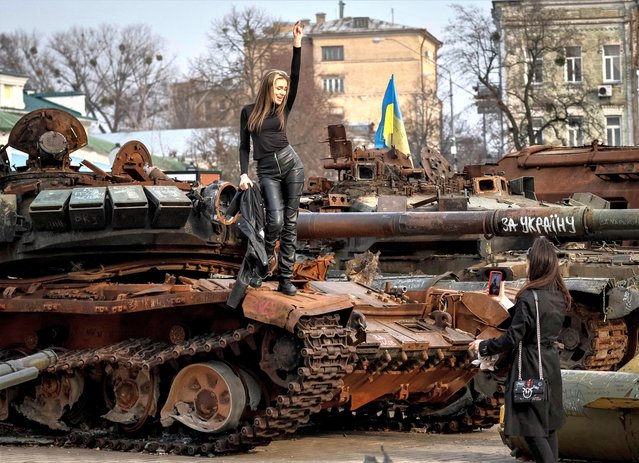
Women take a picture atop a destroyed Russian tank during an exhibition displaying destroyed Russian military vehicles, amid Russia's invasion, in central Kyiv, Ukraine on March 21, 2023. (Photo by Gleb Garanich/Reuters)

Women take a picture atop a destroyed Russian tank during an exhibition displaying destroyed Russian military vehicles, amid Russia's invasion, in central Kyiv, Ukraine on March 21, 2023. (Photo by Gleb Garanich/Reuters)
Details
08 Jul 2024 05:56:00
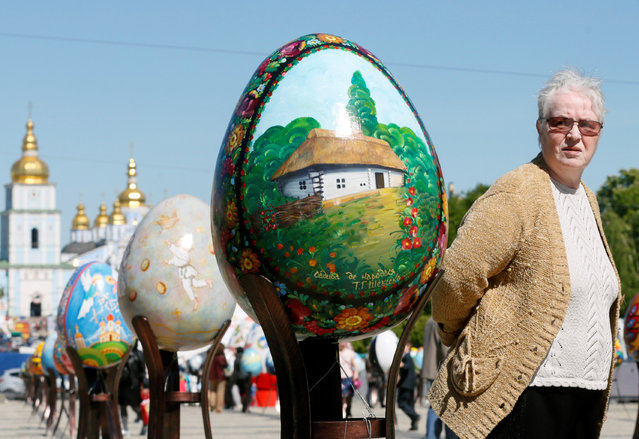
A woman looks at traditional Ukrainian Easter eggs “Pysanka”, installed as part of the upcoming celebrations of Easter, in central Kiev, Ukraine, April 29, 2016. A pysanka is a Ukrainian Easter egg, decorated with traditional Ukrainian folk designs using a wax-resist (batik) method. The word pysanka comes from the verb pysaty, “to write”, as the designs are not painted on, but written with beeswax. Many other eastern European ethnic groups decorate eggs using wax resist for Easter. These include the Belarusians, Bulgarians, Croats, Czechs, Hungarians, Lithuanians, Poles, Romanians, Serbs, Slovaks, Slovenes and Sorbs. (Photo by Valentyn Ogirenko/Reuters)

A woman looks at traditional Ukrainian Easter eggs “Pysanka”, installed as part of the upcoming celebrations of Easter, in central Kiev, Ukraine, April 29, 2016. A pysanka is a Ukrainian Easter egg, decorated with traditional Ukrainian folk designs using a wax-resist (batik) method. The word pysanka comes from the verb pysaty, “to write”, as the designs are not painted on, but written with beeswax. Many other eastern European ethnic groups decorate eggs using wax resist for Easter. These include the Belarusians, Bulgarians, Croats, Czechs, Hungarians, Lithuanians, Poles, Romanians, Serbs, Slovaks, Slovenes and Sorbs. (Photo by Valentyn Ogirenko/Reuters)
Details
30 Apr 2016 09:00:00