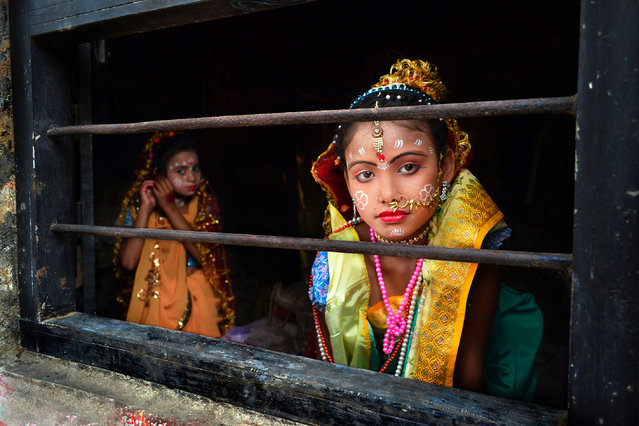
“Festive preparation”. Baghnapara, Bardhaman, West Bengal, India. Two girls prepare for the Gajan festival. They will perform a play based on Indian mythology. (Photo by Krishnasis Ghosh)
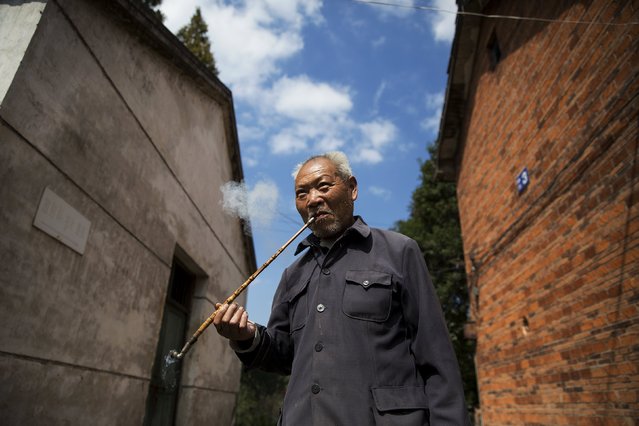
Wang Zhengqing, a 74 year old pneumoconiosis patient, smokes his pipe at Yangjia Hospital in Wuyi County, Zhejiang Province, China October 19, 2015. Former miner Wang was diagnosed with the disease, which is caused by dust inhalation, when he was 24 and has lived at Yangjia Hospital for ten years. (Photo by Damir Sagolj/Reuters)
“Sunward”. When the Mediterrenean Mantis opened its wings, It seemed very impressive at the sunshine... Photo location: Nicosia, Cyprus. (Photo and caption by Hasan Baglar/National Geographic Photo Contest)
Students dance in the hallway during a break at Moscow State Academy of Choreography in Moscow, Russia 03 March 2016. Moscow State Academy of Choreography is the oldest institution in Moscow which teaches Ballet arts not only Russian citizens, but also representatives from more than 20 countries. (Photo by Yuri Kochetkov/EPA)
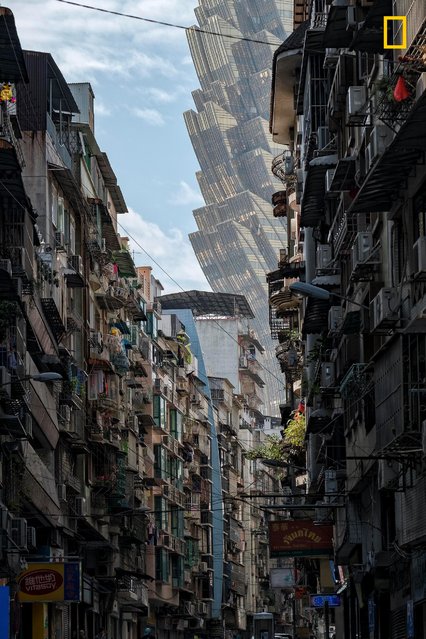
The Invasion. A quiet street in Macau. Modernization around is quickly changing the city, as documented by Paul Tsui. (Photo by Paul Tsui/National Geographic Travel Photographer of the Year Contest)
Volunteers wait before taking part in the 66th National Day celebrations in Malaysia's administrative capital Putrajaya, on August 31, 2023. The country commemorates the independence of the Federation of Malaya from British rule in 1957. (Photo by Mohd Rasfan/AFP Photo)
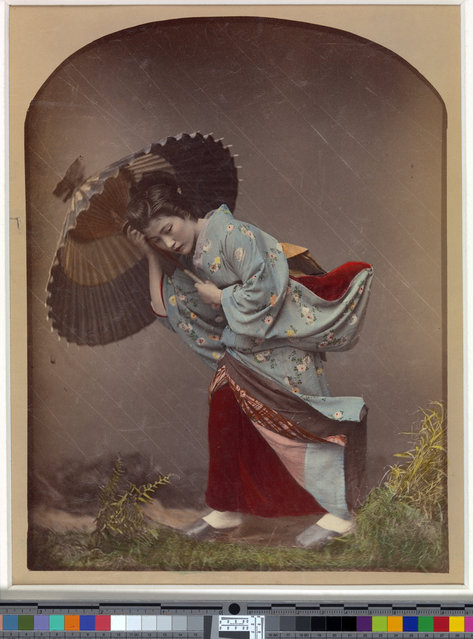
“Woman with Umbrella in Rain” by Raimund von Stillfried. Artist: Kusakabe Kimbei (Japanese, 1841–1934), 1870s. Commercial photography studios in Meiji-era Japan were renowned for the subtlety and refinement of their coloring techniques. This hand-tinted image of a young woman caught in a heavy rainstorm achieved its naturalistic effect by knitting together multiple strands of artifice: the greenery in the foreground was a studio prop; the flaps of the kimono were suspended by thin wires to create the impression of a strong wind; and long, diagonal marks were made on the negative to suggest streaks of rain. (Photo courtesy of The Metropolitan Museum of Art)