Loading...
Done
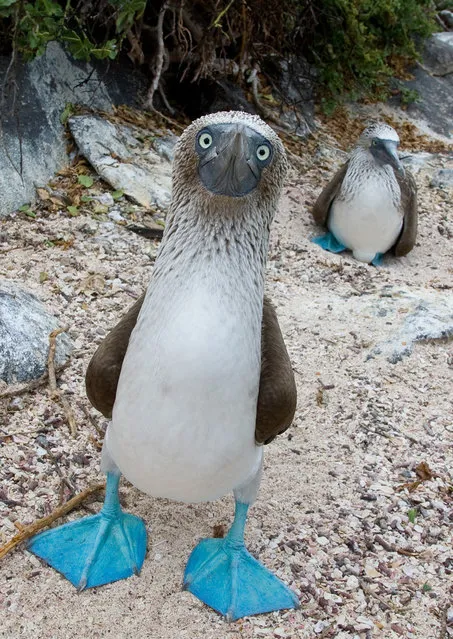
Blue-Footed Booby

The blue-footed booby (Sula nebouxii) is a marine bird in the family Sulidae, which includes ten species of long-winged seabirds. Blue-footed boobies belong to the genus Sula, which comprises six species of boobies. It is easily recognizable by its distinctive bright blue feet, which is a sexually selected trait. Males display their feet in an elaborate mating ritual by lifting their feet up and down while strutting before the female.

See Also: Red
Details
03 Oct 2014 12:42:00
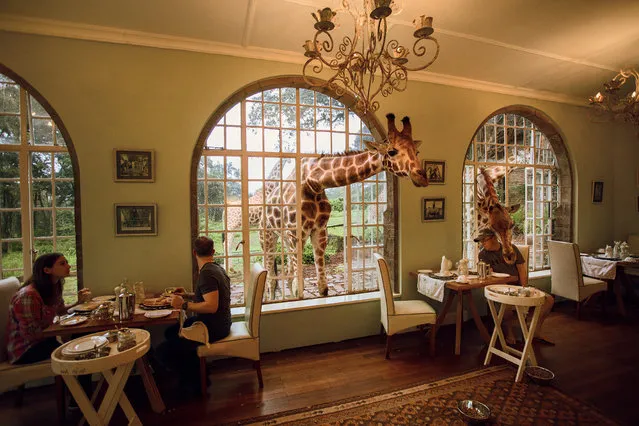
The giraffes visit twice a day searching for food, before returning to the forest. Although still wild animals, they have become accustomed to receiving treats from residents and guests. (Photo by Klaus Thymann)

Situated 10km outside Nairobi city centre, this private giraffe sanctuary is centred around a colonial manor house named Giraffe Manor. Living within the grounds is a herd of rare Rothschild giraffe. The giraffes visit twice a day searching for food, before returning to the forest. Although still wild animals, they have become accustomed to receiving treats from residents and guests. (Photo by Klaus Thymann)
Details
28 Jan 2016 12:36:00
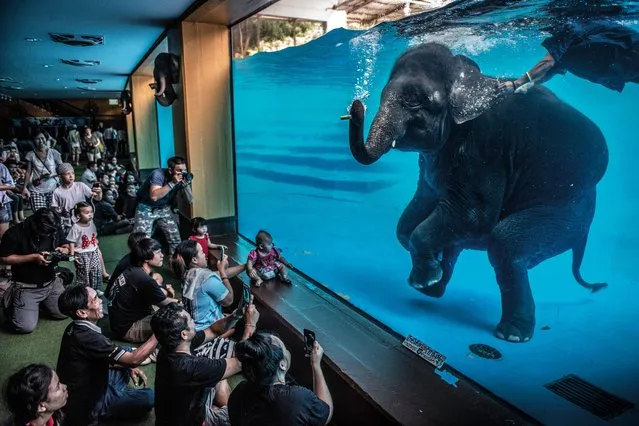
Winner, photojournalism. Elephant in the room, by Adam Oswell, Australia Zoo. Visitors watch a young elephant performing underwater. Oswell was disturbed by this scene, and organisations concerned with the welfare of captive elephants say performances like this encourage unnatural behaviour. In Thailand, there are now more elephants in captivity than in the wild. With the Covid pandemic causing tourism to collapse, elephant sanctuaries are becoming overwhelmed with animals that can no longer be looked after by their owners. (Photo by Adam Oswell/Wildlife Photographer of the Year 2021)

Winner, photojournalism. Elephant in the room, by Adam Oswell, Australia Zoo. Visitors watch a young elephant performing underwater. Oswell was disturbed by this scene, and organisations concerned with the welfare of captive elephants say performances like this encourage unnatural behaviour. In Thailand, there are now more elephants in captivity than in the wild. With the Covid pandemic causing tourism to collapse, elephant sanctuaries are becoming overwhelmed with animals that can no longer be looked after by their owners. (Photo by Adam Oswell/Wildlife Photographer of the Year 2021)
Details
30 Oct 2021 08:40:00
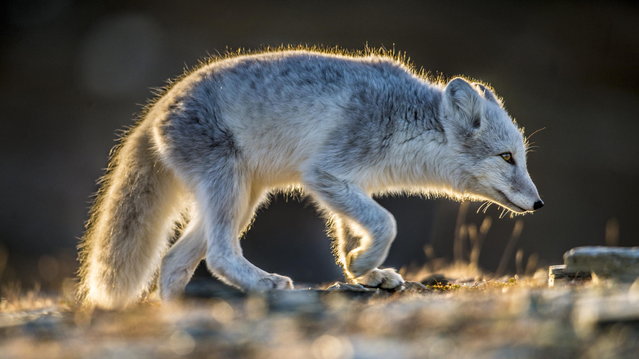
Arctic Fox. (Photo by Trond Eriksen)

“The arctic fox (Vulpes lagopus), also known as the white fox, polar fox, or snow fox, is a small fox native to the Arctic regions of the Northern Hemisphere and is common throughout the Arctic tundra biome. It is well adapted to living in cold environments. It has a deep thick fur which is brown in summer and white in winter. It averages in size at about 85.3 cm (33.6 in) in body length, with a generally rounded body shape to minimize the escape of body heat. – Wikipedia. (Photo by Trond Eriksen)
Details
26 May 2014 14:09:00


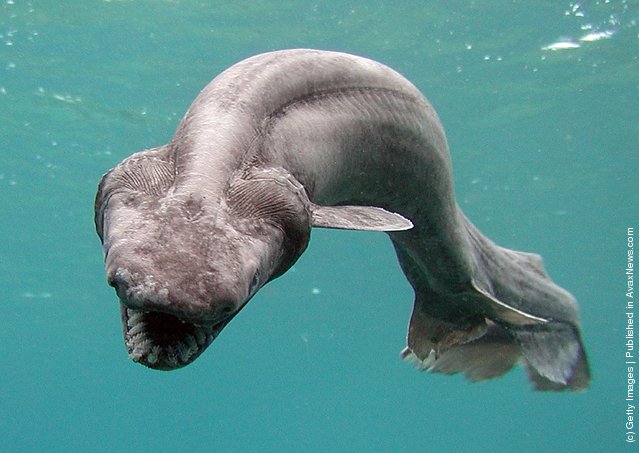
“The frilled shark (Chlamydoselachus anguineus) is one of two extant species of shark in the family Chlamydoselachidae, with a wide but patchy distribution in the Atlantic and Pacific Oceans. This uncommon species is found over the outer continental shelf and upper continental slope, generally near the bottom though there is evidence of substantial upward movements. It has been caught as deep as 1,570 m (5,150 ft), whereas in Suruga Bay, Japan it is most common at depths of 50–200 m (160–660 ft). Exhibiting several “primitive” features, the frilled shark has often been termed a «living fossil»”. – Wikipedia

Photo: A 1.6 meter long Frill shark swims in a tank after being found by a fisherman at a bay in Numazu, on January 21, 2007 in Numazu, Japan. The frill shark, also known as a Frilled shark usually lives in waters of a depth of 600 meters and so it is very rare that this shark is found alive at sea-level. It's body shape and the number of gill are similar to fossils of sharks which lived 350,000,000 years ago. (Photo by Awashima Marine Park/Getty Images)

Details
05 May 2011 10:01:00
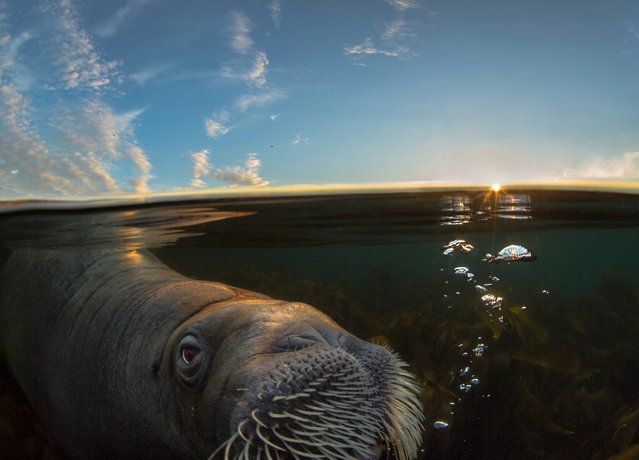
The Wildscreen festival is the world’s biggest celebration of screen-based natural history storytelling which takes place every two years in Bristol. Here: “Walrus in Midnight Sun”. Walrus feed mostly on bivalves in productive, shallow and often sandy habitats in the Arctic. This individual, though, arrived on a beach outside Tromsø, northern Norway, and found comfort on a stranded dead sperm whale. After two weeks he approached Audun, and only half a metre away he stretched his tusk forward and touched his hand gently. “This was one of the most memorable moments of my life”, Rikardsen says. He named the 500kg male Buddy. After two months, the dead whale was decomposed and Buddy suddenly disappeared. (Photo by Audun Rikardsen/Wildscreen 2016)

The Wildscreen festival is the world’s biggest celebration of screen-based natural history storytelling which takes place every two years in Bristol. Here: “Walrus in Midnight Sun”. Walrus feed mostly on bivalves in productive, shallow and often sandy habitats in the Arctic. This individual, though, arrived on a beach outside Tromsø, northern Norway, and found comfort on a stranded dead sperm whale. After two weeks he approached Audun, and only half a metre away he stretched his tusk forward and touched his hand gently. “This was one of the most memorable moments of my life”, Rikardsen says. He named the 500kg male Buddy. After two months, the dead whale was decomposed and Buddy suddenly disappeared. (Photo by Audun Rikardsen/Wildscreen 2016)
Details
07 Oct 2016 10:02:00
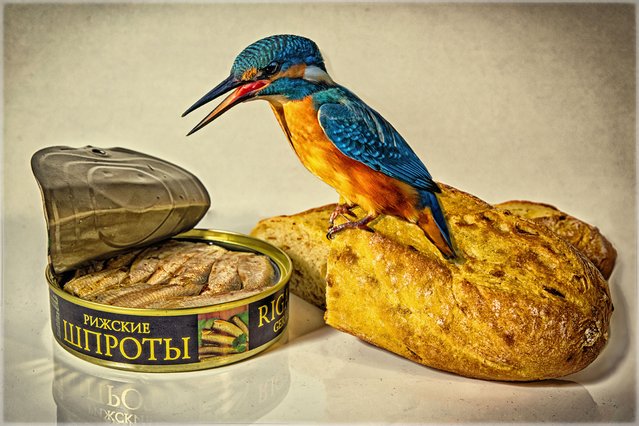
Creative imagery, gold winner: Sprats and Bread, Ruediger Schulz, Germany. (Photo by Ruediger Schulz/2021 Bird Photographer of the Year)

Creative imagery, gold winner: Sprats and Bread, Ruediger Schulz, Germany. (Photo by Ruediger Schulz/2021 Bird Photographer of the Year)
Details
26 Sep 2021 02:43:00
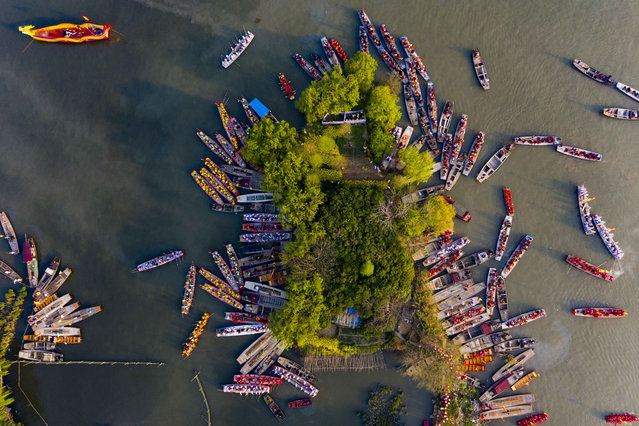
Performers on boats take part in the Qintong Boat Festival at Qin Lake National Wetland Park on April 6, 2019 in Taizhou, Jiangsu Province of China. The boat festival is held around the Qingming Festival every year, and up to 10,000 participants from nearby villages and towns, with more than 500 boats, took part in the event this year. (Photo by Tang Dehong/VCG via Getty Images)

Performers on boats take part in the Qintong Boat Festival at Qin Lake National Wetland Park on April 6, 2019 in Taizhou, Jiangsu Province of China. The boat festival is held around the Qingming Festival every year, and up to 10,000 participants from nearby villages and towns, with more than 500 boats, took part in the event this year. (Photo by Tang Dehong/VCG via Getty Images)
Details
18 May 2019 00:05:00