Loading...
Done


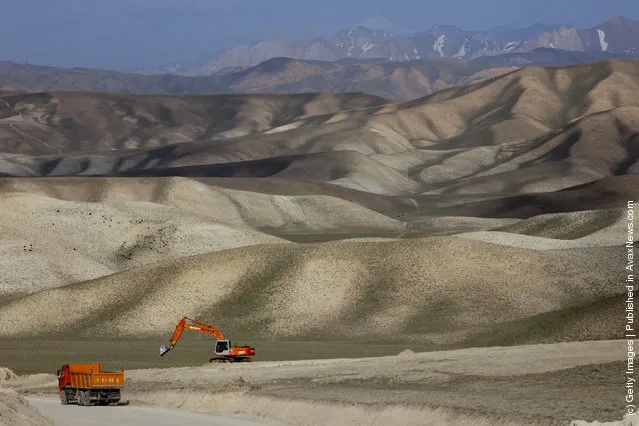
Heavy equipment works along the still under construction Bamiyan-Yakawlang road June 10, 2011 in Yakawlang, Afghanistan. The 69 Million US$ project is supported by the Government of Japan and World Bank. The 90K road project was started three years ago and is slated to be finished within another year. This new road means faster travel from Bamiyan to Afghanistan's only national park, Band-e-Amir. This is in of the safest parts of the country and the hope is to expand tourism in the region. (Photo by Paula Bronstein/Getty Images)
Details
11 Jun 2011 12:32:00
The Y-40 Deep Joy features several levels and grottos. (Photo by Courtesy Y40 Deep Joy)

The Y-40 Deep Joy is the worlds deepest pool. Y-40 is projected by Architect Emanuele Boaretto and supported by the “Boaretto Group Hotel and Resort”. The name Y-40 is inspired by mathematical symbols. “Y” is the ordinate axis of the Cartesian system and “–40” means the world's record depth or our pool- that is 40 meters underground. (Photo by Courtesy Y40 Deep Joy)
Details
07 Oct 2014 11:09:00
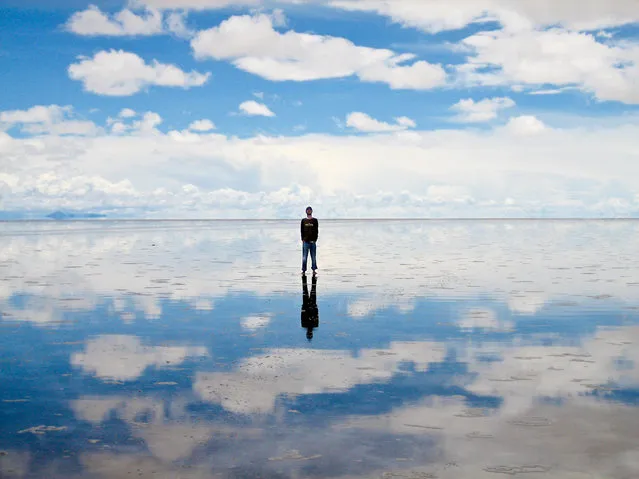
Salar de Uyuni

Salar de Uyuni (or Salar de Tunupa) is the world's largest salt flat at 10,582 square kilometers (4,086 sq mi). It is located in the Potosí and Oruro departments in southwest Bolivia, near the crest of the Andes, and is elevated 3,656 meters (11,995 ft) above mean sea level. The Salar was formed as a result of transformations between several prehistoric lakes. It is covered by a few meters of salt crust, which has an extraordinary flatness with the average altitude variations within one meter over the entire area of the Salar.
Details
04 Aug 2012 08:42:00
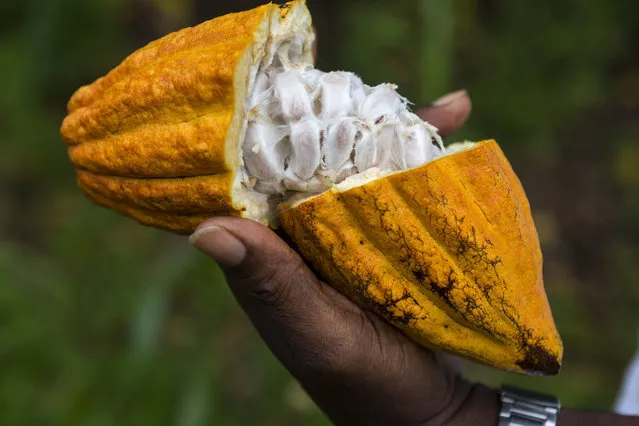
Farmer holding a freshly cut cocoa bean pod, revealing the pulp and seed inside on a rainforest farm. (Photo by Doug McKinlay/Getty Images)

Chocolate is the greatest gift the Earth has given us. The dessert table would be a sad sight without it. It’s so beloved, so appreciated, that the Swedish scientist who named the cocoa plant that gives us chocolate called it Theobroma cacao, which means “food of the gods”. Here: Farmer holding a freshly cut cocoa bean pod, revealing the pulp and seed inside on a rainforest farm. (Photo by Doug McKinlay/Getty Images)
Details
10 Aug 2016 10:20:00
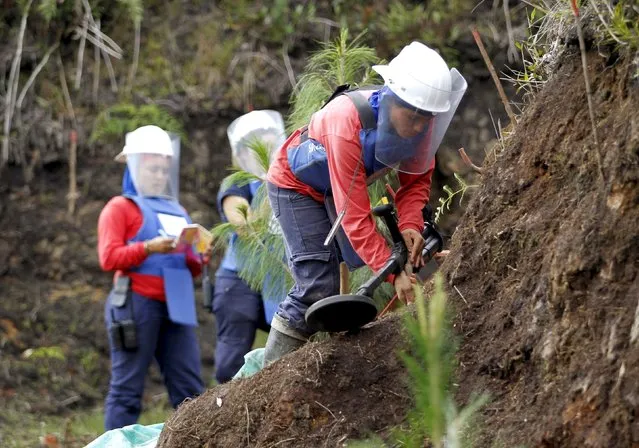
Natalia Arango works with her mine detector in a zone of landmines planted by rebels groups near Sonson in Antioquia province, November 19, 2015. (Photo by Fredy Builes/Reuters)

Natalia Arango works with her mine detector in a zone of landmines planted by rebels groups near Sonson in Antioquia province, November 19, 2015. Women's work takes on a nontraditional meaning for fifteen Colombian women who work to rid the Antioquia Mountains of deadly landmines as the country edges closer to a peace agreement with Marxist rebels to end over a decade of conflict which has claimed 220,000 lives. (Photo by Fredy Builes/Reuters)
Details
27 Nov 2015 04:44:00
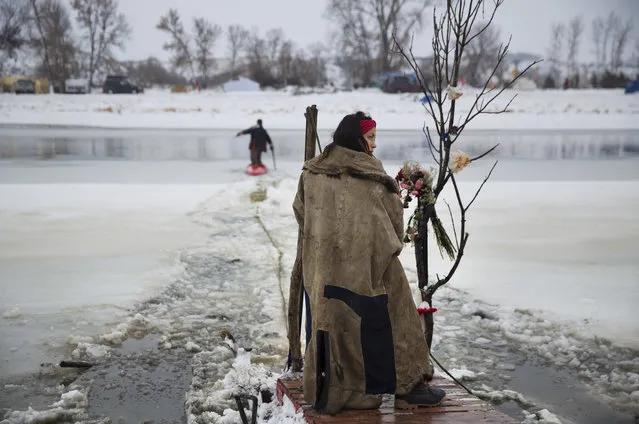
In this Thursday, December 1, 2016 photo, Cat Bigney, part of the Oglala Native American tribe, waits on the shore of the Cannonball river for travelers to arrive by canoe at the Oceti Sakowin camp where people have gathered to protest the Dakota Access oil pipeline in Cannon Ball, N.D. So far, those at the camp have shrugged off the heavy snow, icy winds and frigid temperatures. But if they defy next week's government deadline to abandon the camp, demonstrators know the real deep freeze lies ahead. Life-threatening wind chills and towering snow drifts could mean the greatest challenge is simple survival. (Photo by David Goldman/AP Photo)

In this Thursday, December 1, 2016 photo, Cat Bigney, part of the Oglala Native American tribe, waits on the shore of the Cannonball river for travelers to arrive by canoe at the Oceti Sakowin camp where people have gathered to protest the Dakota Access oil pipeline in Cannon Ball, N.D. So far, those at the camp have shrugged off the heavy snow, icy winds and frigid temperatures. But if they defy next week's government deadline to abandon the camp, demonstrators know the real deep freeze lies ahead. Life-threatening wind chills and towering snow drifts could mean the greatest challenge is simple survival. (Photo by David Goldman/AP Photo)
Details
06 Dec 2016 10:22:00
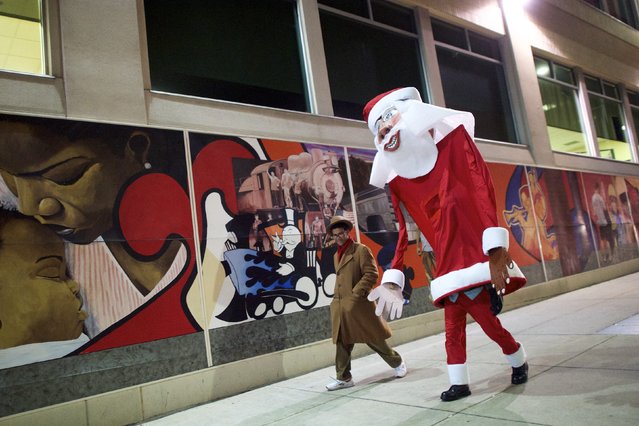
A giant Santa Claus, created and worn by local artist Ed Terrell, 66, walks home with his son and assistant, Rupanuga, 18, following a ceremony to decorate a scraggly Christmas tree with a single red Bulb in Reading, Pennsylvania, December 7, 2014. A ceremony to decorate the scraggly Christmas tree in Reading, Pennsylvania with a single red bulb, much like Charlie Brown's tree in the animated holiday classic, was postponed to Sunday from Saturday because of rain and cold temperatures, officials said. (Photo by Mark Makela/Reuters)

A giant Santa Claus, created and worn by local artist Ed Terrell, 66, walks home with his son and assistant, Rupanuga, 18, following a ceremony to decorate a scraggly Christmas tree with a single red Bulb in Reading, Pennsylvania, December 7, 2014. A ceremony to decorate the scraggly Christmas tree in Reading, Pennsylvania with a single red bulb, much like Charlie Brown's tree in the animated holiday classic, was postponed to Sunday from Saturday because of rain and cold temperatures, officials said. Officials decided to hold a re-dedication ceremony, which will include a Spanish and English reading from the movie's screenplay, and decorate it with a single red bulb, as in the 1965 animated television special, “A Charlie Brown Christmas”. (Photo by Mark Makela/Reuters)
Details
13 Dec 2014 12:05:00
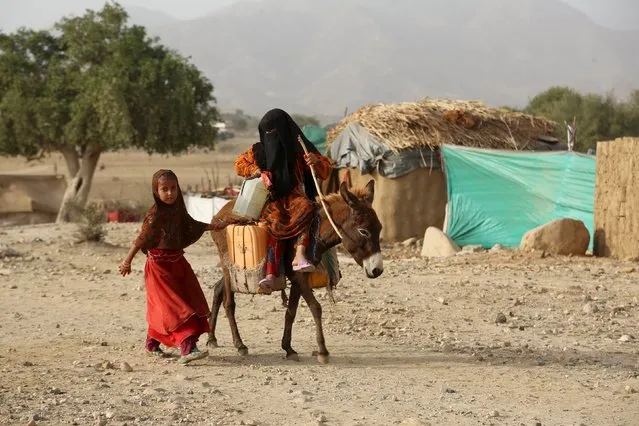
A girl rides a donkey as another walks by at the Shawqaba camp for internally displaced people who were forced to leave their villages by the war in Yemen's northwestern province of Hajjah March 12, 2016. In northwest Yemen, one of the poorest countries in the Middle East, about 400 families uprooted by the war have been stuck in the Shawqaba camp in Hajjah province for the past year. Residents live in poorly built huts that protect them neither from summer heat nor winter cold in a camp that lacks the most basic services. (Photo by Abduljabbar Zeyad/Reuters)

A girl rides a donkey as another walks by at the Shawqaba camp for internally displaced people who were forced to leave their villages by the war in Yemen's northwestern province of Hajjah March 12, 2016. In northwest Yemen, one of the poorest countries in the Middle East, about 400 families uprooted by the war have been stuck in the Shawqaba camp in Hajjah province for the past year. Residents live in poorly built huts that protect them neither from summer heat nor winter cold in a camp that lacks the most basic services. (Photo by Abduljabbar Zeyad/Reuters)
Details
09 Apr 2016 13:16:00