Loading...
Done
A migrant smokes a cigarette as he waits among others to cross the Croatian border near the village of Berkasovo, Serbia October 19, 2015. (Photo by Marko Djurica/Reuters)

A migrant smokes a cigarette as he waits among others to cross the Croatian border near the village of Berkasovo, Serbia October 19, 2015. Thousands of migrants clamoured to enter European Union member Croatia from Serbia on Monday after a night spent in the cold and mud of no-man's land, their passage west slowed by a Slovenian effort to impose limits on the flow to western Europe. (Photo by Marko Djurica/Reuters)
Details
22 Oct 2015 08:00:00

A military band prepares to play the national anthems before Cuban President Raul Castro welcomes U.S. President Barack Obama at the Palacio de la Revolucion in Havana March 21, 2016. (Photo by Jonathan Ernst/Reuters)

A military band prepares to play the national anthems before Cuban President Raul Castro welcomes U.S. President Barack Obama at the Palacio de la Revolucion in Havana March 21, 2016. Barack Obama on Sunday became the first US president in 88 years to visit Cuba, touching down in Havana for a landmark trip aimed at ending decades of Cold War animosity. (Photo by Jonathan Ernst/Reuters)
Details
22 Mar 2016 11:16:00
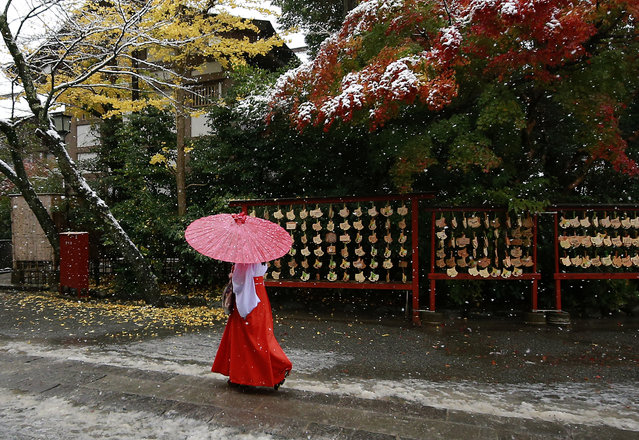
A shrine maiden walks in the snow at the Tsurugaoka Hachimangu Shrine in Kamakura, near Tokyo, Thursday, November 24, 2016. (Photo by Shizuo Kambayashi/AP Photo)

A shrine maiden walks in the snow at the Tsurugaoka Hachimangu Shrine in Kamakura, near Tokyo, Thursday, November 24, 2016. Tokyo residents have woken up to the first November snowfall in more than 50 years. An unusually cold air mass brought wet snow to Japan's capital on Thursday. Above-freezing temperatures kept the snow from sticking, but forecasters said there could be an accumulation of up to 2 centimeters (1 inch). The last time it snowed in central Tokyo in November was in 1962. (Photo by Shizuo Kambayashi/AP Photo)
Details
25 Nov 2016 11:33:00
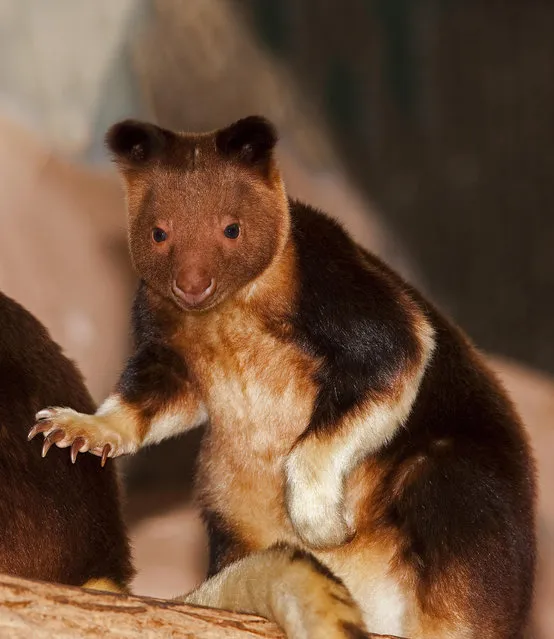
Goodfellow's Tree-Kangaroo

For some reason, everything that comes from Australia is either very cute or very poisonous; sometimes cute and poisonous at the same time. For example, Slow Loris, which you probably have seen eating a ball of rice on YouTube, is actually a very poisonous creature, despite its extreme cuteness. Goodfellow’s tree-kangaroos, on the other hand, are all cuteness and no poison. Just look at its cute little snout and furry paws, as it gingerly scratches its stomach, while sitting on its hind legs! If you don’t find this creature adorable, nothing will be able to thaw your stone-cold heart.
Details
30 Nov 2014 13:38:00
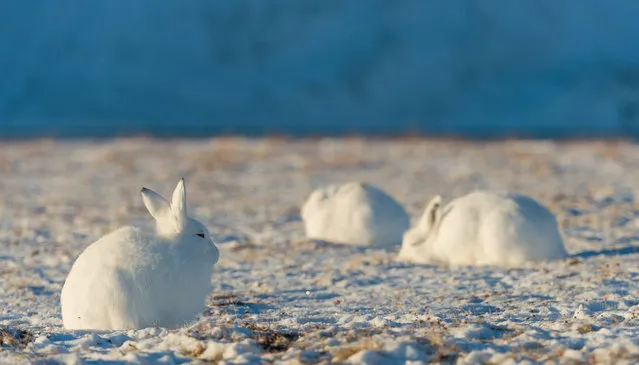
Arctic Hare

The arctic hare, or polar rabbit, is a species of hare which is adapted largely to polar and mountainous habitats. The arctic hare survives with a thick coat of fur and usually digs holes in the ground or under snow to keep warm and sleep. Arctic hares look like rabbits but have shorter ears, are taller when standing, and, unlike rabbits, can thrive in cold climates. They can travel together with many other hares, sometimes huddling with dozens or more, but are usually found alone, taking, in some cases, more than one partner. The arctic hare can run up to 60 kilometres per hour (40 mph). Its predators include the arctic wolf, arctic fox, and ermine.
Details
17 Mar 2014 13:56:00
Spectators pose for a photo upon entry for Derby Day at Flemington Racecourse on October 30, 2021 in Melbourne, Australia. Victoria's COVID-19 restrictions have eased to allow spectators to return to Flemington racecourse for the first time since 2019. Up to 5,500 fully vaccinated fans are permitted to attend Derby Day, while the remainder of the Melbourne Cup Carnival Race days will have a spectator limit of 10,000 people. Under COVID-19 restrictions, all patrons to the Melbourne Cup Carnival will be separated into three zones, with allocated seats for the service of food and drink. Spectators will be required to wear masks at Flemington, despite Victoria's outdoor mask mandate easing on Friday. (Photo by Asanka Ratnayake/Getty Images)

Spectators pose for a photo upon entry for Derby Day at Flemington Racecourse on October 30, 2021 in Melbourne, Australia. Victoria's COVID-19 restrictions have eased to allow spectators to return to Flemington racecourse for the first time since 2019. (Photo by Asanka Ratnayake/Getty Images)
Details
18 Jun 2022 04:34:00
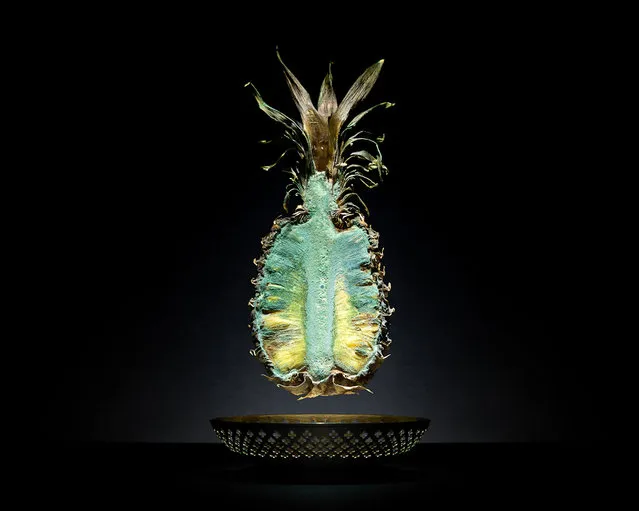
Pineapple

“One Third” – a project on food waste by an Austrian photography Klaus Pichler. According to a UN study one third of the world's food goes to waste – the largest part thereof in the industrialized nations of the global north. Equally, 925 million people around the world are threatened by starvation. The series “One Third” describes the connection between individual wastage of food and globalized food production.

Photo: Pineapple. Place of production: Guayaquil, Ecuador. Cultivation method: Outdoor plantation • Time of harvest: All- season. Transporting distance: 10.666 km (linear distance) • Means of transportation: Aircraft, truck. Carbon footprint (total) per kg: 11,94 kg • Water requirement (total) per kg: 360 l. Price: 2,10 € / kg. (Photo by Klaus Picher)
Details
02 May 2012 11:01:00
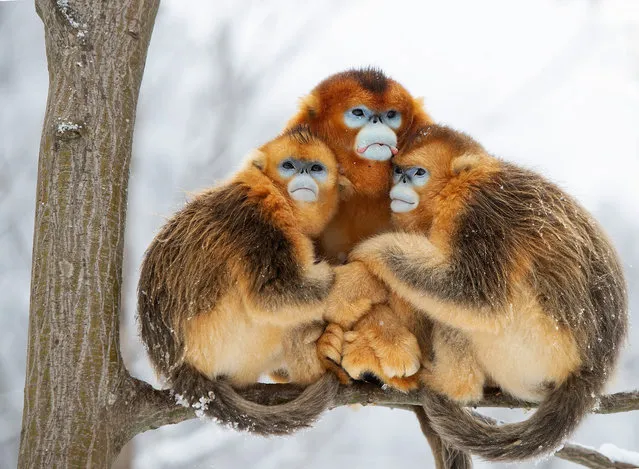
A golden huddle by Minqiang Lu, China. Two females and a male golden snub-nosed monkey huddle together to keep warm in the extreme cold. Threatened by forest loss and fragmentation, this endangered species is confined to central China. Restricted to living high up in the temperate forests, these monkeys – here in the Qinling mountains in Shaanxi province – feed mostly in the trees, on leaves, bark, buds and lichen. In heavy wind and snow, Minqiang walked up the mountain carrying his equipment. He stayed for half an hour in temperatures of –10C opposite the tree where the group was huddled before achieving this eye-level composition. (Photo by Minqiang Lu/Wildlife Photographer of the Year)

A golden huddle by Minqiang Lu, China. Two females and a male golden snub-nosed monkey huddle together to keep warm in the extreme cold. Threatened by forest loss and fragmentation, this endangered species is confined to central China. Restricted to living high up in the temperate forests, these monkeys – here in the Qinling mountains in Shaanxi province – feed mostly in the trees, on leaves, bark, buds and lichen. In heavy wind and snow, Minqiang walked up the mountain carrying his equipment. He stayed for half an hour in temperatures of –10C opposite the tree where the group was huddled before achieving this eye-level composition. (Photo by Minqiang Lu/Wildlife Photographer of the Year)
Details
12 Jan 2023 01:19:00