Loading...
Done
Montegut fire chief Toby Henry walks back to his fire truck in the rain as firefighters cut through trees on the road in Bourg, Louisiana as Hurricane Ida passes on August 29, 2021. Hurricane Ida struck the coast of Louisiana on August 29 as a powerful Category 4 storm, 16 years to the day after deadly Hurricane Katrina devastated the southern US city of New Orleans. “Extremely dangerous Category 4 Hurricane Ida makes landfall near Port Fourchon, Louisiana”, the National Hurricane Center wrote in an advisory. (Photo by Mark Felix/AFP Photo)

Montegut fire chief Toby Henry walks back to his fire truck in the rain as firefighters cut through trees on the road in Bourg, Louisiana as Hurricane Ida passes on August 29, 2021. Hurricane Ida struck the coast of Louisiana on August 29 as a powerful Category 4 storm, 16 years to the day after deadly Hurricane Katrina devastated the southern US city of New Orleans. “Extremely dangerous Category 4 Hurricane Ida makes landfall near Port Fourchon, Louisiana”, the National Hurricane Center wrote in an advisory. (Photo by Mark Felix/AFP Photo)
Details
28 Sep 2021 08:03:00
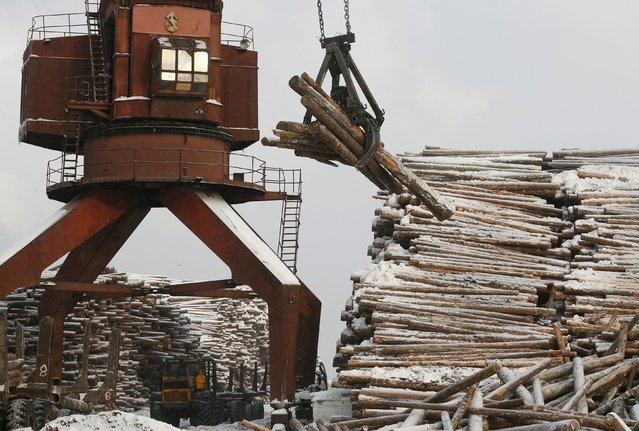
A crane loads logs at the Novoyeniseisk wood processing plant, with the air temperature at about minus 20 degrees Celsius (minus 4 degrees Fahrenheit), in the town of Lesosibirsk in Krasnoyarsk Region, Siberia, Russia, February 16, 2016. The plant exports timber to Europe, Northern Africa and Asia. The Taiga, also known as the boreal forest, on the coast of the Angara River and Yenisei River is one of the main areas for the industrial cutting of wood thanks to the high quality of the Angara pine. (Photo by Ilya Naymushin/Reuters)

A crane loads logs at the Novoyeniseisk wood processing plant, with the air temperature at about minus 20 degrees Celsius (minus 4 degrees Fahrenheit), in the town of Lesosibirsk in Krasnoyarsk Region, Siberia, Russia, February 16, 2016. The plant exports timber to Europe, Northern Africa and Asia. The Taiga, also known as the boreal forest, on the coast of the Angara River and Yenisei River is one of the main areas for the industrial cutting of wood thanks to the high quality of the Angara pine. Open air work continues all year around regardless to temperatures which can drop to minus 52 degrees Celsius (minus 61.6 degrees Fahrenheit), according to employees. (Photo by Ilya Naymushin/Reuters)
Details
18 Feb 2016 13:10:00
Pictures of deceased people are seen inside a chapel at a cemetery in the village of Smoljinac, Serbia, October 25, 2016. (Photo by Marko Djurica/Reuters)

Pictures of deceased people are seen inside a chapel at a cemetery in the village of Smoljinac, Serbia, October 25, 2016. From a distance, the cemetery in the eastern Serbian village of Smoljinac looks like a residential neighbourhood eerily placed among graves. But once inside the grounds, after passing a section with the usual stone slabs, visitors find rows of small bungalows painted in pastel colours. They have one or two rooms, large windows and ornate plaques – some inside, some outside – memorialising the deceased. These are the burial chapels of Smoljinac, cosy cabins with a furnished room inside, a storage place for wreaths and funeral paraphernalia, and the family crypt below. Some even have electric power inside. (Photo by Marko Djurica/Reuters)
Details
12 Nov 2016 10:37:00
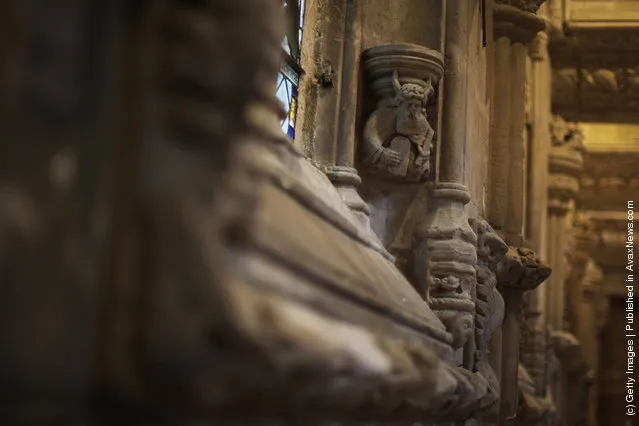
The interior of Rosslyn Chapel on February 9, 2012 in Roslin, Scotland

“Rosslyn Chapel, properly named the Collegiate Chapel of St. Matthew, was founded on a small hill above Roslin Glen as a Roman Catholic collegiate church (with between four and six ordained canons and two boy choristers) in the mid-15th century. Rosslyn Chapel and the nearby Roslin Castle are located at the village of Roslin, Midlothian, Scotland”. – Wikipedia

Photo: The interior of Rosslyn Chapel on February 9, 2012 in Roslin, Scotland. Built between 1446 and 1484 it is a category A listed building, covered in ornate stonework and carvings of individual figures and scenes. People travel from all over the world to visit the chapel which many have described as an architectural wonder and a library in stone. Many theories, myths and legends associated with the Chapel have given it a unique sense of mystery and wonder. (Photo by Jeff J. Mitchell/Getty Images)
Details
10 Feb 2012 10:13:00
Mud Makes Man By Alejandro Maestre Gasteazi

31-year-old Alejandro Maestre Gasteazi has created an incredibly interesting photographic series about the struggle of an artist. First, though, you may be asking yourself these questions: Exactly, what are we looking at? How did the photographer achieve this strange, sculpture-like illusion?

Gasteazi asked his friend Julián to cover himself with a mixture of blue paint and mud. He then photographed Julián at various stages. Later, in Photoshop, Gasteazi cut around his subject's body to make him appear like a floating sculpture.
Details
06 Jun 2015 09:18:00
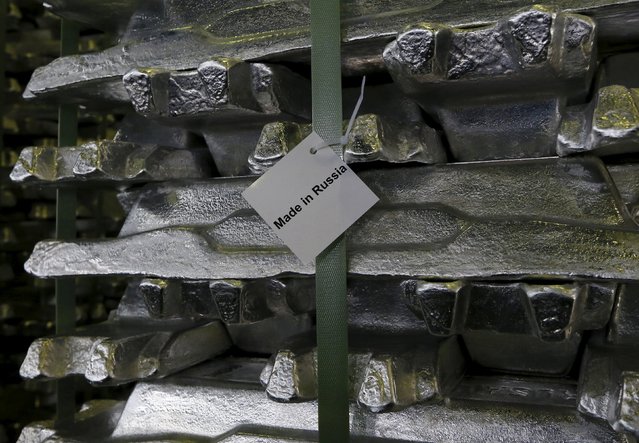
Aluminium ingots are stored at a foundry shop of the Rusal Khakassia aluminium smelter outside the town of Sayanogorsk, Russia, September 3, 2015. (Photo by Ilya Naymushin/Reuters)

Aluminium ingots are stored at a foundry shop of the Rusal Khakassia aluminium smelter outside the town of Sayanogorsk, Russia, September 3, 2015. Russia's Rusal has decided to delay a decision on its possible first dividend since listing five years ago though its second-quarter core profit more than doubled thanks to cost cuts and a weaker rouble. (Photo by Ilya Naymushin/Reuters)
Details
04 Sep 2015 12:39:00
A tea garden worker plucks tea leaves inside Aideobarie Tea Estate in Jorhat in Assam, India, April 21, 2015. (Photo by Ahmad Masood/Reuters)

A tea garden worker plucks tea leaves inside Aideobarie Tea Estate in Jorhat in Assam, India, April 21, 2015. Unrest is brewing among Assam's so-called Tea Tribes as changing weather patterns upset the economics of the industry. Scientists say climate change is to blame for uneven rainfall that is cutting yields and lifting costs for tea firms. (Photo by Ahmad Masood/Reuters)
Details
05 May 2015 11:21:00
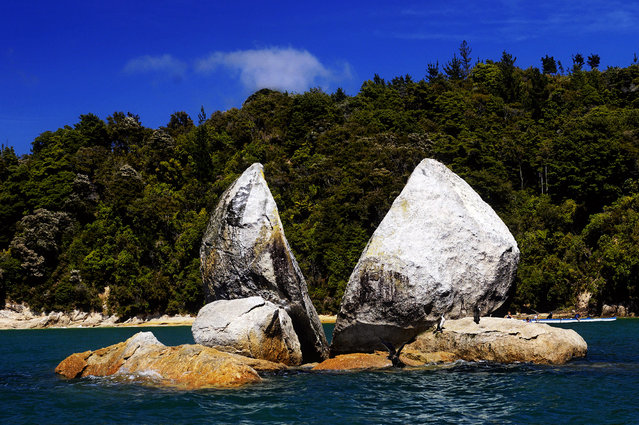
Split Apple Rock

Split Apple Rock is a geological rock formation in The Tasman Bay off the northern coast of the South Island of New Zealand. Made of granite, it is in the shape of an apple which has been cut in half. It is a popular tourist attraction in the waters of the Tasman Sea approximately 50 metres off the coast between Kaiteriteri and Marahau. The rock sits in shallow water at low tide and is accessible by wading. It is also a point of interest for the many tourist boats and pleasure craft which operate along the shores of the Abel Tasman National Park. The cleft to produce two sides of the 'apple' was a natural occurrence. It is unknown when this happened and therefore the cleaving of the rock has attracted mythological explanations.
Details
19 Oct 2013 10:58:00