Loading...
Done
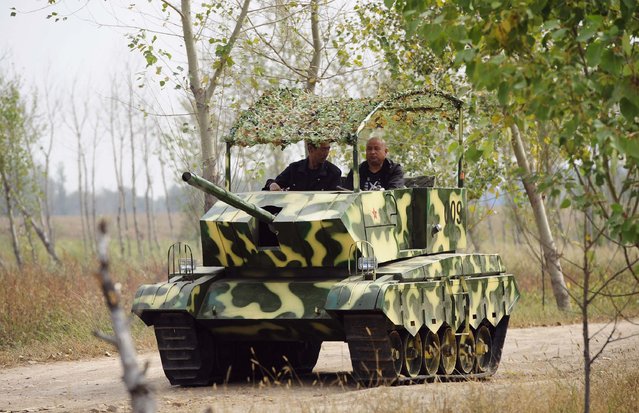
Friends of Li Guojun drive a homemade tank-shaped vehicle in Kangping county, China. Li, a farmer who is a fan of tanks, spent six months with help from his friends to construct the almost 20-foot vehicle which weighs 2.5 tons. (Photo by Sheng Li/Reuters)

Friends of Li Guojun drive a homemade tank-shaped vehicle in Kangping county, China. Li, a farmer who is a fan of tanks, spent six months with help from his friends to construct the almost 20-foot vehicle which weighs 2.5 tons. (Photo by Sheng Li/Reuters)
Details
27 Sep 2014 12:20:00
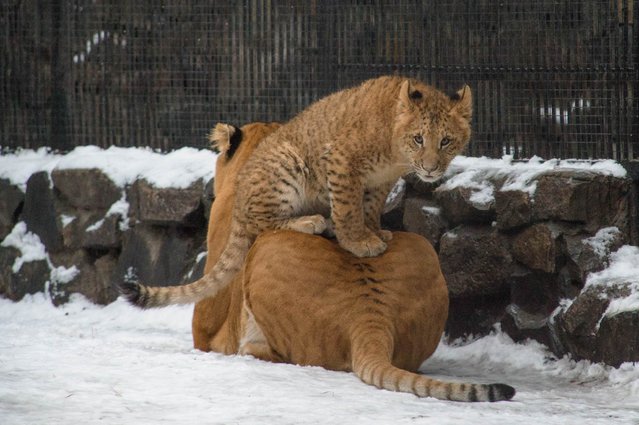
Six-month old female liliger cub Eva plays in snow with her mother Zita in the Zoo in Novosibirsk,  Russia, Thursday, December 5, 2013. The cub's mother is Zita, a liger – half-lioness, half-tiger, and its father is a lion, Sam. (Photo by Ilnar Salakhiev/AP Photo)

Six-month old female liliger cub Eva plays in snow with her mother Zita in the Zoo in Novosibirsk, Russia, Thursday, December 5, 2013. The cub's mother is Zita, a liger – half-lioness, half-tiger, and its father is a lion, Sam. (Photo by Ilnar Salakhiev/AP Photo)
Details
07 Dec 2013 12:15:00
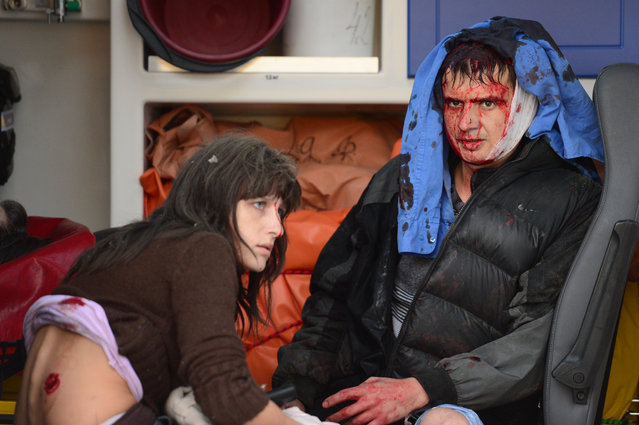
Two people sit in an ambulance waiting to be treated after a Grad rocket slammed into a shopping mall in Donetsk's Kubishevski district, in the eastern Ukraine,  on October 8, 2014. At least two people were killed, and five were injured after some six Grad rockets hit the area. (Photo by John Macdougall/AFP Photo)

Two people sit in an ambulance waiting to be treated after a Grad rocket slammed into a shopping mall in Donetsk's Kubishevski district, in the eastern Ukraine, on October 8, 2014. At least two people were killed, and five were injured after some six Grad rockets hit the area. (Photo by John Macdougall/AFP Photo)
Details
09 Dec 2019 00:03:00
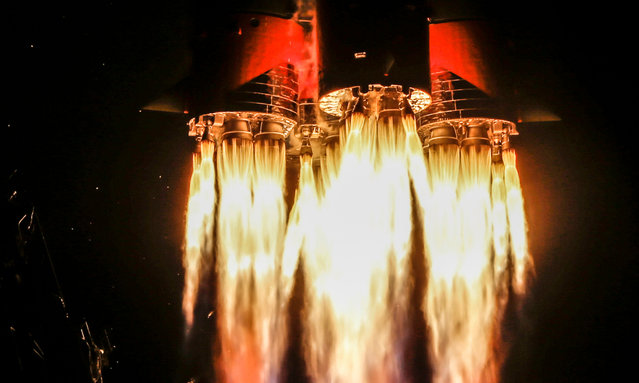
Soyuz MS-12 spacecraft with crew members of Expedition 59/60 Russian cosmonaut Alexey Ovchinin, NASA astronauts Christina Koch and Nick Hague lifts off from the launch pad at the Russian leased Baikonur cosmodrome, Kazakhstan, 15 March 2019. Hague, Koch, and Ovchinin will spend six-and-a-half months living and working aboard the International Space Station. (Photo by Sergei Ilnitsky/EPA/EFE)

Soyuz MS-12 spacecraft with crew members of Expedition 59/60 Russian cosmonaut Alexey Ovchinin, NASA astronauts Christina Koch and Nick Hague lifts off from the launch pad at the Russian leased Baikonur cosmodrome, Kazakhstan, 15 March 2019. Hague, Koch, and Ovchinin will spend six-and-a-half months living and working aboard the International Space Station. (Photo by Sergei Ilnitsky/EPA/EFE)
Details
11 Apr 2019 00:03:00
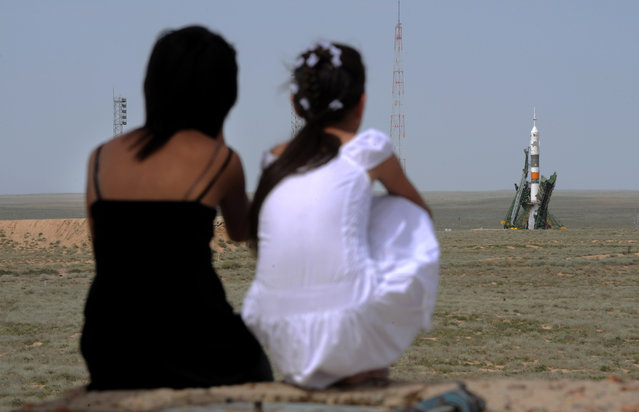
Kazakh girls watch as the Russian Soyuz TMA-15 rocket carrying Canadian astronaut Robert Thirsk, European Space Agency (ESA) astronaut Frank De Winne of Belgium and Russian cosmonaut Roman Romanenko readies for take-off from the Baikonur cosmodrome, in Kazakhstan on May 27, 2009. Three astronauts, from Canada, Belgium and Russia, blasted off for the International Space Station in a landmark mission that will double its crew to six for the first time. (Photo by Dmitry Kostyukov/AFP Photo)

Kazakh girls watch as the Russian Soyuz TMA-15 rocket carrying Canadian astronaut Robert Thirsk, European Space Agency (ESA) astronaut Frank De Winne of Belgium and Russian cosmonaut Roman Romanenko readies for take-off from the Baikonur cosmodrome, in Kazakhstan on May 27, 2009. Three astronauts, from Canada, Belgium and Russia, blasted off for the International Space Station in a landmark mission that will double its crew to six for the first time. (Photo by Dmitry Kostyukov/AFP Photo)
Details
21 Jun 2020 00:01:00
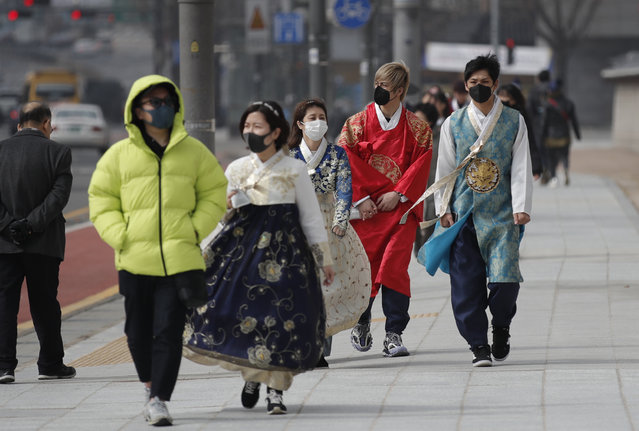
Visitors wearing face masks walk near the Gwanghwamun, the main gate of the 14th-century Gyeongbok Palace, and one of South Korea's well-known landmarks, in Seoul, South Korea, Saturday, February 22, 2020. South Korea on Saturday reported a six-fold jump in viral infections in four days to 346, most of them linked to a church and a hospital in and around the fourth-largest city where schools were closed and worshipers and others told to avoid mass gatherings. (Photo by Lee Jin-man/AP Photo)

Visitors wearing face masks walk near the Gwanghwamun, the main gate of the 14th-century Gyeongbok Palace, and one of South Korea's well-known landmarks, in Seoul, South Korea, Saturday, February 22, 2020. South Korea on Saturday reported a six-fold jump in viral infections in four days to 346, most of them linked to a church and a hospital in and around the fourth-largest city where schools were closed and worshipers and others told to avoid mass gatherings. (Photo by Lee Jin-man/AP Photo)
Details
13 Mar 2020 00:05:00
Dive The Deadly Jacob’s Well In Texas

Jacob's Well is a perennial karstic spring in the Texas Hill Country flowing from the bed of Cypress Creek, located northwest of Wimberley, Texas. The twelve foot (four meter) diameter mouth of the spring serves as a popular swimming spot for the local land owners whose properties adjoin Cypress Creek. From the opening in the creek bed, Jacob's Well cave descends vertically for about thirty feet (ten meters), then continues downward at an angle through a series of silted chambers separated by narrow restrictions, finally reaching a depth of one hundred and twenty feet (forty meters). Until the modern era, the Trinity Aquifer-fed natural artesian spring gushed water from the mouth of the cave, with a measured flow in 1924 of one hundred and seventy gallons per second (six hundred and forty liters per second) discharging six feet (two meters) into the air. The spring is the greatest source of water recharging the Edwards Aquifer.
Details
03 Jan 2014 08:20:00
A man takes a “selfie” with camels at a farm in Taif November 1, 2014. Saudi Arabia said late on Wednesday it had detected six new cases of the deadly Middle East Respiratory Syndrome (MERS) in 24 hours, the biggest daily jump for months with officials blaming lax hospital procedures. (Photo by Mohamed Alhwaity/Reuters)

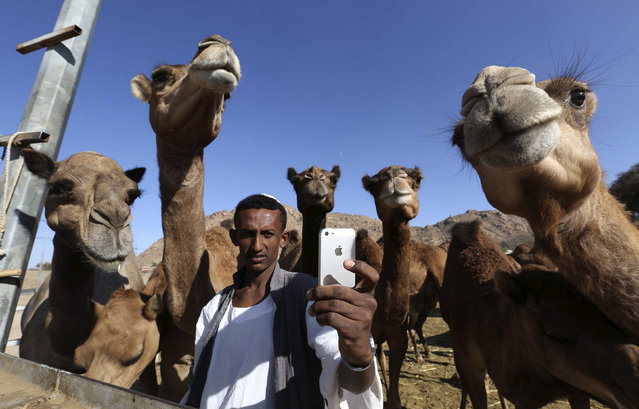
A man takes a “selfie” with camels at a farm in Taif November 1, 2014. Saudi Arabia said late on Wednesday it had detected six new cases of the deadly Middle East Respiratory Syndrome (MERS) in 24 hours, the biggest daily jump for months with officials blaming lax hospital procedures. Scientists are not sure of the origin of the virus, but several studies have linked it to camels and some experts think it is being passed to humans through close physical contact or through the consumption of camel meat or camel milk. (Photo by Mohamed Alhwaity/Reuters)
Details
08 Nov 2014 12:33:00