Loading...
Done
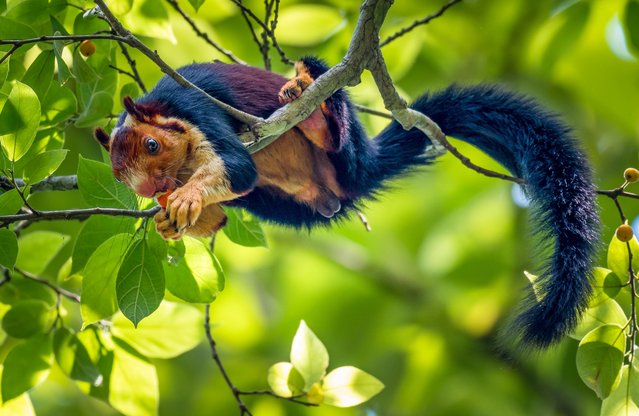
Its main predators are the birds of prey and the leopard. The Giant Squirrel is mostly active in the early hours of the morning and in the evening, resting in the midday. They are typically solitary animals that only come together for breeding. (Photo by Kaushik Vijayan/South West News Service)

The Malabar Giant squirrel – double the size of their grey relatives and measuring up to 36 inches (91.5 cm) from head to tail – lives deep in the forests of India. The athletic animals can leap an incredible 20 feet (6 m) between trees. Photographer Kaushik Vijayan, 39, snapped the animals in their native habit to produce these stunning images. Kaushik, from Kerala State, India, said: “Up until that point I had never heard about a squirrel like that or seen one. The sight was an absolute feast for my eyes. The squirrels fascinated me and I got excited to capture this beauty on my camera”. (Photo by Kaushik Vijayan/South West News Service)
Details
04 Apr 2019 00:03:00


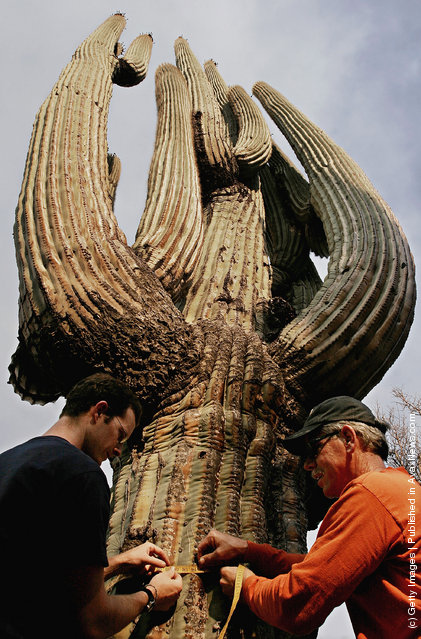
“The saguaro (scientific name Carnegiea gigantea) is a large, tree-sized cactus species in the monotypic genus Carnegiea. It is native to the Sonoran Desert in the U.S. state of Arizona, the Mexican state of Sonora, a small part of Baja California in the San Felipe Desert and an extremely small area of California, U.S. The saguaro blossom is the State Wildflower of Arizona”. – Wikipedia

Photo: Daniel Appel (L), a firefighter with Engine 84 from the Lassen National Forest in California and Mike Hallen, (R), Arizona representative of the National Register of Big Trees, measure the circumference of this Saguaro cactus called the "Grand One," in the Tonto National Forest on July 1, 2005 35 miles north of Phoenix, near Carefree, Arizona. The cactus, estimated to be more than 200 years old, measures a circumference of 7 feet, 10 inches (2.4 meters) and stands 46 feet high (14 meters). The cactus was burned in the Cave Creek Complex fire and may not survive. It was once the largest Saguaro in the world, two others have been found recently that have tied it's measurements. The fire has burned more than 214,000 acres of the Sonoran desert. (Photo by Jeff Topping/Getty Images)
Details
26 Jul 2011 12:27:00
Bo (pictured) is president and co-founder of Grown Men On Bikes (GMOB), one of the oldest groups at Slow Roll. Bo spent $1,300 getting a one-off low-rider custom bike build – but that’s just the start. “Once I go back in it’s going to get big”, he says. “I’m going to get a custom seat, wheels, paint” … The finished bike could cost around $3,000 – but would still be far cheaper than pimping a car. “This is much better. It’s a community. We party”. (Photo by Nick Van Mead)

“We take rusty old junk and we put love into it”. The old Motor City has a unique style in bicycles these days: from fat wheels and fake fuel tanks to stretched cycles with powerful sound systems – and even a family-sized BBQ. “Detroit’s custom bike scene developed alongside Slow Roll, a weekly cycle ride started in 2010 by Jason Hall and Mike MacKool. Now upwards of 2,000 people turn up each Monday to cruise a different part of the city. The week I go the crowd seems evenly split between black and white, male and female, city and suburbs. It’s the most inclusive cycle event I’ve ever witnessed”. (Photo by Jason Walker/Slow Roll Monday Nights)
Details
03 Nov 2016 12:33:00
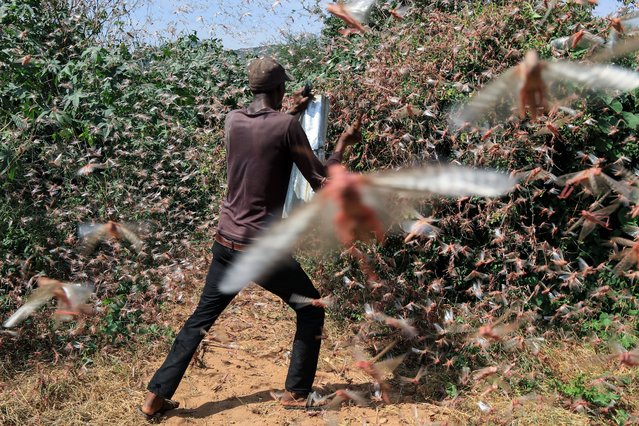
A man uses iron sheet to make noises, as a way of trying to disperse desert locusts that had invaded their farms during the second wave invasion in Kakongo village, in Nuu-Mwingi East, in Kitui, Kenya, 06 February 2021. The second wave invasion of the desert locusts in the country comes at a time where most famers are expecting to harvest their farm produce in the country. According to the United Nations Food and Agriculture Organization (FAO), on 04 February, warned numerous immature desert locust swarms persist in southern Ethiopia and Kenya. Some of the swarms are in community areas and therefore cannot be treated. In Kenya, immature swarms continue to spread westwards across northern and central counties where there are currently about 20 small swarms present, mostly about 50 hectares in size, it said. (Photo by Daniel Irungu/EPA/EFE)

A man uses iron sheet to make noises, as a way of trying to disperse desert locusts that had invaded their farms during the second wave invasion in Kakongo village, in Nuu-Mwingi East, in Kitui, Kenya, 06 February 2021. The second wave invasion of the desert locusts in the country comes at a time where most famers are expecting to harvest their farm produce in the country. (Photo by Daniel Irungu/EPA/EFE)
Details
25 Feb 2021 08:17:00
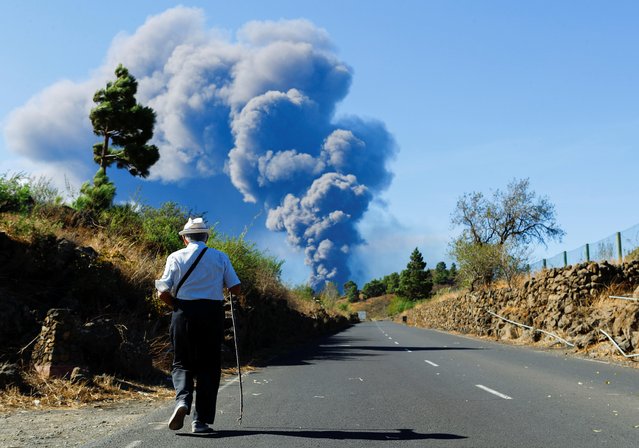
A man walks along an El Paso road while observing a large ash column from the Cumbre Vieja volcano on the Canary Island of La Palma, Spain, October 4, 2021. (Photo by Borja Suarez/Reuters)

A man walks along an El Paso road while observing a large ash column from the Cumbre Vieja volcano on the Canary Island of La Palma, Spain, October 4, 2021. (Photo by Borja Suarez/Reuters)
Details
28 Oct 2021 06:01:00
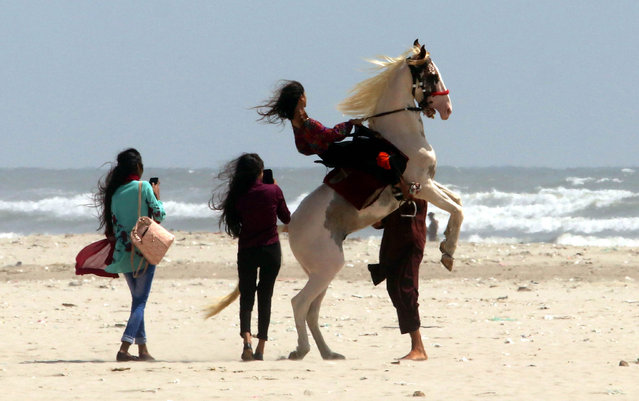
An Afghan girl rides a horse at the beach in Karachi, Pakistan, 07 September 2020. (Photo by Rehan Khan/EPA/EFE)

An Afghan girl rides a horse at the beach in Karachi, Pakistan, 07 September 2020. (Photo by Rehan Khan/EPA/EFE)
Details
23 Sep 2020 00:05:00
The Lun-class Ekranoplane was used by the Soviet Navy starting in 1987, and wasn't retired until the late 1990s, after the Soviet Union's fall. (Igor113)

“The Lun-class ekranoplan (NATO reporting name Duck) was a ground effect vehicle (GEV) designed by Rostislav Evgenievich Alexeev and used by the Soviet and Russian navies from 1987 until sometime in the late 1990s. It “flew” using the lift generated by the ground effect of its large wings when close to the surface of the water – about four metres or less. Although they might look similar and/or have related technical characteristics, ekranoplans like the Lun are not aircraft, seaplanes, hovercraft, or hydrofoils – ground effect is a separate technology altogether. The International Maritime Organization classifies these vehicles as maritime ships. The name Lun comes from the Russian for harrier”. – Wikipedia (Photo by Igor113)
Details
08 Aug 2014 10:51:00


In this artist's impression supplied by the ESO (European Southern Observatory) on April 25, 2007, the planetary system around the red dwarf, Gliese 581, is pictured showing what astronomers believe is the most earth like planet found outside our solar system to date. Using the ESO 3.6-m telescope in Chile, astronomers have uncovered the planet which could have water running on its surface. The planet orbits the faint star Gliese 581, which is 20.5 light-years away in the constellation Libra. (Photo by ESO via Getty Images)
Details
12 Apr 2011 11:00:00