Loading...
Done
A woman crowd-surfs in front of the main stage at the Woodstock Festival in Kostrzyn-upon-Odra, close to the Polish-German border, August 2, 2014. Some 500 thousand people attended the festival that is the brainchild of Polish journalist and social campaigner Jerzy Owsiak. He initiated the event to say thank you to those who donated money to his GOCC charity organisation that delivers medical care for children. (Photo by Thomas Peter/Reuters)

A woman crowd-surfs in front of the main stage at the Woodstock Festival in Kostrzyn-upon-Odra, close to the Polish-German border, August 2, 2014. Some 500 thousand people attended the festival that is the brainchild of Polish journalist and social campaigner Jerzy Owsiak. He initiated the event to say thank you to those who donated money to his GOCC charity organisation that delivers medical care for children. (Photo by Thomas Peter/Reuters)
Details
09 Aug 2014 11:26:00
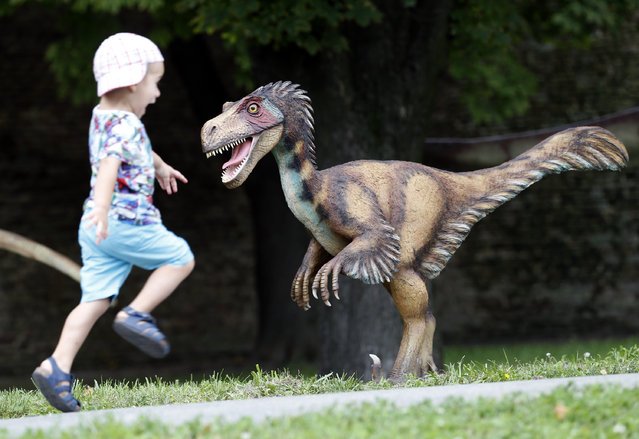
A boy runs past one of the exhibits during the Dinosaurs exhibition in Belgrade, Serbia, Thursday, August 21, 2014. “Dino Park” has opened at Belgrade's Kalemegdan Fortress. (Photo by Darko Vojinovic/AP Photo)

A boy runs past one of the exhibits during the Dinosaurs exhibition in Belgrade, Serbia, Thursday, August 21, 2014. “Dino Park” has opened at Belgrade's Kalemegdan Fortress. (Photo by Darko Vojinovic/AP Photo)
Details
23 Aug 2014 11:56:00
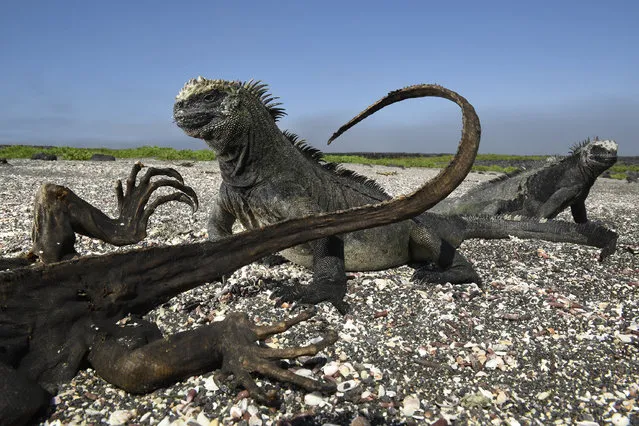
Galapagos – Rocking the Cradle: Four major ocean currents converge along the Galapagos archipelago, creating the conditions for an extraordinary diversity of animal life, April 25, 2016. The islands are home to at least 7,000 flora and fauna species, of which 97 percent of the reptiles, 80 percent of the land birds, 50 percent of the insects and 30 percent of the plants are endemic. The local ecosystem is highly sensitive to the changes in temperature, rainfall and ocean currents that characterize the climatic events known as El Niño and La Niña. These changes cause marked fluctuations in weather and food availability. Many scientists expect the frequency of El Niño and La Niña to increase as a result of climate change, making the Galapagos a possible early-warning location for its effects. (Photo by Thomas P. Peschak for National Geographic/World Press Photo)

Galapagos – Rocking the Cradle: Four major ocean currents converge along the Galapagos archipelago, creating the conditions for an extraordinary diversity of animal life, April 25, 2016. The islands are home to at least 7,000 flora and fauna species, of which 97 percent of the reptiles, 80 percent of the land birds, 50 percent of the insects and 30 percent of the plants are endemic. (Photo by Thomas P. Peschak for National Geographic/World Press Photo)
Details
16 Apr 2018 00:01:00
A mother bear takes a dip in the water to cool off in the warm summer sun but refuses to leave her three youngsters behind – so they climb aboard her back. (Photo by Jon Langeland/Solent News & Photo Agency)

A mother bear takes a dip in the water to cool off in the warm summer sun but refuses to leave her three youngsters behind – so they climb aboard her back. (Photo by Jon Langeland/Solent News & Photo Agency)
Details
13 Sep 2014 12:10:00
Lindsey. Then: 11 years old, 6th Grade, in Maumelle, Arkansas.
Now: 32 years old, Nanny/personal assistant residing in Holladay, Utah. (Photo by Awkward Years Project)

“The Awkward Years Project highlights the time in our lives when we felt the most awkward. Some of us had crazy hair, glasses, and/or braces. Some fell victim to the fashion trends of the decade. And some of us struggled even deeper than others realize. This project is a before-and-after transition showing how far the subjects have come and who they turned out to be”. – Awkward Years Project. Photo: Lindsey. Then: 11 years old, 6th Grade, in Maumelle, Arkansas.
Now: 32 years old, Nanny/personal assistant residing in Holladay, Utah. (Photo by Awkward Years Project)
Details
31 Jul 2013 06:41:00


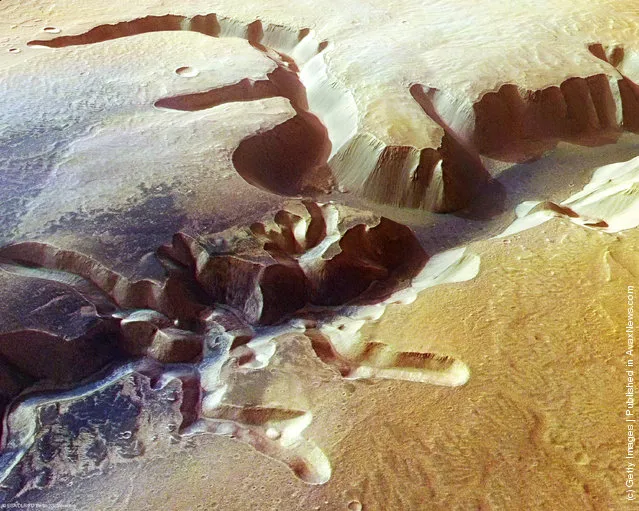
“Echus Chasma is a chasma in the Lunae Planum high plateau north of the Valles Marineris canyon system of Mars. Clay has been found in Echus Chasma that means that water once sat there for a time. Echus Chasma is approximately 100 km long and 10 km wide, with valleys ranging in depth from around 1 km to 4 km”. – Wikipedia

Photo: In this handout image supplied by the European Space Agency (ESA) on July 16, 2008, The Echus Chasma, one of the largest water source regions on Mars, is pictured from ESA's Mars Express. The data was acquired on September 25, 2005. The dark material shows a network of light-coloured, incised valleys that look similar to drainage networks known on Earth. It is still debated whether the valleys originate from precipitation, groundwater springs or liquid or magma flows on the surface. (Photo by ESA via Getty Images)
Details
18 Jul 2011 11:47:00
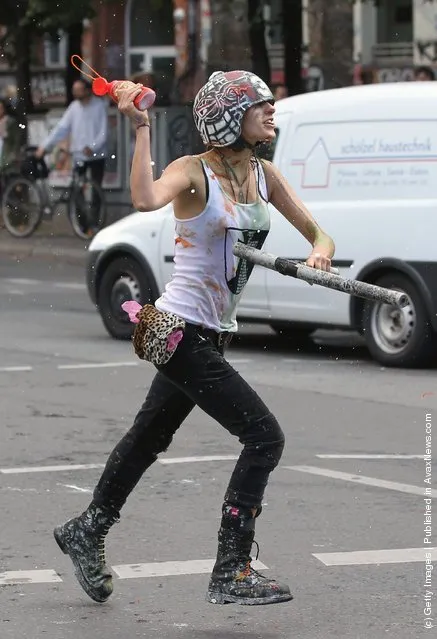
Kreuzberg Vegetable Battle

A female participant armed with a bottle of ketchup attacks in the annual Vegetable Battle in Kreuzberg district near Oberbaumbruecke Bridge on August 28, 2011 in Berlin, Germany. The event pits Kreuzberg district residents againts Friedrichshain district residents for control of the Oberbaumbruecke, and the two sides pelt each other with rotten vegetables, other foods, ketchup, water guns and styrofoam bats until one side has pushed the other from the bridge. The event had originally been cancelled for today, but so many participants showed up anyway and began battling on the Kreuzberg side, where the situation escalated and began to threaten traffic, that police relented and let them later battle it out on the bridge. Kreuzberg claimed victory. (Photo by Sean Gallup/Getty Images)
Details
29 Aug 2011 15:02:00
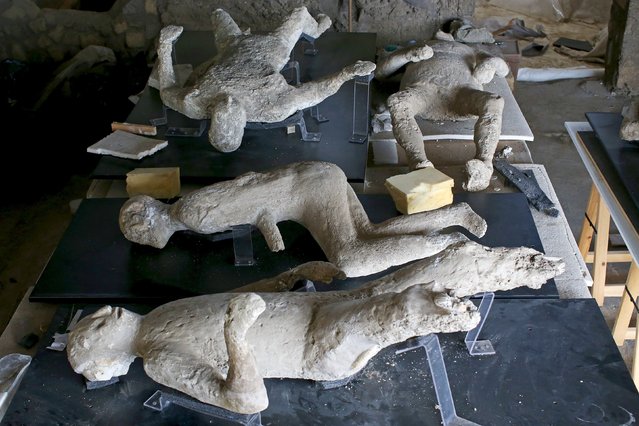
Plaster cast moulds of victims of the Mount Vesuvius eruption lie on a display table in a laboratory at Pompeii October 13, 2015. An expert team made up of archaeologists, radiologists, orthodontists and anthropologists began on September 2015 to use CAT scan technology (computerised axial tomography) to peer inside the plaster cast moulds of Pompeii's victims, in a study that has added more detail to previous findings. (Photo by Alessandro Bianchi/Reuters)

Plaster cast moulds of victims of the Mount Vesuvius eruption lie on a display table in a laboratory at Pompeii October 13, 2015. An expert team made up of archaeologists, radiologists, orthodontists and anthropologists began on September 2015 to use CAT scan technology (computerised axial tomography) to peer inside the plaster cast moulds of Pompeii's victims, in a study that has added more detail to previous findings. A 16-layer scan had to be used in order to penetrate the hardened plaster but the results showed up impressive skeletal remains and near perfect teeth. (Photo by Alessandro Bianchi/Reuters)
Details
22 Oct 2015 08:02:00