Participants take part in a high-wheel bicycle race in the Frederick county, in Maryland, United States on July 15, 2023. (Photo by Celal Gunes/Anadolu Agency via Getty Images)
Pals let their hair down for one last hoorah in Cardiff, capital of Wales on September 12, 2020. Groups of friends crammed into pubs and restaurants to “go out in style” before the “rule of six” is enforced on Monday. (Photo by Huw Evans Picture Agency/The Sun)
Aymara indigenous people celebrate the “Roscasiri”, the change of command of local authorities, in Pomata District, one of seven districts of the Chucuito Province in the Puno Region, southern Peru, on January 1, 2022. This ancient Aymara event, in which people adorn themselves with breads and fruits that represent abundance for the new year, celebrates the change of command of local authorities. (Photo by Carlos Mamani/AFP Photo)
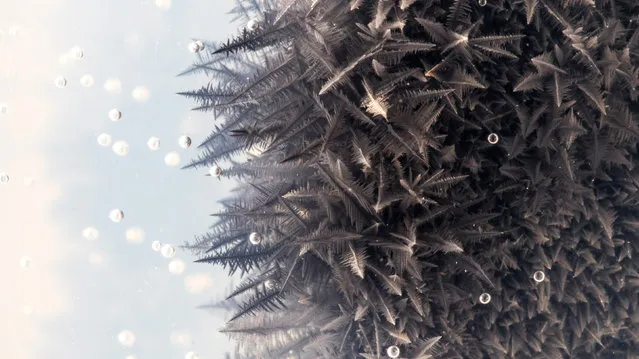
These beautiful shots may look like works of modern art – but they are actually close-ups of chemical reactions. The works were snapped with the help of a group of scientists from the University of Science and Technology of China (USTC) in Anhui, China. Here: Zinc reacting with lead nitrate in a soft gel to form lead crystals. (Photo by Yan Liang/Caters News)
In this December 19, 2014 photo, a man stands beside his 1957 Chevrolet Bel-Air car in Havana, Cuba. U.S. car sales have been banned in Cuba since 1959. Cubans have been have been forced to patch together Fords, Chevrolets and Chryslers that date back to before Fidel Castro's revolution which can make it appear like the country is stuck in a 1950s time warp. Since the Communist economic system isn't likely to change soon, many of those cars will have to stay on the road for years. (Photo by Desmond Boylan/AP Photo)
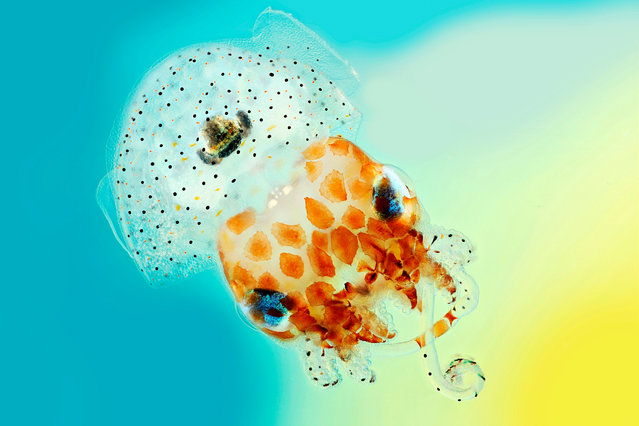
With its huge eyes, comical name and diminutive size, Mark R. Smith’s image of a baby Hawaiian bobtail squid can’t help but raise a smile. A curiously endearing creature, the cephalopod is just 1.5cm across, its mantle cavity bearing more than a passing resemblance to a rather natty shower cap. But it is also a beautiful example of symbiosis – nature’s version of “I’ll scratch your back if you scratch mine” – for on the underside of the squid is a light organ which houses bioluminescent bacteria. The squid offers the bacteria protection and food, while the bacteria emit a glow – a handy trait that the squid uses to offset its silhouette, helping it to evade predators in the depths below. Mark R. Smith’s entry combines several images of a Hawaiian bobtail squid with different focus lengths to create a final picture with greater depth of field than normal. (Photo by Mark R. Smith/Wellcome Images/Macroscopic Solutions)
Border between Sweden and Norway at Moldusen. An approximately 20-meter wide clearing in the forest separates the two Scandinavian nations, consequently cutting Finnskogen in two. Grue Finnskog 2016. (Photo by Terje Abusdal/The Washington Post)