Loading...
Done
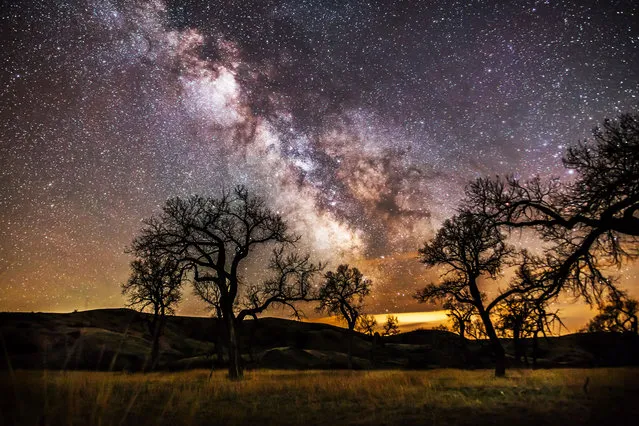
The stunning Milkyway in Midwestern U.S.A.  captured by photographer Randy Halverson in 2013. The stunning skies in Midwestern U.S.A. captured by photographer Randy Halverson. The videographer captured rare footage of the Milky Way, the elusive Northern Lights and raging night storms in some of the most isolated regions of the U.S.A. (Photo by Randy Halverson/Barcroft Media)

The stunning Milkyway in Midwestern U.S.A. captured by photographer Randy Halverson in 2013. The stunning skies in Midwestern U.S.A. captured by photographer Randy Halverson. The videographer captured rare footage of the Milky Way, the elusive Northern Lights and raging night storms in some of the most isolated regions of the U.S.A. The footage, which spans the skies of South Dakota, Wyoming and Utah, was taken between spring and autumn 2013. The 47-year-old spent 40 nights scattered across the eight-month period sat near his camera to capture the clear footage. Randy from Kennebec, South Dakota has been shooting timelapse for over 4 years. (Photo by Randy Halverson/Barcroft Media)
Details
20 Aug 2014 10:32:00
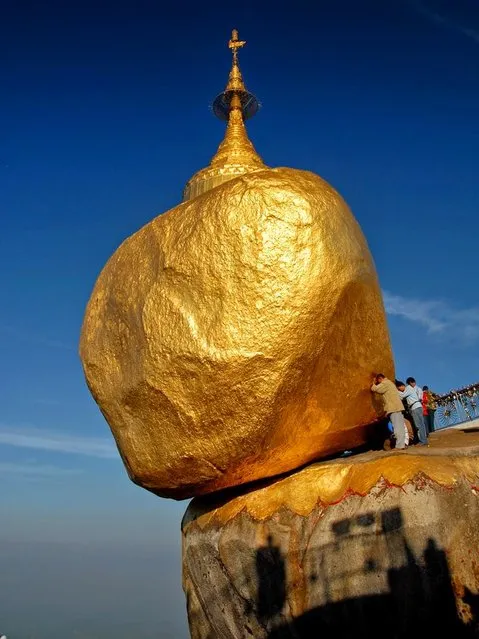
 Kyaiktiyo Pagoda AKA  Golden Rock In Burma

Kyaiktiyo Pagoda, also known as Golden Rock is a well-known Buddhist pilgrimage site in Mon State, Burma. It is a small pagoda (7.3 metres (24 ft)) built on the top of a granite boulder covered with gold leaves pasted on by devotees. According to legend, the Golden Rock itself is precariously perched on a strand of the Buddha's hair. The balancing rock seems to defy gravity, as it perpetually appears to be on the verge of rolling down the hill. The rock and the pagoda are at the top of Mt. Kyaiktiyo. It is the third most important Buddhist pilgrimage site in Burma after the Shwedagon Pagoda and the Mahamuni Pagoda. A glimpse of the "gravity defying" Golden Rock is believed to be enough of an inspiration for any person to turn to Buddhism.
Details
04 Jun 2015 11:42:00
An activist with a painted face symbolizing the count of days spent in captivity attends the Free Azov rally in support of the captured defenders of Mariupol on April 21, 2024 in Kyiv, Ukraine. The participants came out to remind about the Ukrainian soldiers who have been held in Russian captivity for more than two years. (Photo by Yan Dobronosov/Global Images Ukraine via Getty Images)

An activist with a painted face symbolizing the count of days spent in captivity attends the Free Azov rally in support of the captured defenders of Mariupol on April 21, 2024 in Kyiv, Ukraine. The participants came out to remind about the Ukrainian soldiers who have been held in Russian captivity for more than two years. (Photo by Yan Dobronosov/Global Images Ukraine via Getty Images)
Details
05 May 2024 04:35:00
Tridacna Gigas, or Giant Clams

“The giant clam, Tridacna gigas (known as pā’ua in Cook Islands Māori), is the largest living bivalve mollusc. T. gigas is one of the most endangered clam species. It was mentioned as early as 1825 in scientific reports. One of a number of large clam species native to the shallow coral reefs of the South Pacific and Indian oceans, they can weigh more than 200 kilograms (440 lb) measure as much as 120 cm (47 in) across, and have an average lifespan in the wild of 100 years or more”. – Wikipedia

Photo: Tridacna Gigas, or Giant Clams spew water as a traditional fisherman passes by a small sanctuary on January 23, 2004 near Bolinao in the Northern Philippines. The clams, prime builders for coral reefs and providing shelter for spawning fish and other marine life, are exposed by low tides in the sanctuary. Overfishing and pollution throughout the country are not only threatening food security, but are also starting to choke one of the few working clam sanctuaries in the world. (Photo by David Greedy/Getty Images)
Details
01 Oct 2011 13:10:00
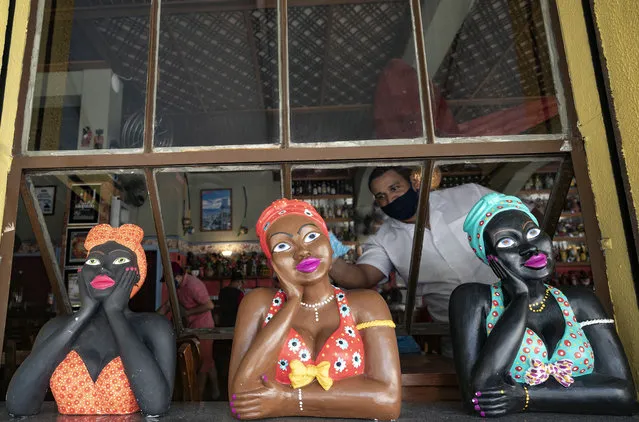
A restaurant worker wearing a mask cleans the windows as the restaurant reopens amid the COVID-19 pandemic in Sao Paulo, Brazil, Monday, July 6, 2020. Bars, restaurants and beauty salons were allowed to re-open Monday after over three months of quarantine, and are required to observe preventative measures and reduced operating hours only during the day. (Photo by Andre Penner/AP Photo)

A restaurant worker wearing a mask cleans the windows as the restaurant reopens amid the COVID-19 pandemic in Sao Paulo, Brazil, Monday, July 6, 2020. Bars, restaurants and beauty salons were allowed to re-open Monday after over three months of quarantine, and are required to observe preventative measures and reduced operating hours only during the day. (Photo by Andre Penner/AP Photo)
Details
26 Jan 2021 10:21:00
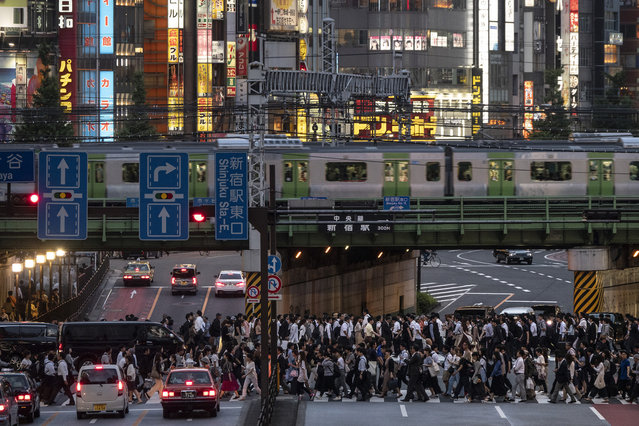
In this Tuesday, June 4, 2019, photo, a Yamanote Line train travels above commuters walking across the crossing during evening rush hours in the Shinjuku district of Tokyo. Operated by the East Japan Railway Co., the Yamanote Line in Tokyo makes a loop around the center of the city, connecting 29 stations that include key stops such as Shinjuku, Shibuya and Ikebukuro. A complete loop of about an hour offers scenes of Japanese daily lives. (Photo by Jae C. Hong/AP Photo)

In this Tuesday, June 4, 2019, photo, a Yamanote Line train travels above commuters walking across the crossing during evening rush hours in the Shinjuku district of Tokyo. Operated by the East Japan Railway Co., the Yamanote Line in Tokyo makes a loop around the center of the city, connecting 29 stations that include key stops such as Shinjuku, Shibuya and Ikebukuro. A complete loop of about an hour offers scenes of Japanese daily lives. (Photo by Jae C. Hong/AP Photo)
Details
27 Jun 2019 00:03:00
Number 10. BELL H-13 SIOUX was a two-bladed, single engine, light helicopter built by Bell Helicopter. Westland Aircraft manufactured the Sioux under license for the British military as the Sioux AH.1 and HT. (Photo by AP Photo)

Number 10. BELL H-13 SIOUX was a two-bladed, single engine, light helicopter built by Bell Helicopter. Westland Aircraft manufactured the Sioux under license for the British military as the Sioux AH.1 and HT. In 1947, the United States Air Force ordered the improved Bell Model 47A. Most were designated YR-13 and three winterized versions were designated YR-13A. The United States Army first ordered Bell 47s in 1948 under the designation H-13. These would later receive the name Sioux. The Bell-built H-13 B is seen airborne in this April 29, 1951 photo. The helicopter is equipped with a 173 horsepower engine, cruises at 85 miles per hour, climbs 900 feet in a minute and has a service ceiling of 11,500 feet. (Photo by AP Photo)
Details
08 Aug 2014 11:59:00
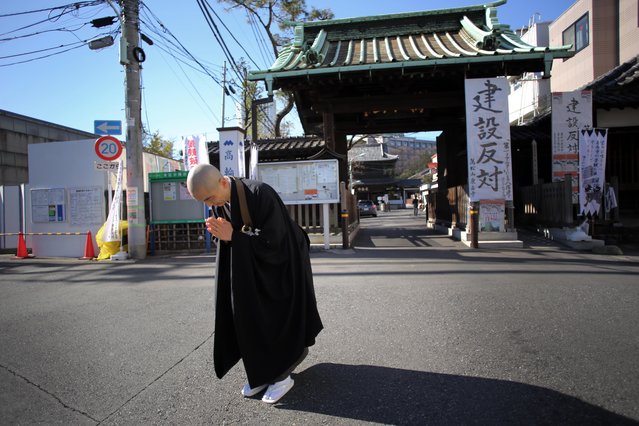
In this January 8, 2015 photo, a monk Kenmyo Muta bows at the condominium construction site and the gate of Sengakuji temple in Tokyo. (Photo by Eugene Hoshiko/AP Photo)

In this January 8, 2015 photo, a monk Kenmyo Muta bows at the condominium construction site and the gate of Sengakuji temple in Tokyo. The “47 ronin” samurai who inspired the long-loved saga of loyalty and honor eulogized in films, books and plays are fighting a new kind of battle in urban Japan. An apartment complex is going up next to the curved tile-roofed Sengakuji temple where the three-century-old graves of the ronin, or masterless samurai, lie. The banner reads: “We only hope to protect landscape of Sengakuji temple”. (Photo by Eugene Hoshiko/AP Photo)
Details
16 Jan 2015 13:01:00