Loading...
Done
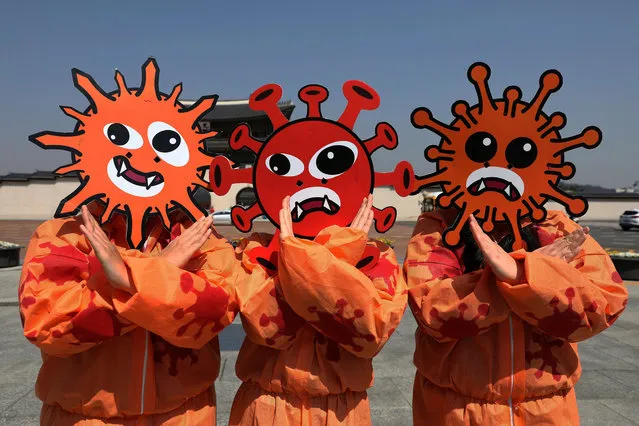
South Korean environmental activists wearing masks symbolizing the coronavirus attend a prevention campaign as South Koreans take measures to protect themselves against the spread of coronavirus (COVID-19) on March 30, 2020 in Seoul, South Korea. South Korea has called for expanded public participation in social distancing, as the country witnesses a wave of community spread and imported infections leading to a resurgence in new cases of COVID-19. According to the Korea Center for Disease Control and Prevention on Monday, 78 new cases were reported. The total number of infections in the nation tallies at 9,661. (Photo by Chung Sung-Jun/Getty Images)

South Korean environmental activists wearing masks symbolizing the coronavirus attend a prevention campaign as South Koreans take measures to protect themselves against the spread of coronavirus (COVID-19) on March 30, 2020 in Seoul, South Korea. South Korea has called for expanded public participation in social distancing, as the country witnesses a wave of community spread and imported infections leading to a resurgence in new cases of COVID-19. According to the Korea Center for Disease Control and Prevention on Monday, 78 new cases were reported. The total number of infections in the nation tallies at 9,661. (Photo by Chung Sung-Jun/Getty Images)
Details
01 Apr 2020 00:07:00
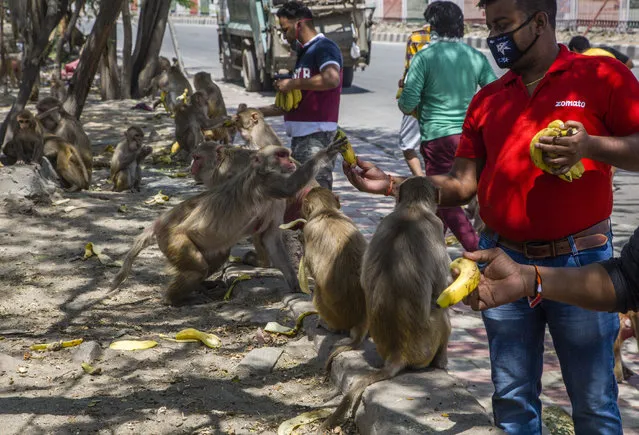
Men give bananas to monkeys gathered on the side of the road as India remains under an unprecedented lockdown over the highly contagious coronavirus (COVID-19) on April 08, 2020 in New Delhi, India. Wild animals, including monkeys, are roaming human settlements in India as people are staying indoors due to the 21-day lockdown. With India's 1.3 billion population and tens of millions of cars off the roads, wildlife is moving towards areas inhabited by humans. Wild animals in many countries have been seen roaming streets. A study says some 60 percent of the new diseases found around the globe every year are zoonotic, meaning they originate in animals and are passed on to humans. COVID-19 is a zoonotic disease that is suspected to have come from the wet markets of Wuhan, China. (Photo by Yawar Nazir/Getty Images)

Men give bananas to monkeys gathered on the side of the road as India remains under an unprecedented lockdown over the highly contagious coronavirus (COVID-19) on April 08, 2020 in New Delhi, India. Wild animals, including monkeys, are roaming human settlements in India as people are staying indoors due to the 21-day lockdown. (Photo by Yawar Nazir/Getty Images)
Details
12 Apr 2020 00:05:00
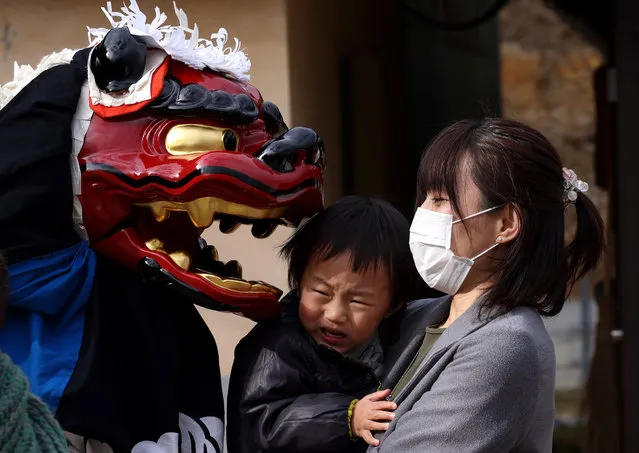
A performer wearing a lion mask performs the Ise Daikagura lion dance at the remote village of Yamanawa on February 08, 2021 in Ryuo, Japan. Ise Daikagura is a group of traditional Lion Dance performers who pray in front of farmers houses and businesses for good grain harvests and disease-free lives. Performers play sacred music using drums and flutes with two lion mask dancers. A lion mask is considered a symbol of God, who enters the house and performs in front of the Shinto God, a statue placed inside the house, mostly in the kitchen. These prayers are called “Kamodo Barai”. After the prayers, they are gifted with money, rice, sake and Japanese sweets from the householders. A group can travel for more than one hundred days to thousands of households and businesses throughout rural-villages in western Japan, and pray to those who are unable to visit the country’s most sacred shrine, the Grand Ise Shrine in Mie Prefecture. The group started its performance in the Edo era between 1603 to 1868 according to Japanese history. The Japanese government designated it as an important folk cultural national property in 1981. (Photo by Buddhika Weerasinghe/Getty Images)

A performer wearing a lion mask performs the Ise Daikagura lion dance at the remote village of Yamanawa on February 08, 2021 in Ryuo, Japan. Ise Daikagura is a group of traditional Lion Dance performers who pray in front of farmers houses and businesses for good grain harvests and disease-free lives. (Photo by Buddhika Weerasinghe/Getty Images)
Details
18 Feb 2021 09:27:00
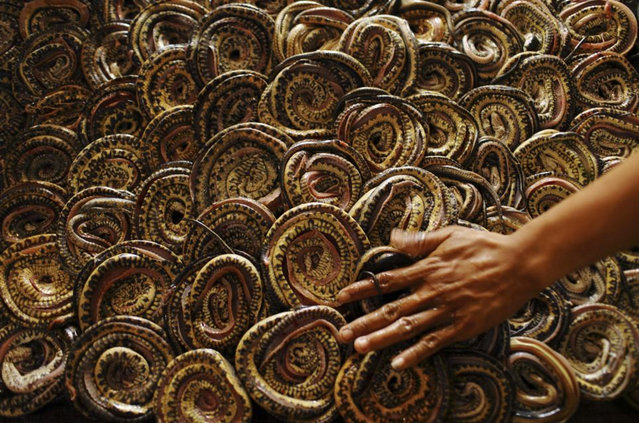
How Snakeskin Handbags Are Made

Images from a snake slaughterhouse at Kapetakan village in Indonesia’s West Java province. Wakira, who is known as “Boss Cobra”, owns the slaughterhouse that produces snake meat and skin. Snake meat is believed by some to be a remedy for skin diseases and asthma, as well as an aid to increase virility. The snake skins, measuring in the hundreds of metres, are sold to bag factories in the West and Central Java provinces on a monthly basis. The price of a bag made from snake skin costs between 150,000 rupiah ($ 15.60) and 300,000 rupiah ($31.20), depending on its size. That snakeskin handbag you’ll buy is costing a hell of a lot more.
Details
20 Feb 2013 12:00:00
Surreal Drawings Of Lips By Christo Dagorov

Have you ever heard of a phenomenon called the Uncanny Valley? Illustrations created by Swiss illustrator Christo Dagorov show how horrible something may look when it’s a hair’s breadth away from looking human. In his illustrations he combined the shape of human lips with trees, buildings, and even human bodies, making it look from a distance as if the lips were horribly deformed by some unknown disease. However, after a while you make out the shapes, yet the feeling of uneasiness remains, making you shiver from unsuppressable disgust. (Photo by Christo Dagorov)
Details
16 Dec 2014 12:14:00
Graffiti is painted on the bathroom walls at a restaurant in the Williamsburg area of Brooklyn borough in New York, United States, October 1, 2015. (Photo by Shannon Stapleton/Reuters)

Graffiti is painted on the bathroom walls at a restaurant in the Williamsburg area of Brooklyn borough in New York, United States, October 1, 2015. Some 2.4 billion people around the world don't have access to decent sanitation and more than a billion are forced to defecate in the open, risking disease and other dangers, according to the United Nations. To mark World Toilet Day on November 19, Reuters photographers captured pictures of toilets in cities, towns and villages around the globe. (Photo by Shannon Stapleton/Reuters)
Details
18 Nov 2015 08:06:00
15-year old Terminally Ill American girl Donica Streling meets with members of SHINee (샤이니) at SM Entertainment head office on June 20, 2012 in Seoul, South Korea

15-year old American girl Donica Streling meets with members of SHINee (샤이니) at SM Entertainment head office on June 20, 2012 in Seoul, South Korea. Donica, diagnosed with Charcot-Marie-Tooth disease, visited Seoul, South Korea to meet her favorite K-pop groups SHINee and Super Junior after finding hope in listening to Korean pop. (Photo by Chung Sung-Jun)
Details
20 Jun 2012 11:32:00
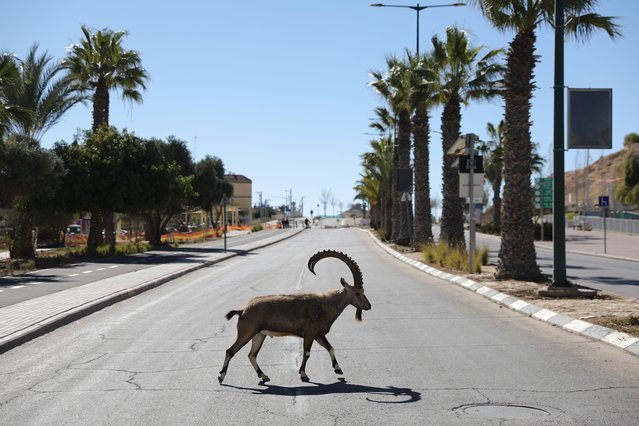
A Nubian ibex roams the streets during a national lockdown in Mitzpe Ramon, southern Israel, 22 January 2021. (Photo by Abir Sultan/EPA/EFE)

A Nubian ibex roams the streets during a national lockdown in Mitzpe Ramon, southern Israel, 22 January 2021. Although Israel is one of the first countries to have received vaccines and has so far vaccinated more then two million of its around nine million citizens, the rate of infection with the Sars-CoV-2 coronavirus, that causes the coronavirus disease (COVID-19), is rising drastically as Israel entered a full closure of two weeks. (Photo by Abir Sultan/EPA/EFE)
Details
23 Jan 2021 09:45:00