Loading...
Done
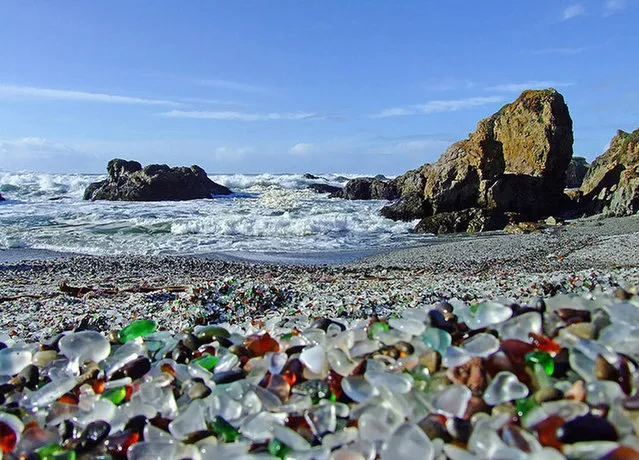
Glass Beach Fort Bragg California

In the early 20th century, Fort Bragg residents threw their household garbage over the cliffs above what is now Glass Beach. They discarded glass, appliances, and even cars. The land was owned at that time by the Union Lumber Company, and locals referred to it as "The Dumps." Sometimes fires were lit to reduce the size of the trash pile.
Details
06 Nov 2012 10:00:00
Tea ceremony in Kobe, Japan

A tea ceremony master use the Hishaku made by bamboo and makes a tea during the outdoor tea ceremony at Zuihoji Temple Park on November 3, 2011 in Kobe, Japan. The tea ceremony began in 1950 to commemorate the 14th century governor Toyotomi Hideyoshi and his tea master Sen no Rikyu, who are said to visit this area and enjoyed tea ceremonies. (Photo by Buddhika Weerasinghe/Getty Images)
Details
04 Nov 2011 13:34:00
London Art Fair

Paintings are moved on a stand at the “London Art Fair” on January 18, 2012 in London, England. The fair includes over 100 different stands featuring work by well known 20th century British artists and showcases some of the best emerging talent in the art world today. The show runs until January 23, at Business Design Centre in Islington. (Photo by Dan Kitwood/Getty Images)
Details
19 Jan 2012 08:37:00
An iconic image of a younger Kate Moss. (Photo by Glen Luchford)

Over 160 photographs, costumes, illustrations and magazine covers will be displayed at Los Angeles' Getty Center, until October 21. The display features a century of art from 1911 through to 2011. The exhibition is free – with no tickets required – and will be displayed in the lower level of the museum's West Pavilion. Here: An iconic image of a younger Kate Moss. (Photo by Glen Luchford)
Details
29 Jun 2018 00:03:00
The mudmen come from the country’s western highlands, where there are virtually no roads, cars, electricity or shops. (Photo by Jeremy Hunter/Exclusivepix Media)

For centuries the Highlands peoples of Papua New Guinea fought over land, women and pigs. Sorcery and battle skills could elevate a clan to Bigmanship, where the bigger the “presentation”, the bigger the man. Clans therefore would paint their bodies and create fearsome masks as part of their psy. Here: These are the terrifying tribe of “mudmen” from a remote part of Papua New Guinea. (Photo by Jeremy Hunter/Exclusivepix Media)
Details
08 May 2017 08:12:00
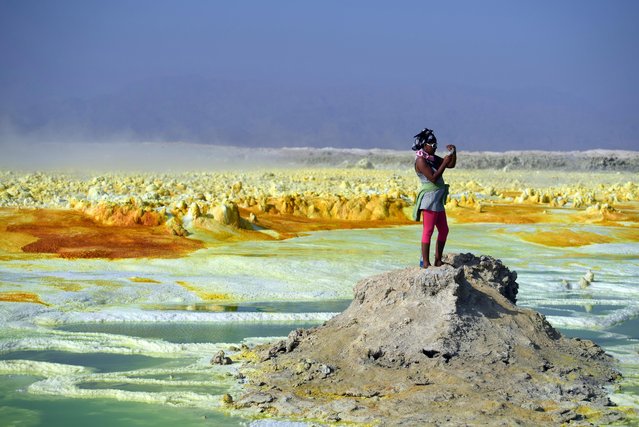
A tourist take a photograph of a sulphur lake in the Danakil Depression on January 23, 2017 near Dallol, Ethiopia. (Photo by Carl Court/Getty Images)

A tourist take a photograph of a sulphur lake in the Danakil Depression on January 23, 2017 near Dallol, Ethiopia. The depression lies 100 metres below sea level and is one of the hottest and most inhospitable places on Earth. Despite the gruelling conditions, Ethiopians continue a centuries old industry of mining salt from the ground by hand in temperatures that average 34.5 degrees centigrade but have risen to over 50 degrees. (Photo by Carl Court/Getty Images)
Details
25 Jan 2017 11:36:00
Full portrait of a woman in the harem in the royal palace of Jaipur, India, 1857 – 1865. (Photo by Maharaja Ram Singh III/Alinari via Getty Images)

These images give a rare insight into the life of a 19th Century Indian Maharajah. Maharajah Ram Singh ruled in the famous pink city of Jaipur between 1835 and 1880, and was also a keen photographer. Here: Full portrait of a woman in the harem in the royal palace of Jaipur, India, 1857 – 1865. (Photo by Maharaja Ram Singh III/Alinari via Getty Images)
Details
06 Feb 2017 01:03:00
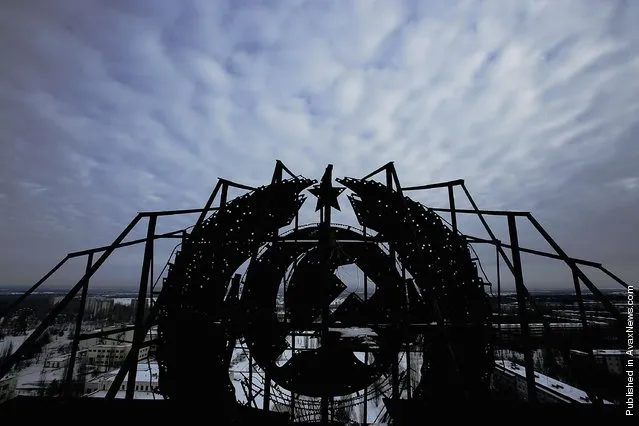
Chernobyl

Scaffolding holding a remnant of the Soviet Union, the hammer and sickle, is seen on a rooftop of an abandoned building in the town of Pripyat on January 25, 2006 near Chernobyl, Ukraine. The town of Pripyat, deserted since the 1986 catastrophe, once housed 30,000 people, the majority of being workers from the Chernobyl Nuclear Power Plant. Days after the catastrophe the inhabitants were relocated to other locations in the Soviet Union. The town of Pripyat has remained uninhabited since. Prypyat and the surrounding area will not be safe for human habitation for several centuries. Scientists estimate that the most dangerous radioactive elements will take up to 900 years to decay sufficiently to render the area safe.
Details
14 Mar 2011 10:20:00