Loading...
Done
Cave Diver, Anhumas Abyss, Bonito, Brazil: The Anhumas Abyss is an underground cavern with a crystal-clear lake below, more than 260 feet (79 m) deep. A visitor must enter through a narrow opening at the top of the chamber and rappel into the cave. Snorkeling and scuba diving in the lake reveal amazing scenery. Distinctive, conical limestone stalagmites and stalactites occupy the lake and the surrounding area, some reaching 65 feet (20 m) high. “One must rappel about 235 feet (72 m) to get down into this deep lake. The photo was taken at a depth of 50 feet (15 m). It was a challenge to create the image because of the high contrast, plus the diver could not see into the darkness, making communication impossible”. (Photo by Marcio Cabral/Nature’s Best Photography Awards 2017)

Cave Diver, Anhumas Abyss, Bonito, Brazil: The Anhumas Abyss is an underground cavern with a crystal-clear lake below, more than 260 feet (79 m) deep. A visitor must enter through a narrow opening at the top of the chamber and rappel into the cave. Snorkeling and scuba diving in the lake reveal amazing scenery. Distinctive, conical limestone stalagmites and stalactites occupy the lake and the surrounding area, some reaching 65 feet (20 m) high. (Photo by Marcio Cabral/Nature’s Best Photography Awards 2017)
Details
26 Oct 2017 08:10:00
A cat tries to find dry ground around an apartment complex in Houston after Hurricane Harvey hit on Aug. 30. Harvey made landfall in South Texas on August 25, leading to days of downpours that dumped more than 50 inches of rain. Harvey damaged or destroyed about 200,000 homes as the storm system flooded much of Houston and smaller coastal communities. (Photo by Scott Olson/Getty Images)

A cat tries to find dry ground around an apartment complex in Houston after Hurricane Harvey hit on Aug. 30. Harvey made landfall in South Texas on August 25, leading to days of downpours that dumped more than 50 inches of rain. Harvey damaged or destroyed about 200,000 homes as the storm system flooded much of Houston and smaller coastal communities. (Photo by Scott Olson/Getty Images)
Details
26 Dec 2017 08:19:00
The secretive indri (Indri indri) of Madagascar, the largest living lemur. It is also critically endangered and highly evolutionarily distinct with no close relatives, which makes its branch one of most precarious on the mammal evolutionary tree. In the likely event that the indri goes extinct, we will lose 19m years of unique evolutionary history from the mammal tree of life. (Photo by Pierre-Yves Babelon/Aarhus University)

The secretive indri (Indri indri) of Madagascar, the largest living lemur. It is also critically endangered and highly evolutionarily distinct with no close relatives, which makes its branch one of most precarious on the mammal evolutionary tree. In the likely event that the indri goes extinct, we will lose 19m years of unique evolutionary history from the mammal tree of life. (Photo by Pierre-Yves Babelon/Aarhus University)
Details
18 Nov 2018 00:02:00
Tourists in the Serengeti, Tanzania in the second decade of February 2024, get more than they bargained for as a cheetah jumps on the bonnet of their jeep to make their acquaintance. (Photo by Ann Aveyard/Animal News Agency)

Tourists in the Serengeti, Tanzania in the second decade of February 2024, get more than they bargained for as a cheetah jumps on the bonnet of their jeep to make their acquaintance. (Photo by Ann Aveyard/Animal News Agency)
Details
10 Mar 2024 07:30:00
Heather Wilson and Tom Hendry, rangers on the Farne Islands, weigh a puffin using a jug as part of the annual seabird census on May 13, 2025. (Photo by Times photographer James Glossop)

Heather Wilson and Tom Hendry, rangers on the Farne Islands, weigh a puffin using a jug as part of the annual seabird census on May 13, 2025. (Photo by Times photographer James Glossop)
Details
25 May 2025 03:17:00
Old Heidelberg, Dog with Pipe, 1905. (Photo by Detroit Publishing Company)

Old Heidelberg, Dog with Pipe, 1905. (Photo by Detroit Publishing Company)
Details
13 Aug 2012 11:12:00
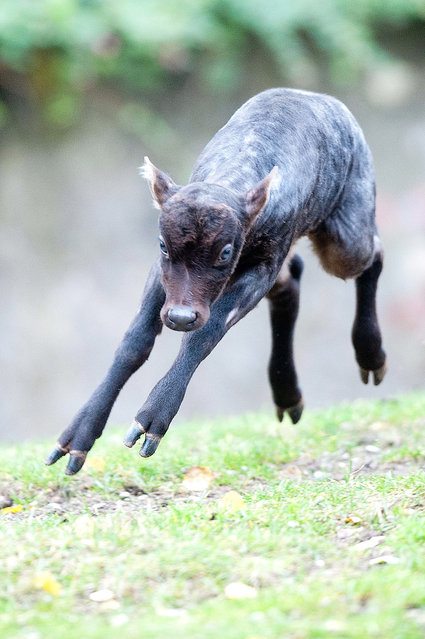
A young anoa, also known as midget buffalo, named Tycoon runs around at the Zoo in Berlin, Germany, on November 9, 2012. (Photo by Maurizio Gambarini/EPA)

A young anoa, also known as midget buffalo, named Tycoon runs around at the Zoo in Berlin, Germany, on November 9, 2012. (Photo by Maurizio Gambarini/EPA)

Details
26 Nov 2012 13:34:00


“Pilot whales are cetaceans belonging to the genus Globicephala. There are two extant species, the long-finned pilot whale (G. melas) and the short-finned pilot whale (G. macrorhynchus). The two are not readily distinguished at sea and analysis of the skulls is the best way to tell the difference between the two species. Between the two species, pilot whales range in waters nearly worldwide with long-finned pilot whales living in cooler waters and short-finned pilot whales living in warmer waters. Pilot whales are among the largest of the oceanic dolphins, exceeded in size only by the killer whale. They and other large members of the dolphin family are also known as blackfish”. – Wikipedia

Photo: Pilot whales swim in Loch Carron on May 20, 2011 in South Uist, Scotland. A major operation is underway to prevent up to 100 pilot whales from stranding on the rocky shoreline of Loch Carron on South Uist in the Western Isles. (Photo by Jeff J Mitchell/Getty Images)
Details
21 May 2011 07:58:00