Loading...
Done
Afghanistan: Dogs of War Part 1

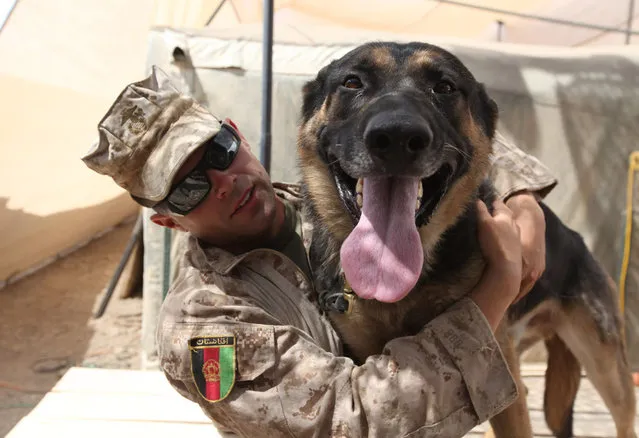
Throughout the course of the long war in Afghanistan, Coalition troops have relied on thousands of military working dogs to help keep them safe, and make their jobs easier. The dogs are trained to detect explosives, to find illegal drugs, to search for missing comrades, or target enemy combatants. Not only are they active on the front lines, but behind the lines they serve as therapy dogs, service dogs, and loyal companions. They also share the same risks as the ground troops, suffering injuries and sometimes death on the battlefields. Gathered here are images of these dogs and their handlers in Afghanistan and back home, from over the past several years, part of the ongoing series here on Afghanistan.
Details
03 Jun 2014 21:02:00
Love at the high place 1 Li Wei

“Li Wei (born in 1970, Hubei, China) is a contemporary artist from Beijing, China. His work often depicts him in apparently gravity-defying situations. Wei started off his performance series, Mirroring, and later on took off attention with his Falls series which shows the artist with his head and chest embedded into the ground. His work is a mixture of performance art and photography that creates illusions of a sometimes dangerous reality. Li Wei states that these images are not computer montages and works with the help of props such as mirror, metal wires, scaffolding and acrobatics”. – Wikipedia

Photo: Love at the high place I (Photo by Li Wei)
Details
25 Apr 2012 12:36:00
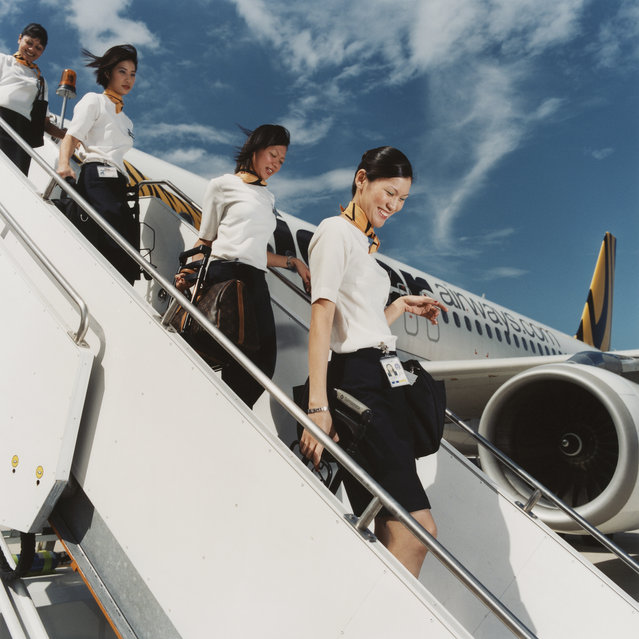
Tiger Airways, Singapore, 2006. (Photo by Brian Finke/The Washington Post)

Photographer Brian Finke spent nearly two years traversing the friendly skies, following the life of flight attendants in the air and on the ground, from Delta and Hawaiian Air, to Hooters Air, Southwest, Air France, British Airways, Air Asia, and dozens more. His images of flight attendants waving, applying makeup and deboarding plans while smiling appear as if they were ripped from an advertisement in a glossy magazine. Here: Tiger Airways, Singapore, 2006. (Photo by Brian Finke/The Washington Post)
Details
30 Sep 2015 08:02:00
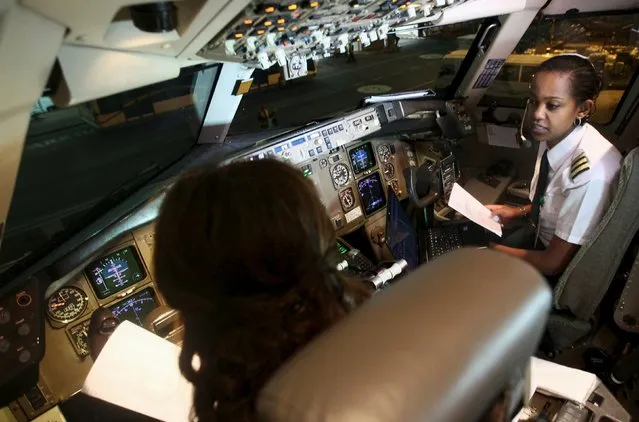
Ethiopian Airlines female pilots prepare the plane before takeoff at Bole international airport in the capital Addis Ababa, November 19, 2015. (Photo by Tiksa Negeri/Reuters)

Ethiopian Airlines female pilots prepare the plane before takeoff at Bole international airport in the capital Addis Ababa, November 19, 2015. Ethiopia Airlines on Thursday, dispatched its first ever all-female operated flight. Every aspect of the journey was handled by women, from the ground crew, aircraft maintenance to traffic controllers. Gualu and her co-pilot were charged with flying the crew and passengers to Bangkok, Thailand. (Photo by Tiksa Negeri/Reuters)
Details
21 Nov 2015 08:00:00
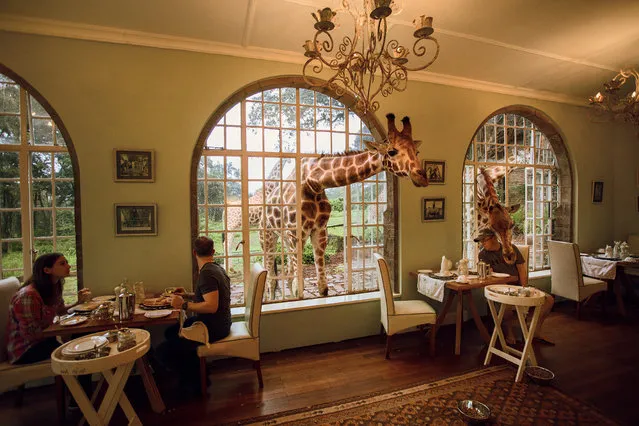
The giraffes visit twice a day searching for food, before returning to the forest. Although still wild animals, they have become accustomed to receiving treats from residents and guests. (Photo by Klaus Thymann)

Situated 10km outside Nairobi city centre, this private giraffe sanctuary is centred around a colonial manor house named Giraffe Manor. Living within the grounds is a herd of rare Rothschild giraffe. The giraffes visit twice a day searching for food, before returning to the forest. Although still wild animals, they have become accustomed to receiving treats from residents and guests. (Photo by Klaus Thymann)
Details
28 Jan 2016 12:36:00
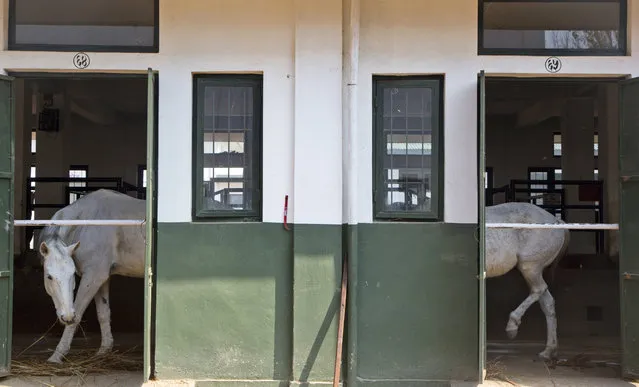
In this April 3, 2019, photo, horses from Nepal cavalry rest in a stable after morning practice for Ghode Jatra festival in Kathmandu, Nepal. (Photo by Niranjan Shrestha/AP Photo)

In this April 3, 2019, photo, horses from Nepal cavalry rest in a stable after morning practice for Ghode Jatra festival in Kathmandu, Nepal. The “Ghode Jatra” is an annual horse festival celebrated on the Nepal Cavalry grounds in Kathmandu, which marks the defeat of a Hindu demon. (Photo by Niranjan Shrestha/AP Photo)
Details
09 Apr 2019 00:03:00
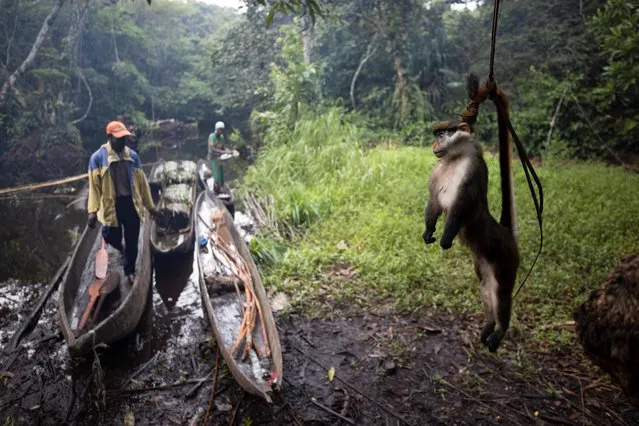
A dead red-tailed monkey hangs by its tail above the ground, in order to keep it away from ants, in the forest near the city of Mbandaka, Democratic Republic of the Congo, April 5, 2019. Bushmeat hunters are emptying Central Africa's forests at a high rate, researchers say. A growing appetite for wild meat in cities has ramped up the scale of hunting. Research shows around 6 million tonnes of bushmeat are sourced annually from the Congo Basin, whose forest spans across six countries and is second in size only to the Amazon. (Photo by Thomas Nicolon/Reuters)

A dead red-tailed monkey hangs by its tail above the ground, in order to keep it away from ants, in the forest near the city of Mbandaka, Democratic Republic of the Congo, April 5, 2019. Bushmeat hunters are emptying Central Africa's forests at a high rate, researchers say. A growing appetite for wild meat in cities has ramped up the scale of hunting. Research shows around 6 million tonnes of bushmeat are sourced annually from the Congo Basin, whose forest spans across six countries and is second in size only to the Amazon. (Photo by Thomas Nicolon/Reuters)
Details
14 Oct 2019 00:03:00
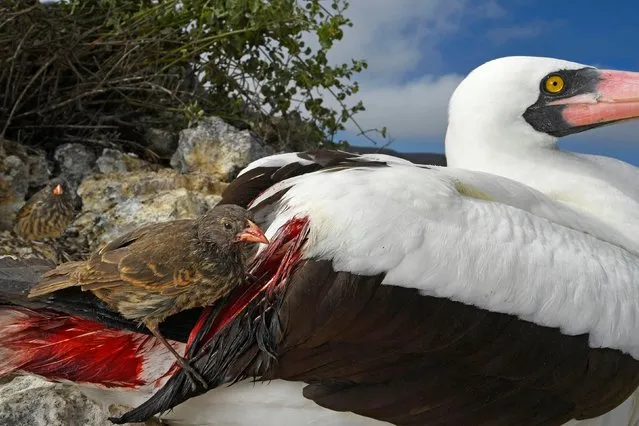
Bloodthirsty by Thomas P Peschak, Germany/South Africa — winner, Behaviour: birds. When rations run short on Wolf Island, in the remote northern Galápagos, the sharp-beaked ground finches become vampires. Their sitting targets are Nazca boobies and other large birds. The finches rely on a scant diet of seeds and insects, which regularly dries up, so they drink blood to survive. ‘I’ve seen more than half a dozen finches drinking from a single Nazca booby,’ says Tom. Rather than leave their nests the boobies tolerate the vampires, and the blood loss doesn’t seem to cause permanent harm. (Photo by Thomas P Peschak/2018 Wildlife Photographer of the Year)

Bloodthirsty by Thomas P. Peschak, Germany/South Africa — winner, Behaviour: birds. When rations run short on Wolf Island, in the remote northern Galápagos, the sharp-beaked ground finches become vampires. Their sitting targets are Nazca boobies and other large birds. The finches rely on a scant diet of seeds and insects, which regularly dries up, so they drink blood to survive. ‘I’ve seen more than half a dozen finches drinking from a single Nazca booby,’ says Tom. Rather than leave their nests the boobies tolerate the vampires, and the blood loss doesn’t seem to cause permanent harm. (Photo by Thomas P. Peschak/2018 Wildlife Photographer of the Year)
Details
19 Oct 2018 00:05:00