Loading...
Done
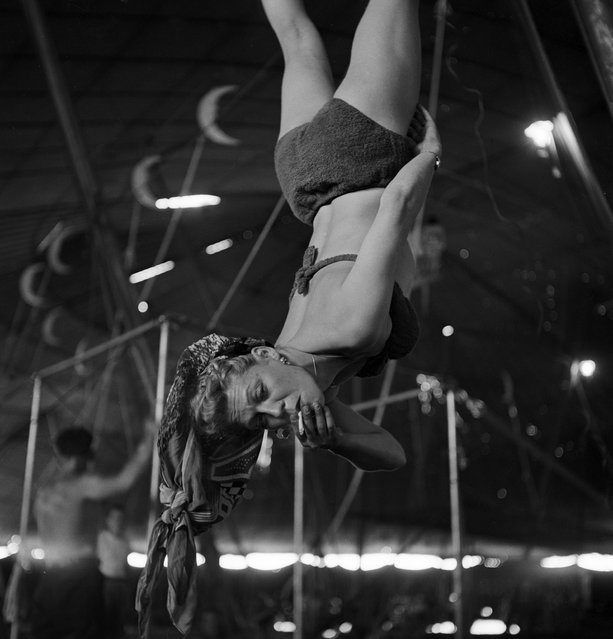
An aerialist smoking while rehearsing for the Ringling Bros. and Barnum & Bailey Circus in Sarasota, FL in 1949. (Photo By Nina Leen/Time Life Pictures/Getty Images)

In 1949, LIFE magazine sent famed photographer Nina Leen to document the daily life of a sassy troupe of young women who had run off and joined the famous Barnum & Bailey Circus in Sarasota, Fla. What developed was a portrait of a sisterhood formed over acrobatics that mixed high-flying wire acts with fashionable high-waisted shorts. Sarasota was once considered “the home of the American circus”. Here: an aerialist smoking while rehearsing for the Ringling Bros. and Barnum & Bailey Circus in Sarasota, FL in 1949. (Photo By Nina Leen/Time Life Pictures/Getty Images)
Details
06 Sep 2015 14:22:00
Aerial Views by  Ken Hong Leung

H. Leung has been acclaimed since 1952 for his brilliant artistic style. A master of oil on canvas, he achieves a haunting quality in his works that absorbs the viewer’s emotions like an irresistible melody. His brush, like a wand, seems to weave a sense of enchantment. In his landscapes and waterside villages, visions of Shangri-La come to mind, superbly mixed with subtle orchestrations of peacefulness and drama.

Technique is both a creative and expressive force in the art of H. Leung. Distinctively semi-abstract, his images allow the viewer’s eye to supply what is merely suggested. This very involving result adds power not only to the impact of his designs, it increases the joy that owning his works provides.
Details
26 Aug 2012 12:10:00
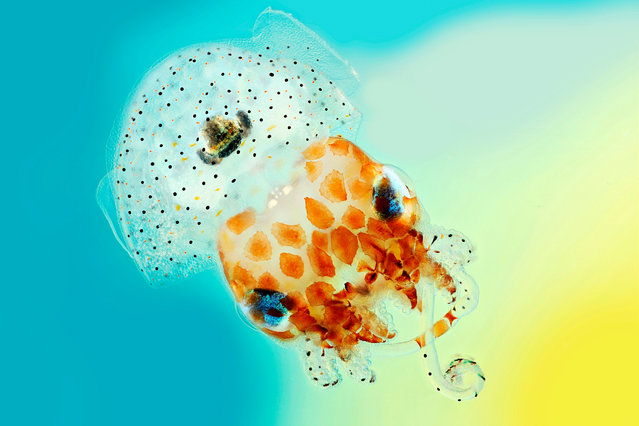
With its huge eyes, comical name and diminutive size, Mark R. Smith’s image of a baby Hawaiian bobtail squid can’t help but raise a smile. A curiously endearing creature, the cephalopod is just 1.5cm across, its mantle cavity bearing more than a passing resemblance to a rather natty shower cap. But it is also a beautiful example of symbiosis – nature’s version of “I’ll scratch your back if you scratch mine” – for on the underside of the squid is a light organ which houses bioluminescent bacteria. The squid offers the bacteria protection and food, while the bacteria emit a glow – a handy trait that the squid uses to offset its silhouette, helping it to evade predators in the depths below. Mark R. Smith’s entry combines several images of a Hawaiian bobtail squid with different focus lengths to create a final picture with greater depth of field than normal. (Photo by Mark R. Smith/Wellcome Images/Macroscopic Solutions)

With its huge eyes, comical name and diminutive size, Mark R. Smith’s image of a baby Hawaiian bobtail squid can’t help but raise a smile. A curiously endearing creature, the cephalopod is just 1.5cm across, its mantle cavity bearing more than a passing resemblance to a rather natty shower cap. But it is also a beautiful example of symbiosis – nature’s version of “I’ll scratch your back if you scratch mine” – for on the underside of the squid is a light organ which houses bioluminescent bacteria. The squid offers the bacteria protection and food, while the bacteria emit a glow – a handy trait that the squid uses to offset its silhouette, helping it to evade predators in the depths below. Mark R. Smith’s entry combines several images of a Hawaiian bobtail squid with different focus lengths to create a final picture with greater depth of field than normal. (Photo by Mark R. Smith/Wellcome Images/Macroscopic Solutions)
Details
08 Mar 2017 00:05:00
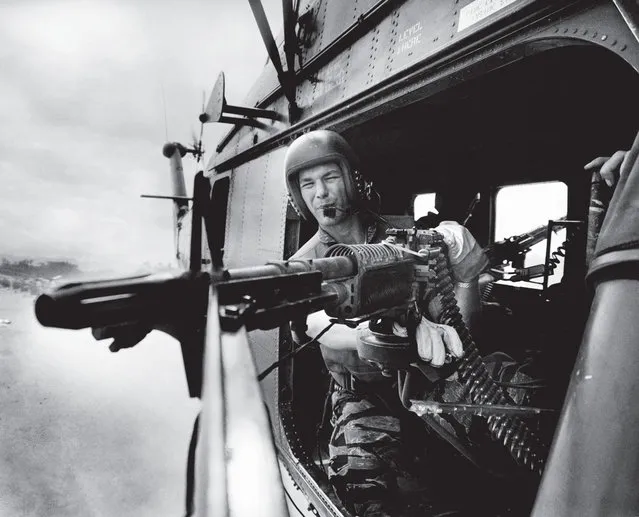
Man your battle stations: The crew chief of helicopter Yankee Papa 13, lance corporal James C. Farley, mans an M-60 machine gun during a mission near Da Nang, Vietnam on March 31, 1965. (Photo by Larry Burrows/Time & Life Pictures)

In the spring of 1965, within weeks of 3,500 American Marines arriving in Vietnam, a 39-year-old Briton named Larry Burrows began work on a feature for LIFE magazine, chronicling the day-to-day experience of U.S. troops on the ground – and in the air – in the midst of the rapidly widening war. The photographs in this gallery focus on a calamitous March 31, 1965, helicopter mission; Burrows’ “report from Da Nang”, featuring his pictures and his personal account of the harrowing operation, was published two weeks later as a now-famous cover story in the April 16, 1965, issue of LIFE.

Photo: Man your battle stations: The crew chief of helicopter Yankee Papa 13, lance corporal James C. Farley, mans an M-60 machine gun during a mission near Da Nang, Vietnam on March 31, 1965. (Photo by Larry Burrows/Time & Life Pictures)
Details
07 Apr 2013 07:08:00
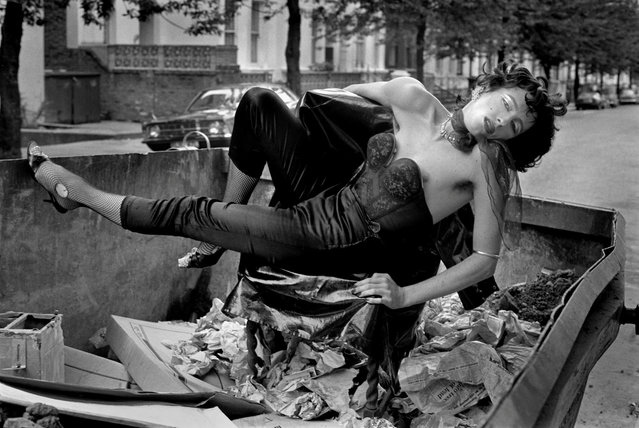
“A very delicate person, beneath the flamboyance”. Jasper, Ladbroke Grove, 1977. “In the 1970s, Australia was rather cut off. I’d always wanted to live abroad, so I moved to Rome and then London. I was an art historian, but started studying photography part-time. I was interested in the demi-monde culture and began mixing in all sorts of circles. Jasper was a rather wonderful character. He was from Sydney, but he was living downstairs from me in Ladbroke Grove, in a flat rented to some gay friends. It was fairly eclectic. Jasper was always playing around with clothes and makeup. If he was looking particularly wonderful, I might get out my lights and take a shot. Or he might put makeup on me. He wasn’t always in drag, but he was permanently in diva mode, dependably louche, funny and naughty. I think all that comes across in the image. He was actually a very delicate person, though, beneath the wit and flamboyance. Jasper floated through London all too briefly. His real name was Peter MacMahon, but to us he was only ever Jasper Havoc, an alter ego he’d created while part of a transvestite troupe called Sylvia and the Synthetics. They were legendary in Sydney gay culture. On this day, we’d been taking some pictures inside and had gone out into the streets to fool around some more. Jasper was wearing a corset and fishnets ensemble, with other bits and pieces, and we joked about him being trashy as he lay in the skip. We just took the shot for ourselves. It wasn’t done with any publication in mind, or anything else. This was way before the internet and people didn’t share images. If you dressed up, it was just for that moment”. (Photo by Jane England)

“A very delicate person, beneath the flamboyance”. Jasper, Ladbroke Grove, 1977. “In the 1970s, Australia was rather cut off. I’d always wanted to live abroad, so I moved to Rome and then London. I was an art historian, but started studying photography part-time. I was interested in the demi-monde culture and began mixing in all sorts of circles. Jasper was a rather wonderful character...”. (Photo by Jane England)
Details
26 Jun 2017 09:04:00
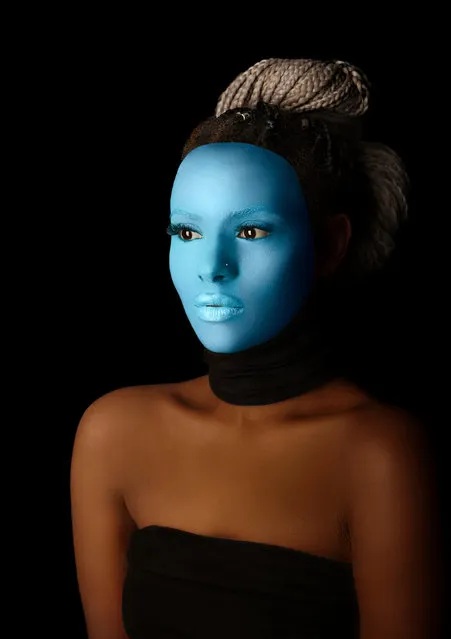
Brtukan. “Being a girl of colour in a society where the majority of the people are white, I have had to get used to all the different ways people approach me. From being asked what kind of rap music you listen to and how you wash your hair, to getting told, “you don’t sound black”, “you’re pretty for a black girl” or “you’re not that black so it’s OK”, as if being black is such a bad thing”. (Photo by Lisa Minogue/The Guardian)

As part of FLAIR Melbourne – a Flinders Lane art festival – Melbourne’s Lisa Minogue presents stylised photographic portraits of Australian women of colour, their faces painted vibrantly to accentuate their individuality and encourage the viewer to study each face more closely. Minogue asked each woman the same question: “What do the words “coloured girl” mean to you?”. (Photo by Lisa Minogue/The Guardian)
Details
17 Aug 2016 11:16:00
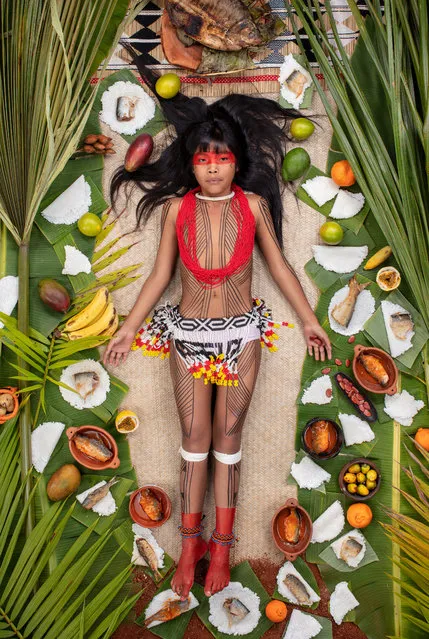
Kawakanih Yawalapiti, 9, Upper Xingu region of Mato Grosso, Brazil, 2018: Kawakanih lives with her tribe, the Yawalapiti, in Xingu national park, a preserve in the Amazon basin of Brazil. The Yawalapiti collect seeds to preserve species unique to their ecosystem, which lies between the rain forest and savannah. Kawakanih’s diet is simple, consisting mainly of fish, cassava, porridge, fruit and nuts. “It takes five minutes to catch dinner”, says Kawakanih. “When you’re hungry, you just go to the river with your net”. (Photo by Gregg Segal/The Guardian)

Photographer Gregg Segal travelled the world to document children and the food they eat in a week. Partly inspired by the increasing problems of childhood obesity, he tracked traditional regional diets as yet unaffected by globalisation, and ironically, found that the healthiest diets were often eaten by the least well off. (Photo by Gregg Segal/The Guardian)
Details
03 Jul 2019 00:03:00
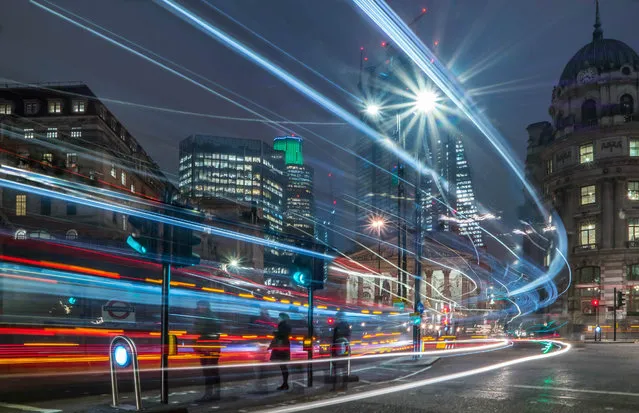
Runner-up. “The City of London, looking towards the Royal Exchange and the Bank of England. The ever-changing London skyline provides many excellent opportunities for cityscape photography, none more exciting than the ebb and flow of traffic at night”. MICK RYAN, JUDGE: “Sophisticated new camera sensors, sharp lenses and the ability to take hundreds of shots in a session and check your work have made night photography much easier than it ever used to be. The results, like this scene, can be spectacular”. (Photo by Mark Caldon/The Guardian)

Runner-up. “The City of London, looking towards the Royal Exchange and the Bank of England. The ever-changing London skyline provides many excellent opportunities for cityscape photography, none more exciting than the ebb and flow of traffic at night”. (Photo by Mark Caldon/The Guardian)
Details
10 Dec 2018 00:03:00